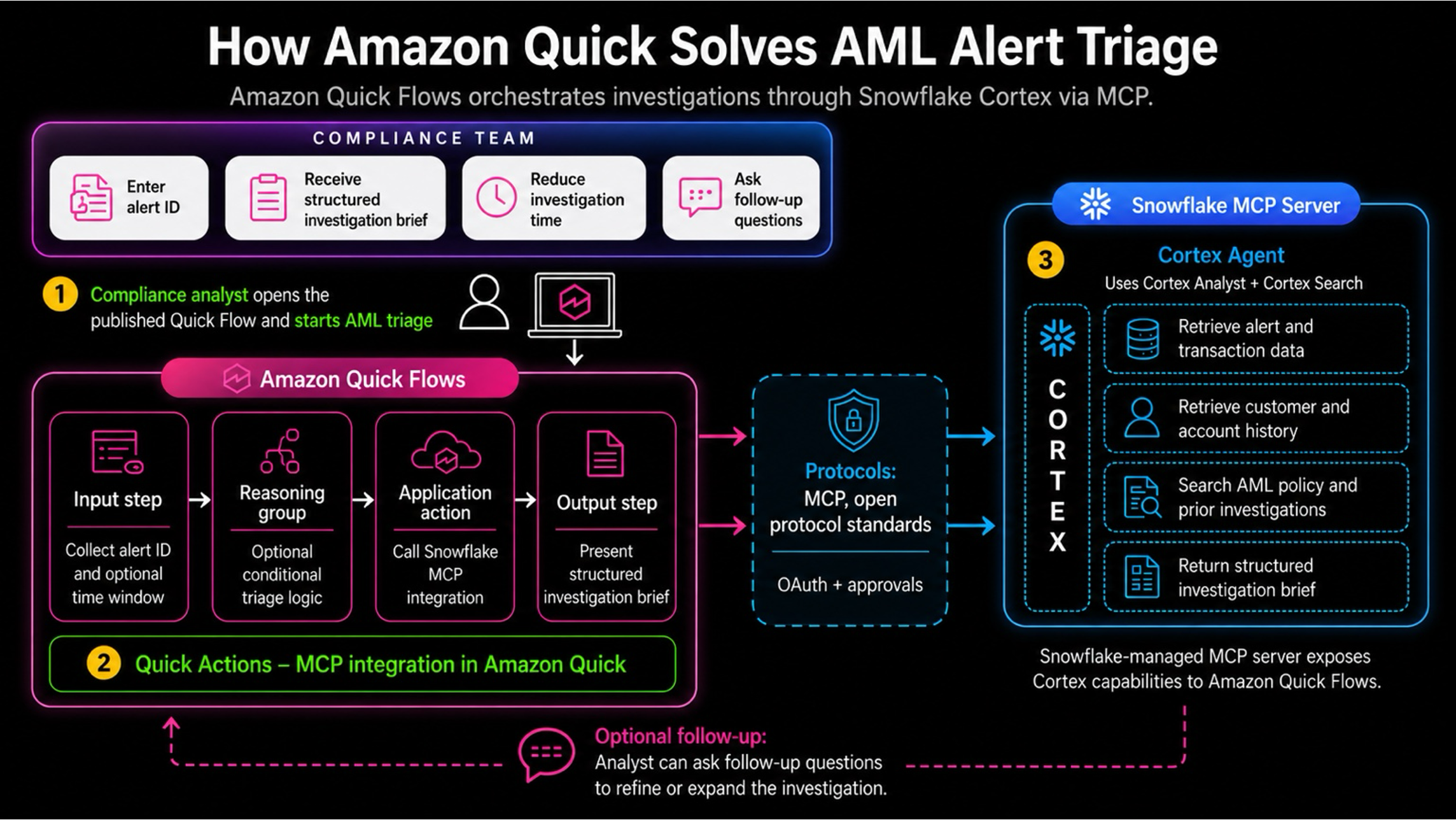
A technical demonstration details an integrated workflow that connects Amazon Quick Flows to Snowflake Cortex through the Model Context Protocol (MCP) to automate anti‑money laundering (AML) alert triage. The end‑to‑end flow replaces many manual data‑gathering steps with an automated sequence designed to reduce analyst effort and speed investigations while preserving enterprise controls. This matters for AML analysts at mid‑to‑large banks, who typically spend 30 — 90 minutes per alert and contend with industry estimates that roughly 90 — 95% of alerts can be false positives.
The architecture places Amazon Quick Flows as the orchestration layer and uses a Snowflake‑managed MCP server for connectivity. Quick Flows translates investigator requests into standardized MCP calls and authenticates via OAuth, removing the need for bespoke connectors. A Snowflake Cortex Agent is invoked through MCP to perform investigative work while Quick handles input validation, reasoning logic, and formatted output presentation.
The demonstration walks through the analyst experience step‑by‑step: an investigator opens the published flow, enters an alert ID (example: ALT-2026-03-02-002) and an optional time window, and the flow validates the input and confirms the alert exists. The flow then calls the Cortex Agent to analyze transaction data, customer profiles, prior history and policy, and returns a structured investigation brief rather than raw logs, streamlining the deliverable an analyst receives.
In the demonstration environment, automated flows built with Amazon Quick reduced average alert investigation time from the customary 30 — 90 minutes to under five minutes; the post cautions that real‑world results will vary by alert complexity and data volume. The combination of MCP’s open protocol and Quick Flows’ standardized calls is presented as a way to make repeatable, one‑click investigative workflows feasible for compliance teams, shortening time to initial triage and enabling faster escalation decisions.
For builders, the writeup preserves technical detail: the Cortex Agent analyzes structured transaction records via Cortex Analyst and unstructured compliance documents via Cortex Search. The solution can also integrate with AWS services such as Amazon S3, AWS Glue, Amazon SageMaker and Amazon Bedrock. The design emphasizes OAuth for enterprise security and a reusable MCP‑based approach that can be adapted beyond AML to FinOps triage, SRE incident response and other repeatable processes.
Adoption is framed within a broader ecosystem: the integration is presented alongside more than 50 AWS and Snowflake native links so teams can assemble compliance workflows that retain data security while accelerating time to value. The demonstration positions MCP and Quick Flows as a standardized path to reduce manual work and increase consistency across investigative processes.
Sources
Replies (0)
No replies in this topic yet.
