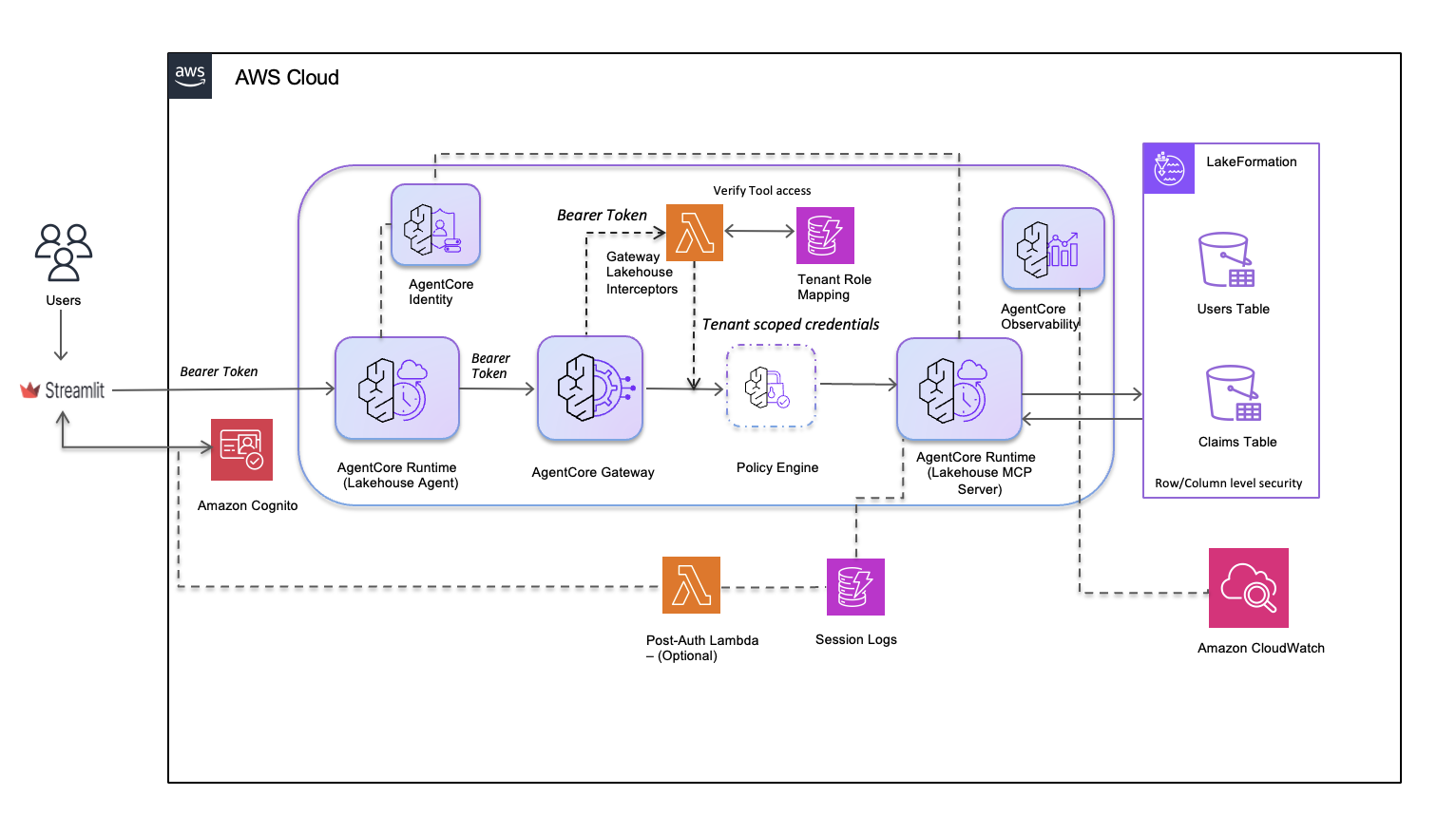
A hands‑on walkthrough shows a lakehouse insurance claims agent that layers declarative Cedar policies with per‑call Lambda interceptors to constrain tool use, enforce geography‑based access and record auditable policy decisions.
An AgentCore example for Amazon Bedrock demonstrates how combining deterministic policy rules with runtime Lambda interceptors can govern agent‑invoked tools, using a lakehouse insurance claims assistant to show the pattern in practice. The walkthrough matters because it shows how static access rules plus per‑call checks can enforce geography‑based tool access and limit what LLM‑driven agents can do at runtime. For enterprise builders, the pattern offers a practical way to reduce risk when many teams and agents share tools and data.
The implementation uses two platform mechanisms. AgentCore’s Policy engine evaluates declarative Cedar policies to return deterministic allow — or-deny decisions based on principal, action, resource and optional request‑context conditions. Lambda‑based interceptors, wired into the AgentCore Gateway, run custom code before or after each tool call to perform dynamic validation, token exchange, payload enrichment and response filtering. Policy decisions and related outcomes are recorded in an audit log.
The example’s data layer is a lakehouse: claims data are stored in Amazon S3 Tables (Apache Iceberg) and queried with Amazon Athena, while AWS Lake Formation enforces row‑level and column‑level security at query time. A Streamlit user interface authenticates users via Amazon Cognito and forwards JWTs to the AgentCore Runtime, which validates tokens and creates isolated sessions for each caller.
The agent’s MCP Server exposes five tools: query_claims, get_claim_details, get_claims_summary, query_login_audit and text_to_sql. Role‑to‑tool mappings, tenant IAM role mappings and user geography metadata are kept in Amazon DynamoDB so the platform can evaluate which tools a caller is permitted to use based on role and location.
A typical request flow routes every tool invocation through the AgentCore Gateway to a Lambda interceptor that extracts the bearer token, checks tool access against the Tenant Role Mapping and issues a tenant‑scoped token for downstream requests. After interception, the AgentCore Policy Engine evaluates the call against declared Cedar policies before permitting access. Downstream enforcement by Lake Formation ensures even broad SQL queries return only the rows and columns allowed for the caller’s IAM role.
The post frames these controls against a governance challenge: enterprise AI platforms can host hundreds of agents and thousands of Model Context Protocol tools across teams, while LLM‑driven agents determine which tools to call, with what arguments and in what sequence at runtime. That dynamic behavior makes precomputed auditing and coarse access controls inadequate and increases the need for both deterministic policy gates and runtime guards.
Sources
Replies (0)
No replies in this topic yet.
