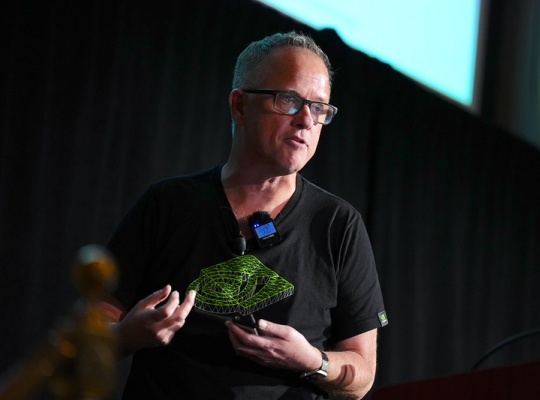
Aaron Erickson opened a 52:06 presentation at the practitioner‑led QCon AI conference by laying out concrete engineering patterns teams can adopt to make AI platforms more reliable. Drawing on his work founding the Applied AI Lab for DGX Cloud at NVIDIA and earlier engineering leadership roles, Erickson argued that pairing deterministic software guardrails with agentic discovery layers reduces uncertainty when deploying AI workloads. This matters because organizations under commercial pressure need repeatable architectures that shift projects from experimental prototypes into production systems.
Erickson described a hybrid pattern in which lower‑level discovery agents are free to explore solution spaces while higher‑level deterministic components enforce correctness, safety and policy constraints. He emphasized optimizing agent hierarchies so exploratory behavior is contained and observable, and recommended formalizing guardrails that bound agentic outputs rather than relying on LLMs alone. As a complement to architectural controls, he advised adopting a layered evaluation pyramid that escalates testing from unit checks to integrated system validation before broad rollout.
To illustrate operational pitfalls, Erickson recounted work from his earlier startup, Orgspace, where a ChatGPT plugin was used experimentally to generate reorganization plans. The anecdote highlighted how large language models can produce plausible but mediocre outputs unless constrained by structured data and deterministic checks, underscoring that naive LLM usage is insufficient for production workflows without structured enforcement and validation.
Erickson also recommended using time‑series foundation models for domain signals that are temporal — examples include anomaly detection and other sequential signal tasks — arguing these models better capture temporal structure than general‑purpose LLMs. He tied this recommendation to the evaluation pyramid, noting that domain‑appropriate foundation models and signal representations improve both detection of regressions and the scalability of monitoring systems.
For builders, Erickson distilled practical next steps: implement deterministic guardrails to bound agentic exploration; document agent hierarchies and the rules that enforce them; capture failure metrics and treat discovery agents as experimental components whose outputs must feed into deterministic enforcement; and design evaluation pipelines that advance from isolated checks to end‑to‑end system tests. These measures, he said, help teams detect regressions before they affect users and make AI behavior auditable.
The session was framed against current market dynamics Erickson referenced in the transcript: since 2023, AI has become a de facto expectation for many startups seeking funding, pressing teams to adopt AI quickly and creating demand for repeatable architectural playbooks and failure metrics. Practitioners interested in the detailed patterns and examples Erickson cited can consult the full talk and transcript for the playbook he presented.
Sources
Replies (0)
No replies in this topic yet.
