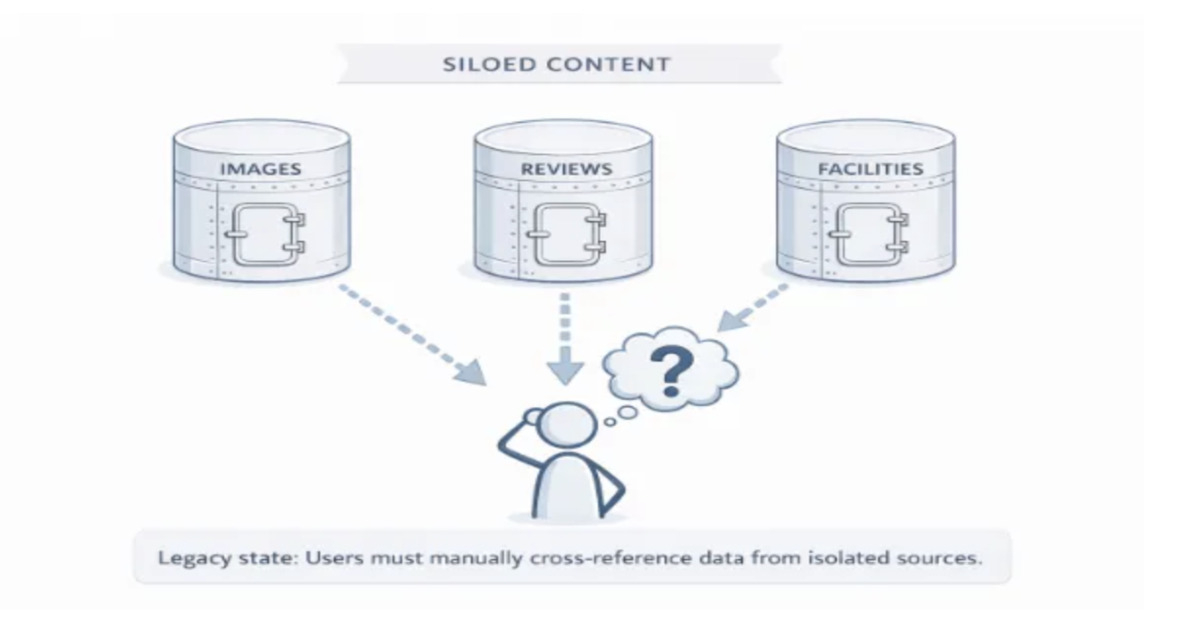
Agoda has consolidated separate image and review pipelines into a single, topic — driven multimodal system that packages curated photos, representative review excerpts and sentiment markers into precomputed, queryable artifacts. The change replaces on-the-fly linking of photos and text with topic — level bundles anchored to hotel attributes such as Pool, Breakfast, Room Quality and Location, reducing runtime complexity and improving retrieval speed for user-facing services.
The system assigns semantic labels to image assets with classification models (for example: pool, beach view, breakfast area) and normalizes those labels to canonical topics. Reviews pass through NLP pipelines that extract key phrases, representative excerpts and sentiment signals, which are aligned to the same taxonomy. Those topic associations are computed offline so a low-latency retrieval layer can serve correlated multimodal content without expensive runtime joins. Agoda designed the platform for scale: it processes more than 700 million images alongside multilingual reviews in over 40 languages. Large — scale ingestion and enrichment run as PySpark jobs orchestrated with Kubeflow, and the resulting topic — level artifacts are stored in Couchbase, which serves production traffic with low latency.
The redesign addresses a practical search — and-discovery gap. Previously, independent ranking and retrieval logic for images and reviews made it difficult to correlate what users saw in photos with what was described in reviews, producing inconsistent feature interpretation across modalities. Aditya Kumar Ray, VP at Flyshop, framed the shift on LinkedIn, saying modern travel tech increasingly requires understanding content context at scale.
The architecture intentionally trades freshness for performance by moving correlation logic offline and relying on taxonomy stability. That approach yields latency and scalability gains but increases the need for governance: a multilingual normalization layer maps semantically equivalent content across languages, and careful maintenance of topic definitions is critical to prevent semantic drift across regions and domains. Agoda’s engineering team describes the design as extensible: structured property metadata and additional user-generated media can be integrated into the same topic framework to broaden semantic coverage. For builders, the implementation demonstrates a repeatable pattern — precompute multimodal associations, use a low-latency store for serving, and centralize taxonomy governance — to improve retrieval efficiency at very large scale.
Sources
Replies (0)
No replies in this topic yet.
