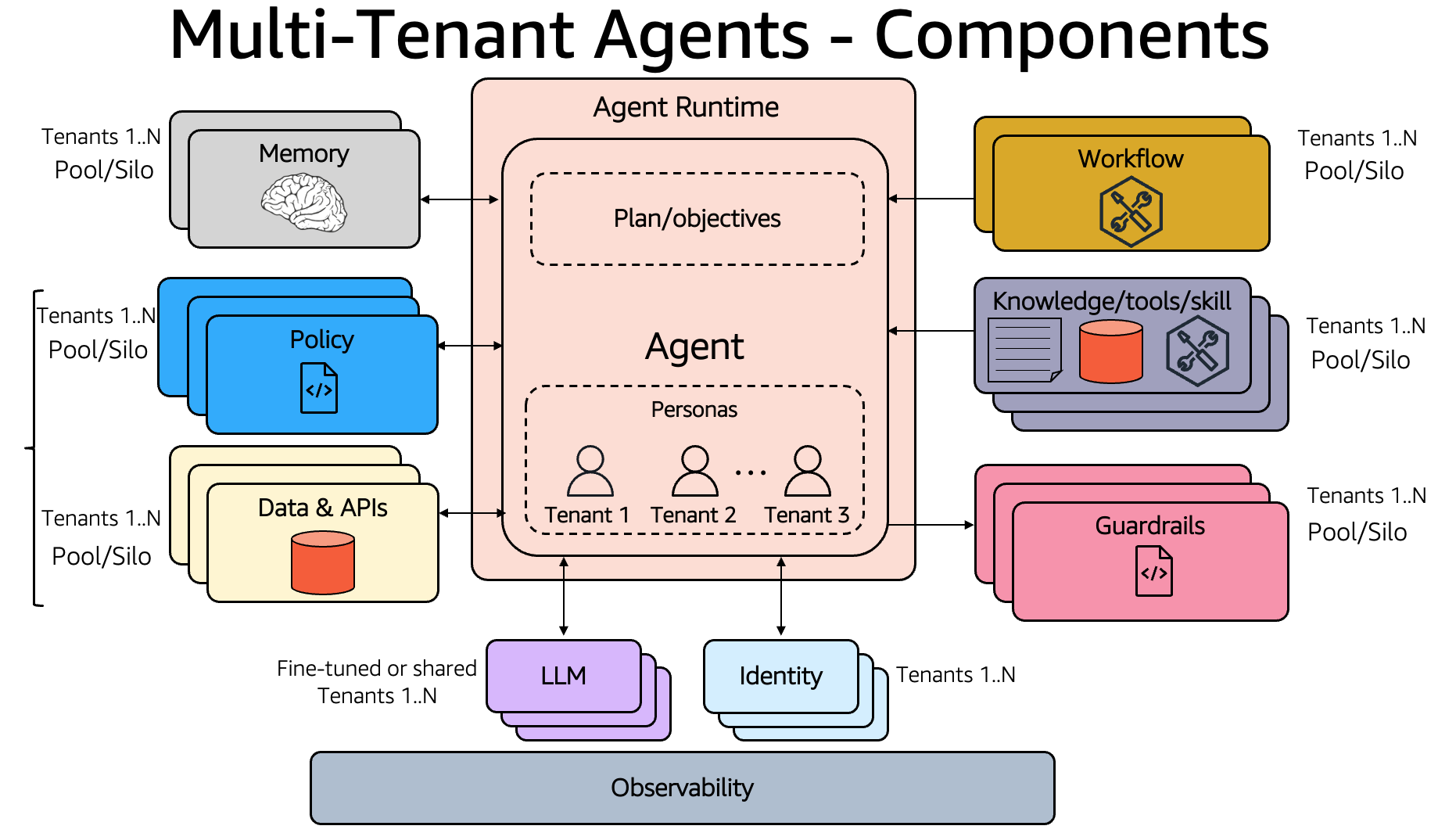
A new technical post documents how Amazon Bedrock AgentCore frames and addresses the operational challenges of running multi‑tenant, agentic SaaS applications in production. The post focuses on tenant isolation, tenant identity, observability, data isolation, cost attribution and mitigation of noisy neighbors — issues the authors identify as central to taking agent demos to production‑grade deployments. Those concerns determine which runtime, isolation and model strategies teams should adopt.
AgentCore is presented as a managed, serverless framework for building, deploying and operating agentic applications. It provides constructs for deploying agents and hosting MCP servers and includes built‑in support for identity management, memory, observability and evaluations. The runtime uses session‑isolated, microVM‑based compute: lightweight microVMs are launched per session and backed by a persistent session file system so agents can retain intermediate artifacts and state across multi‑step interactions without the cost or latency of full VM spin‑up.
Tenant context is propagated into AgentCore Runtime sessions via custom HTTP headers. When a SaaS platform forwards a request it can attach headers carrying tenant metadata — tenant identifier, tier, regional preferences, feature flags and entitlements — alongside standard authorization tokens. Agents read those headers at invocation time to establish tenant awareness, enabling tenant‑specific workflows, licensing checks and routing to tenant endpoints without embedding routing logic inside the agent itself.
The post categorizes multi‑tenant architecture into three isolation patterns — Silo, Pool and Bridge — and stresses a tiering strategy when choosing among them. It contrasts dedicated runtimes (a silo per tenant with separate container image or process lifecycle) against shared runtimes (many tenants in the same container or process pool). Dedicated deployments offer stronger noisy‑neighbor protection and simplify compliance audits; shared deployments reduce infrastructure cost and operational overhead but require rigorous in‑process tenant context propagation to avoid leakage.
On model strategy, the guidance recommends starting with shared foundation models as the operational baseline because they centralize maintenance and updates. Tier‑specific models are advised where tenant tiers demand different cost or performance trade‑offs. Tenant‑specific fine‑tuned models are described as an escalation path for specialized use cases that require per‑tenant behavior or higher domain accuracy.
For builders, the practical implication is a trade‑off among isolation, cost and operational complexity. AgentCore’s session microVMs, persistent session storage, header‑based tenant context and integrated identity and observability tooling are intended to reduce cross‑session leakage and simplify hosting of MCP servers, agents and AG‑UI servers. Teams still must map their noisy‑neighbor risk, compliance obligations, cost attribution and tenant tiers to an isolation pattern and model strategy before production rollout.
Sources
Replies (0)
No replies in this topic yet.
