Amazon published technical guidance that lays out three concrete implementation patterns for programmatic tool calling (PTC) on Amazon Bedrock, ranging from fully self-hosted to managed and SDK-compatible approaches. The guidance reframes tool calling so the model emits code once and a sandboxed execution environment runs the tool invocations and returns only a single, final processed result to the model — reducing token use, latency, and privacy exposure. This matters for teams that need to scale multi — step automations without repeatedly exposing intermediate data to the model.
The three paths described are: a self-hosted Docker sandbox deployed on Amazon ECS for teams that require maximum control and customization; a managed execution option using Amazon Bedrock AgentCore Code Interpreter to reduce operational burden; and an Anthropic SDK-compatible route implemented via a proxy for teams that want to preserve the Anthropic SDK developer experience. Each path preserves the same core PTC pattern: model — generated code, sandboxed execution of tool calls, and a single final result returned to the model.
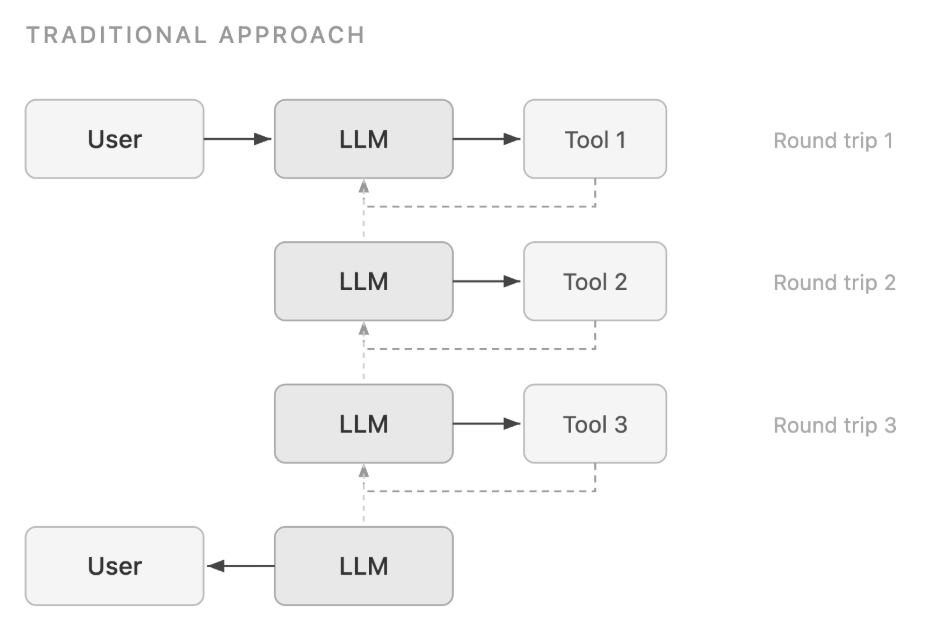
The post contrasts PTC with traditional sequential tool-calling workflows. In a typical sequential approach a model must be invoked for every tool interaction, which can balloon context exposure and latency. The blog gives a concrete example: asking which engineering team members exceeded Q3 travel budgets might involve calling a tool for 20 people, fetching 50 — 100 line items per person and exposing over 2,000 expense records to the model. Those sequential round trips compound token consumption, increase latency, and make aggregation error — prone when done by language models.
PTC flips that workflow: the model outputs a single Python code block that orchestrates parallel tool calls, performs filtering, aggregation and conditional logic inside a sandbox, and returns only the compact result back to the model. Because the model is sampled once, intermediate results never enter the model’s context window, which dramatically reduces token usage and inference round trips and improves accuracy for deterministic operations such as numeric aggregation.
The blog includes a representative Python pattern that uses asyncio and JSON parsing to implement this flow: fetch the team roster, spawn parallel get_expenses tasks with asyncio.gather, compute totals locally, compare them against budgets, and return a compact list of budget exceedances. The example illustrates how PTC enables parallelism, precise numerical calculations, loops and conditionals, and local filtering before any aggregated output re-enters the model.
For builders the trade — offs are clear: a self-hosted Docker sandbox on ECS offers maximum operational control at the cost of greater maintenance; AgentCore Code Interpreter provides a managed execution path to lower ops burden; and an Anthropic SDK-compatible proxy lets teams reuse existing SDK tooling and workflows. All three approaches aim to lower latency, cut token costs, and reduce privacy exposure by keeping raw data out of the model context.
Sources
Replies (0)
No replies in this topic yet.
