Amazon published a technical walkthrough showing how to build an Agentic AI system to orchestrate radiology worklists, aiming to reduce diagnostic delays and assignment costs across hospital networks. The post provides an end‑to‑end solution that uses foundation models through Amazon Bedrock, wired via AgentCore and the Strands Agents SDK, to coordinate specialized agents that recommend case assignments with rationale. Hospitals and radiology groups facing backlog and inefficiency are the primary beneficiaries if the approach is adopted.
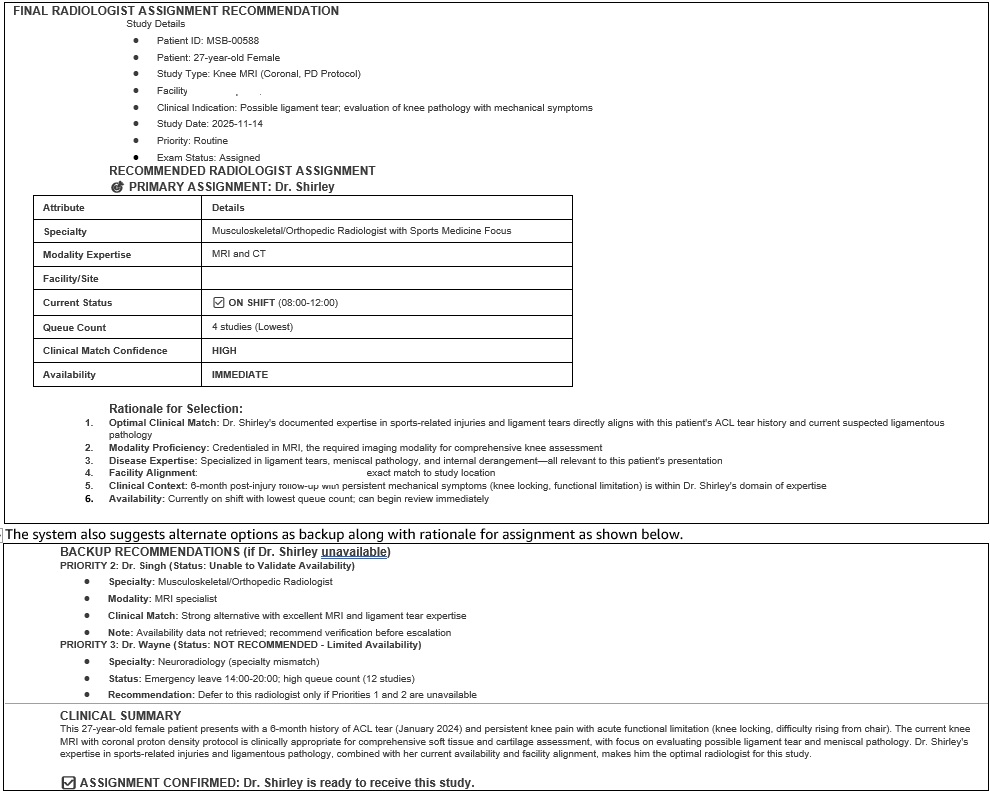
The proposed architecture chains a network of specialized agents that perceive signals from the clinical environment and coordinate across specialties. Agents evaluate factors such as radiologist subspecialty, current workload, fatigue patterns, case complexity, clinical urgency and availability to recommend a primary assignment and explain the reasoning. The walkthrough illustrates this with a knee MRI arriving in a PACS and shows sample outputs the orchestrator might produce.
The post contrasts the agentic design with conventional deterministic worklist engines, which rely on static specialty matching or simple queue‑depth balancing. Those rule‑based systems can miss crucial context — for example whether a clinician has been reading complex cases for hours or whether a follow‑up truly requires a subspecialist — and they require manual logic updates rather than learning from past suboptimal assignments.
Quantitative analysis cited in the post underpins the shift: a research review across 62 hospitals and 2.2 million studies found inefficient case assignment added an average 17.7 minutes of delay for expedited cases and imposed estimated costs of $2.1M–$4.2M across hospital networks. Those metrics are presented as drivers for moving beyond rule‑based routing toward context‑aware, adaptive assignment.
The walkthrough maps practical implementation components: a technologist acquisition event that triggers processing, PACS ingestion, the intelligent worklist orchestrator and inter‑agent coordination that outputs assignment recommendations with rationale. It also sets builder objectives — reduce diagnostic delays, deploy agents that reason about specialization and fatigue, and implement context‑aware assignment to lower incentives for cherry‑picking.
For builders and clinical IT teams the significance is operational: continuously learning agents can match the right subspecialist to the right case at the right time, reduce diagnostic delays and free radiologists to focus on interpretation. The post notes an industry adoption signal in Radiology Partners’ partnership to adopt Agentic AI for workflow optimization and emphasizes integration points and training agents on historical patterns so the system can adapt over time.
Sources
Replies (0)
No replies in this topic yet.
