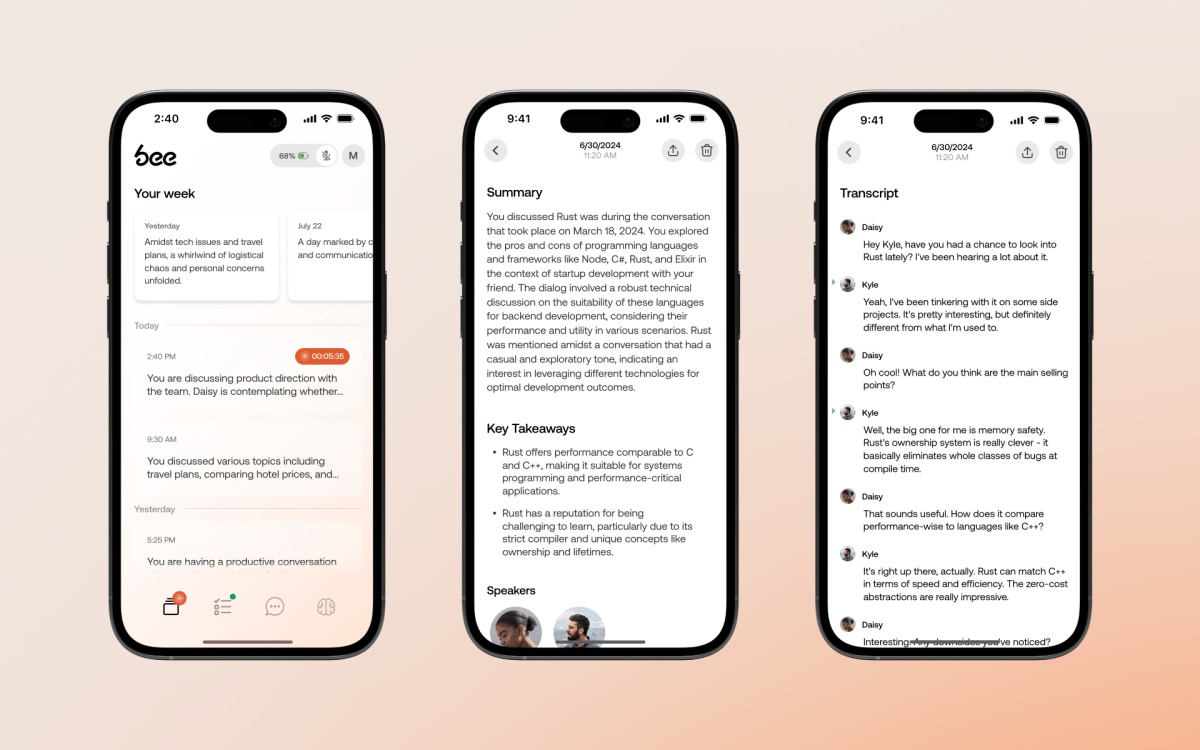
The Bee wrist wearable records, transcribes and auto-summarizes conversations for daylong note-taking, but transcription gaps and broad app permissions raise privacy and accuracy questions.
Bee, a wrist‑worn AI assistant Amazon acquired last year and has since updated, records conversations throughout the day, transcribes them and produces automated summaries — capabilities intended to serve as a constant, passive note‑taking tool. Paired with its mobile app, Bee can also sync with a calendar to surface alerts and reminders tied to events, making it potentially useful for people who need quick access to meeting takeaways and timelines.
Setup is straightforward: power the device, strap it on, pair it with the Bee mobile app and enter basic personal details. A physical button toggles the built‑in recorder; a green light flashes while recording and goes dark when recording is off. After a recorded conversation the app generates both a concise, readable summary and a full transcription for later review.
Hands‑on testing showed clear utility for professionals who juggle many meetings: segmented summaries let users skim key points without replaying entire calls, saving review time and reducing friction in follow‑up. Yet the core feature set-recording, transcription and automated summarization — overlaps with existing services such as Otter and Granola, so Bee’s competitive edge will likely depend on integration quality, transcription accuracy and how smoothly it fits into existing meeting workflows.
Privacy emerged as a central concern. The tester, who described themselves as privacy‑minded, said wearing an always‑on recorder 24/7 felt uncomfortable outside explicitly consented situations. Although Bee is marketed for personal use, the app requests broad mobile permissions, including access to location, photos, phone contacts and calendar data, forcing users to weigh convenience against substantial access to both offline and digital life.
Concrete moments from the trial illustrated both strengths and limits. With permission, a business phone call was recorded and the app produced a segmented summary that mapped to portions of the conversation, streamlining review. At a movie night Bee remained active and correctly inferred context, labeling the capture “Tarantino Film Scene Analysis.” Still, transcripts were sometimes messy: sections were omitted and speaker names often had to be entered manually.
For builders and integrators the practical takeaways are clear: visible recording indicators and a physical record toggle are useful privacy affordances, but improvements are needed in speaker diarization and transcript completeness to be competitive. Designers should prioritize clearer consent flows and more granular permission controls if Bee‑style wearables are to move beyond niche professional use into broader, daylong personal adoption.
Sources
Replies (0)
No replies in this topic yet.
