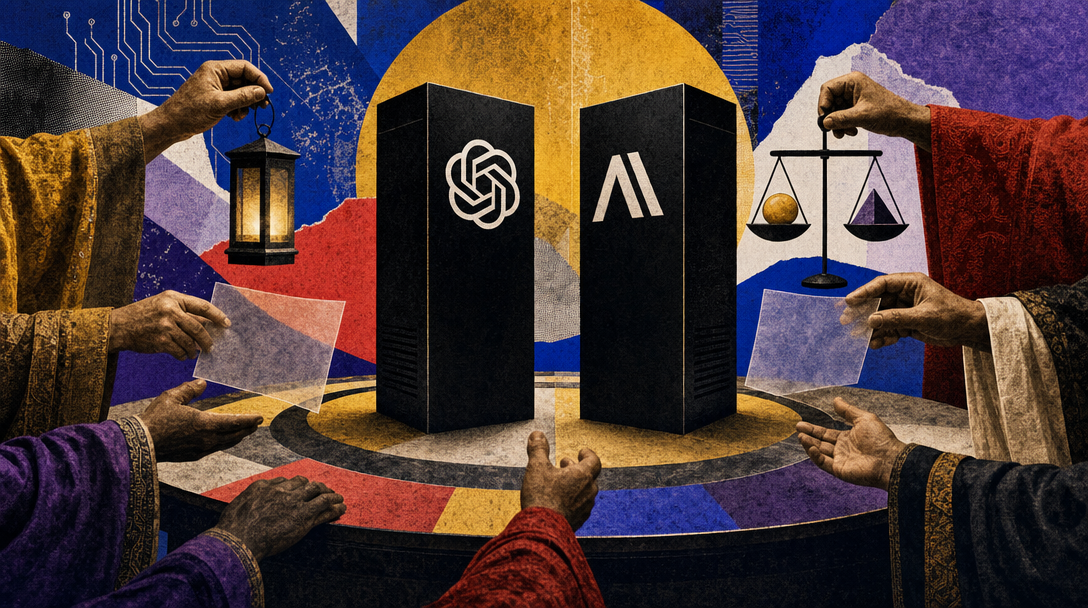
Representatives from Anthropic and OpenAI met last week with leaders of multiple faith traditions at the inaugural “Faith — AI Covenant” roundtable in New York to introduce religious perspectives into debates about AI ethics. The convening aimed to connect community‑level moral priorities to governance discussions at an early stage, potentially shaping product policy, deployment practices and public trust in emerging systems.
The Interfaith Alliance for Safer Communities (IAFSC) organized the session and confirmed it on LinkedIn. Founded in 2018 and based in Geneva, IAFSC works with religious leaders on issues including extremism, radicalization, human trafficking and child protection, and positioned the new initiative as a way to apply those community‑facing priorities to AI governance. Organizers described New York as the first in a planned series, with additional sessions slated for Beijing, Nairobi and Abu Dhabi.
Attendance and prior engagement varied across companies. Anthropic has already involved faith leaders in drafting its internal “Claude Constitution,” while OpenAI’s CEO Sam Altman has publicly used spiritual metaphors for the company’s roadmap, saying the group pursues “magical intelligence in the sky” and that he feels “on the side of the angels.” Baroness Joanna Shields, a partner in the Interfaith Alliance and a former Google and Facebook executive who leads advisory firm Precognition, told participants regulation can’t keep up with development and urged faster institutional responses.
Not all observers welcomed the outreach. AI researcher Rumman Chowdhury described the talks as “at best a distraction,” arguing that centering religious ethics risks diverting attention from concrete questions about regulation, power and control over deployed systems. Dylan Baker of the Distributed AI Research Institute warned the ethical framing might overshadow the more fundamental debate over whether certain AI systems should be built at all.
Some participants and outside experts framed the meetings as partly reputational. Brian Boyd of the Future of Life Institute said there is “some aspect of PR” to Silicon Valley’s embrace of faith communities, referencing a broader industry reckoning after the era of “move fast and break things.” For builders, the dialogue can signal a search for external moral legitimacy even as regulators and researchers press for technical controls and accountability mechanisms.
Organizers and many attendees presented the roundtable as an opportunity to translate longstanding moral teachings into practical standards for AI systems that could inform product policy and deployment practices. The IAFSC model — bringing community leaders into harm‑reduction conversations — aims to create shared ethical standards; whether those standards affect regulation, audits or system design will depend on follow‑up rounds and on how companies and policymakers act on any agreed principles.
Sources
Replies (0)
No replies in this topic yet.
