On May 5, 2026, Anthropic introduced Auto Mode for Claude Code, letting developers define objectives while the system generates, executes and iterates on code with automated approvals and human checkpoints to reduce repetitive confirmations.
Anthropic released Auto Mode for Claude Code on May 5, 2026, enabling developers to specify objectives and let the system handle multi‑step code generation, execution, tool integration and iterative refinements with less manual intervention. The feature is intended to cut repetitive permission prompts while preserving human oversight through selected checkpoints for high‑impact or sensitive operations.
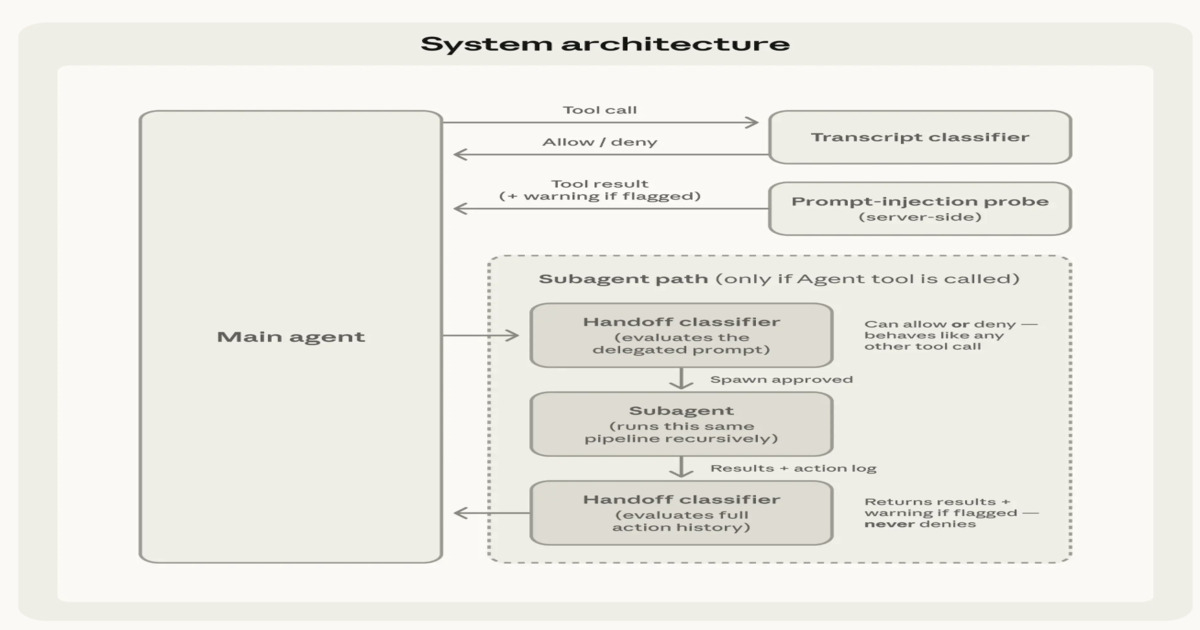
Auto Mode uses a layered architecture that inspects tool outputs before they enter an agent’s working context. File reads, shell results and web responses are filtered and flagged when they appear malicious or attempt to alter instructions. At the execution layer, each proposed action is evaluated by an automated approval mechanism that allows clearly safe operations to proceed and escalates ambiguous or risky requests for further review.
The change addresses friction in the prior permission‑based model, where users manually approved most file changes and commands and reported what Anthropic characterizes as “approval fatigue.” Sid Chaudhary, Head of Product at Intempt, said the update lets developers step away from active sessions without losing control. Test Engineer Ankit Kalluraya pointed to a UI cue — a red spinner — that signals when a permission check has paused execution so users know why progress is halted.
Safety checks extend into delegation and subagent workflows. Outbound checks verify that a delegated task matches the original user intent before a subagent runs it, and a return check examines the subagent’s full execution history to detect prompt‑injection or runtime manipulation. When risks are identified, the system attaches warnings to results before they return to the orchestrating agent, allowing human reviewers to decide whether to accept, modify or reject outcomes.
To balance speed and coverage, Anthropic implemented a two‑stage classification pipeline. A fast initial filter lets most tool calls proceed with minimal latency; calls that are uncertain or higher risk are escalated to deeper analysis to improve recall for edge cases without dramatically increasing compute cost. Anthropic frames the design as a tradeoff among efficiency, latency and safety coverage.
Anthropic says it will continue iterating on safety and cost tradeoffs by expanding evaluation sets and tuning detection to capture a sufficient portion of high‑risk actions. Practically, the company preserves human approval for sensitive operations and asks users to remain aware of residual risks and to report issues — acknowledging that autonomous workflows reduce friction but do not eliminate security and governance challenges.
Sources
Replies (0)
No replies in this topic yet.
