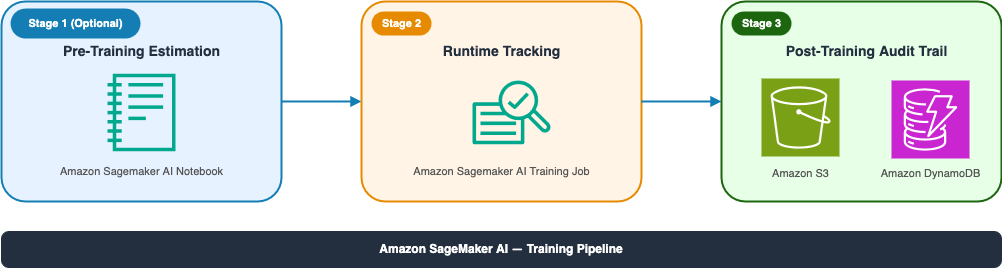
The EU AI Act now requires organizations that fine‑tune LLMs to track floating‑point operations (FLOPs) to determine whether they must register as general‑purpose AI (GPAI) providers;
On August 2, 2025 the EU AI Act introduced explicit FLOPs‑tracking requirements for organizations that fine‑tune large language models, using a computational threshold — commonly called the one‑third rule-to decide whether downstream fine‑tuning is a minor modification or a substantial retraining that reclassifies a party as a general‑purpose AI (GPAI) model provider. That reclassification matters because GPAI providers face additional disclosure, data‑publishing and governance obligations under the Act. To help builders comply, Amazon published guidance showing how to record fine‑tuning compute on Amazon SageMaker AI with the open‑source Fine‑Tuning FLOPs Meter.
The FLOPs Meter integrates into SageMaker Training jobs and CI/CD pipelines, emits audit‑ready artifacts, and can auto‑classify the applicable regulatory path for a training run. The toolkit is designed to be lightweight — the blog highlights that a single configuration flag can determine compliance status for a job-and to produce the compute accounting signals and logs needed for regulatory review.
The Act defines three threshold scenarios with concrete FLOPs numbers. If a base model’s pretraining FLOPs are unknown, the default threshold is 3.3×10^22 FLOPs. If pretraining compute is known and at least 10^23 FLOPs, the threshold is relative: 30% of that pretraining compute. For systemic‑risk models (pretraining ≥10^25 FLOPs) or when scale is uncertain, a higher threshold of 3.3×10^24 FLOPs applies. The FLOPs Meter uses the PRETRAIN_FLOPS environment variable to select the correct scenario automatically.
Because many base‑model providers do not publish exact pretraining FLOPs, the guidance notes teams frequently fall back to the default numeric threshold unless they can supply PRETRAIN_FLOPS. Crossing the applicable threshold has material legal and operational consequences: GPAI designation obliges providers to disclose architecture and training processes, publish the data sources used, and demonstrate compliance with EU copyright rules — requirements that substantially increase documentation and governance overhead.
The SageMaker context matters operationally. SageMaker Training jobs provide managed resource provisioning, automated scaling, built‑in distributed‑training support and automatic decommissioning of compute after jobs finish. These jobs already integrate with AWS CloudTrail and Amazon CloudWatch for governance, and the FLOPs Meter is designed to feed its outputs into those monitoring and audit traces so teams can retain end‑to‑end logs and account for compute in the same systems they use for other compliance telemetry.
The blog gives a concrete example to illustrate the thresholds: Llama‑3‑70B is estimated to have a minimum pretraining compute of 1.5×10^24 FLOPs, which sets a 30% threshold at 4.5×10^23 FLOPs under the Act; exceeding that amount would reclassify a fine‑tuner as a GPAI provider. For builders the practical steps are clear: instrument fine‑tuning jobs to capture end‑to‑end FLOPs, set PRETRAIN_FLOPS when the base model’s compute is known, wire the FLOPs Meter outputs into CloudTrail/CloudWatch and CI/CD, and retain audit artifacts so teams can prove whether a job crosses the regulatory threshold.
Sources
Replies (0)
No replies in this topic yet.
