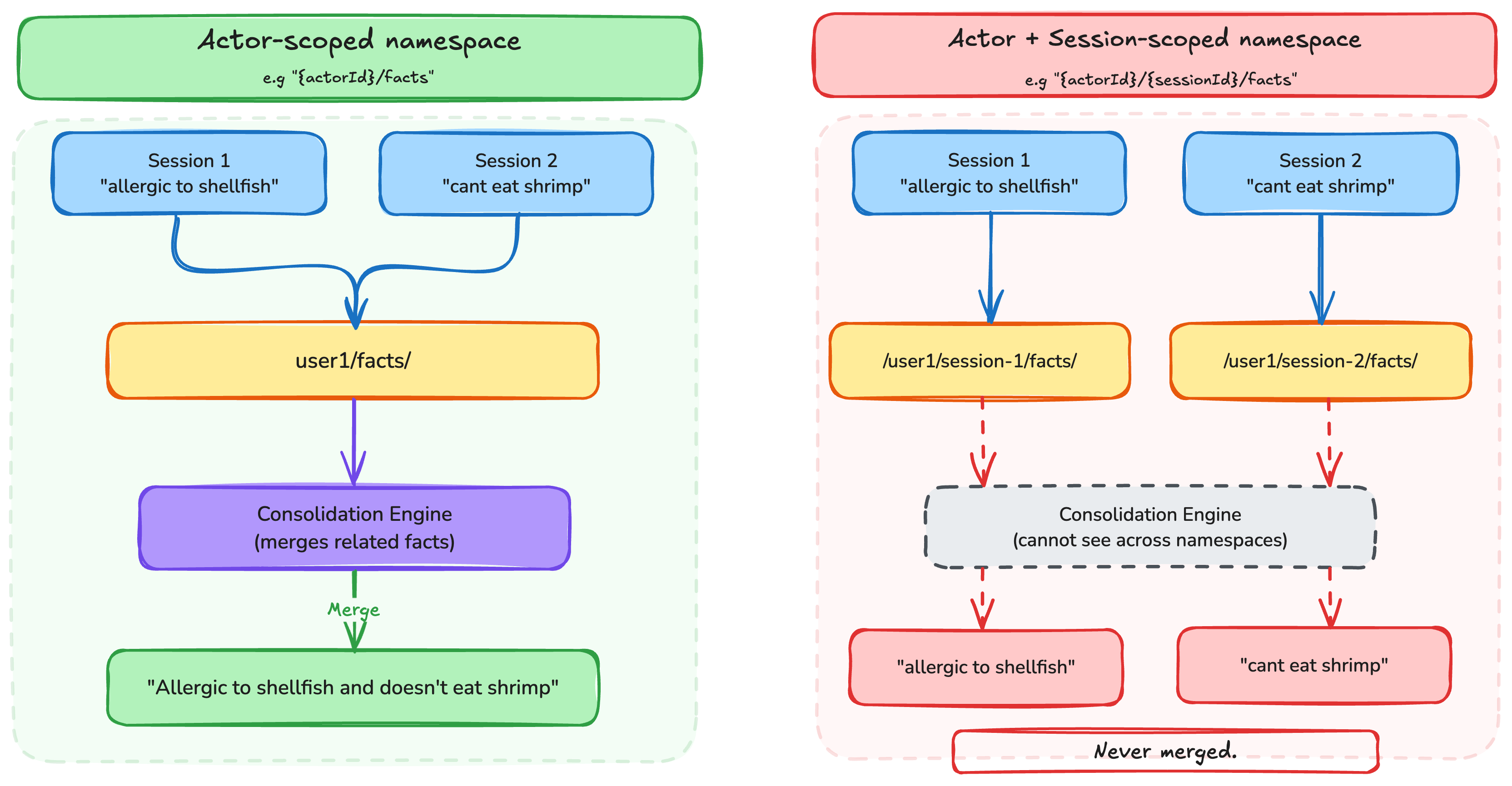
Amazon Web Services (AWS) has introduced sophisticated namespace design patterns within its AgentCore Memory service, offering a robust solution for developers managing the complexities of organizing AI agents' long-term memory at scale. This enhancement addresses the critical need for organized, retrievable, and secure long-term context, fundamental for advanced AI agent development. The patterns aim to streamline the management of persistent information, allowing AI systems to maintain relevance and effectiveness across varied interactions.
Namespaces in AgentCore Memory are hierarchical paths that logically structure memory records within a resource, functioning similarly to directory paths in file systems or folder structures in Amazon Simple Storage Service (Amazon S3). This architecture facilitates highly scoped information retrieval and supports granular access control, crucial for maintaining data integrity, privacy, and security within intelligent agent systems.
Developers building AI agents have historically struggled with organizing memory across sessions, often leading to irrelevant context retrieval and significant security vulnerabilities. Prior storage — only solutions proved insufficient; context — aware agents require memory that is intelligently organized, efficiently retrievable, and robustly secured. This new capability directly addresses these long-standing issues by providing a structured framework, thus enhancing the reliability and security of agent operations.
Effective namespace design is essential for an efficient memory system, as namespaces determine how records are organized, retrieved, and accessed. For instance, a user's preferences might reside at `/actor/customer — 123/preferences/`, while session summaries could be stored at `/actor/customer — 123/session/session — 789/summary/`. This structure enables precise retrieval granularity, whether for cross — session user preferences or specific session details. Unlike a simple partition key, AgentCore Memory namespaces support hierarchical retrieval, allowing queries at any path level, offering superior flexibility in data access patterns.
Memory resources utilize namespace templates, defined via the `namespaceTemplate` field within each strategy configuration. These templates integrate pre-defined variables like `{actorId}` for the actor identifier, `{sessionId}` for the session identifier, and `{memoryStrategyId}` for the strategy identifier. An example template such as `/actor/{actorId}/session/{sessionId}/summary/` would dynamically resolve to a path like `/actor/customer — 456/session/session — 789/summary/` when events arrive for `actorId=customer — 456` in `sessionId=session — 789`. This dynamic resolution automatically organizes memory into appropriate hierarchical paths as new information is processed, simplifying developer management.
Namespace design is tailored to the distinct needs of various memory strategies. For semantic memory, which captures facts (e.g., "customer's company has 500 employees"), and user preference memory, recording choices (e.g., "User prefers Python"), an actor — scoped pattern is recommended. Designs like `/actor/{actorId}/facts/` or `/actor/{actorId}/preferences/` consolidate all relevant information for a given user under a single namespace, irrespective of the session. This ensures facts and preferences remain retrievable and relevant across future interactions, with a consolidation engine merging related memories to maintain a coherent knowledge base for each actor.
These new design patterns represent a significant advancement for the AI community, enhancing the reliability and operational capabilities of intelligent agents. By providing a structured, secure, and flexible foundation for operational memory, AgentCore Memory empowers developers to build more sophisticated and trustworthy AI applications. The combination of hierarchical memory organization and robust access control through AWS Identity and Access Management (IAM) ensures agent memory is both effective and compliant with stringent security and privacy requirements, fostering innovation across AI-powered services.
Sources
Replies (0)
No replies in this topic yet.
