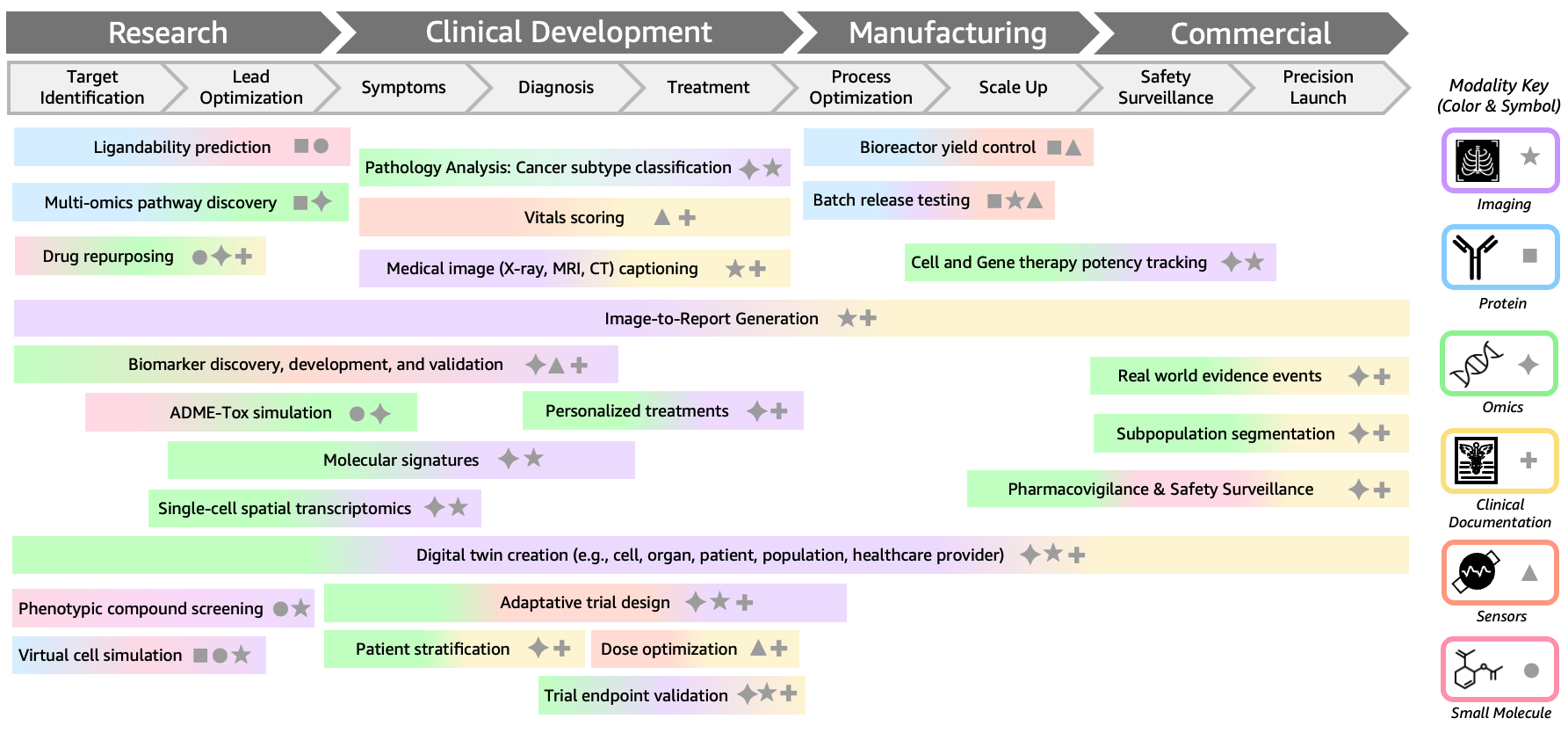
AWS introduces a unified platform for deploying multimodal biological foundation models (BioFMs). These AI models, integrating various data types, are designed to make breakthroughs in diagnostics, therapy, and drug development in healthcare and biomedical sciences.
Modern healthcare and biomedical sciences increasingly face a critical need for comprehensive analysis of multimodal data for accurate diagnosis, effective drug prescription, and prediction of treatment outcomes. Traditional approaches, operating with fragmented data, often miss key interrelationships and deep insights. In response to this challenge, AWS introduces a unified environment for deploying multimodal biological foundation models (BioFMs).
These advanced AI models, pre-trained on extensive biological datasets, can seamlessly integrate and analyze disparate information streams. This approach opens up unprecedented opportunities for a deep understanding of therapeutic strategies and personalized patient care. Even unimodal BioFMs, focusing on a single data modality, such as amino acid sequences for predicting protein structures, have already demonstrated significant successes, as noted by the Nobel Prize in Chemistry in 2024, foreshadowing even greater breakthroughs with the development of multimodal systems.
Multimodal BioFMs, unlike their unimodal predecessors, are trained on multiple data types simultaneously — text, images, audio, and video — and can draw complex conclusions across various streams within a single model. This allows for a significantly more complete understanding of biological processes and states. Among the outstanding examples of such models are Latent-X1 and Latent-X2 from Latent Labs. These models not only accurately predict 3D protein structures but are also capable of generating novel binding agents, including highly effective antibodies and miniproteins.
The Evo 2 model from Arc Institute, in turn, offers unique capabilities for interpreting and predicting the structure and function of DNA, RNA, and proteins. Insilco Medicine has also made a significant contribution by developing the Nach01 model, which integrates natural language data, chemical information, and 3D molecular structures, thereby accelerating the discovery and development of new drug candidates. Innovations in multimodal BioFMs continue to actively evolve through the efforts of leading industry players. For instance, Bioptimus, with its M-Optimys model, successfully deciphers histological and clinical data, extracting deep biological insights from them, which is invaluable at all stages—from fundamental research to personalized patient care.
Researchers from Harvard and AstraZeneca introduced the MADRIGAL model, which uniquely combines structural data, cell viability information, and transcriptomic data for highly accurate prediction of drug combination outcomes. Concurrently, John Snow Lab developed a specialized language model, Medical VLM-24B, capable of efficiently processing and analyzing a wide range of clinical data, including physician notes, laboratory reports, and medical images.
Sources
Replies (0)
No replies in this topic yet.
