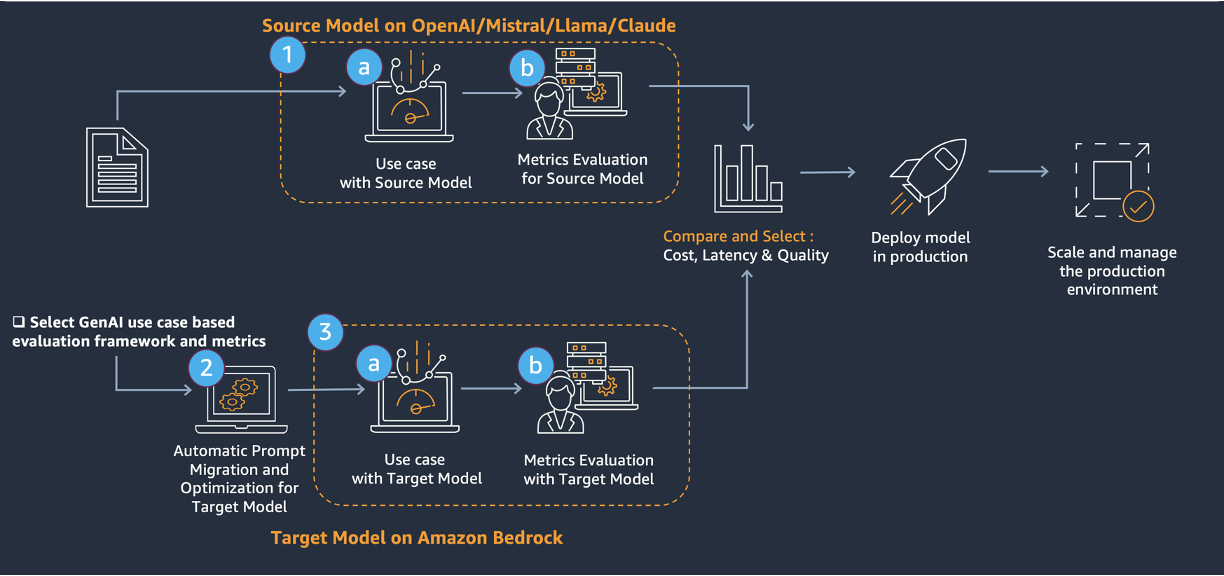
Amazon Web Services (AWS) has unveiled its Generative AI Model Agility Solution, a new systematic framework engineered to streamline the often — complex process of migrating and upgrading Large Language Models (LLMs) within generative AI production environments. This comprehensive guide provides organizations with essential tools, methodologies, and best practices, facilitating smoother transitions between different LLM families or newer versions, thereby ensuring continuous performance improvement and minimal operational disruptions.
In the rapidly evolving landscape of artificial intelligence, maintaining model agility is paramount for organizations striving to adapt to technological advancements and optimize their AI solutions. Developing a robust solution for LLM migration, however, presents significant challenges, encompassing both technical and non-technical aspects. These include the necessity for the solution to be generic enough for a variety of use cases while also being specific for easy application, offering comprehensive and fair comparison between LLMs, ensuring automation and scalability, and incorporating domain — and task-specific knowledge. Moreover, a well-defined, end-to-end process from data preparation guidance to final success criteria is crucial for effective implementation.
The newly introduced framework from AWS offers a robust protocol for prompt conversion and optimization, which is fundamental to successful LLM transitions. It integrates sophisticated evaluation mechanisms designed to assess multiple performance dimensions, empowering data-driven decision — making through detailed and comparative analysis of both source and destination models. The solution further enhances this process by providing diverse reporting options with various LLM evaluation frameworks, comprehensive guidance for metrics selection tailored to specific use cases, and practical feature and use case examples to expedite user adoption.
At the heart of the Generative AI Model Agility Solution lies a three — step migration approach: first, evaluating the source model; second, performing prompt migration to and optimization of the target model utilizing tools like Amazon Bedrock Prompt Optimization and the Anthropic Metaprompt; and third, evaluating the newly optimized target model. This structured methodology directly addresses critical technical challenges by offering frameworks for evaluation metrics selection, facilitating significant prompt improvement and migration, and enabling comprehensive model comparison across vital parameters such as cost, latency, accuracy, and overall quality. This end-to-end guidance is designed to ensure a seamless and efficient transition.
A cornerstone of successful LLM migration and upgrade within this framework is the preparation of a high-quality evaluation dataset. For most use cases, this necessitates samples with ground truth answers, rigorously validated for correctness and alignment with subject matter expert guidance and evaluation criteria. For scenarios where ground truth may not be feasible, the solution supports metrics such as answer relevancy, faithfulness, toxicity, and bias. The framework provides guidance on data format, suggesting fields like the prompt used for the source model, any prompt input (e.g.
By adopting this structured approach, organizations can transition between LLMs with unprecedented agility, unlocking improved performance, enhanced cost-efficiency, and expanded capabilities in their AI applications. The process emphasizes thorough preparation, systematic evaluation, and continuous improvement, setting the stage for long-term success in leveraging advanced language models. Depending on the complexity of the use case, a complete LLM migration or upgrade following this framework typically ranges from two days up to two weeks.
Sources
Replies (0)
No replies in this topic yet.
