Cline has open-sourced its internal agent harness as @cline/sdk, a TypeScript agent runtime that already powers the company’s CLI and Kanban and is being adopted for VS Code and JetBrains extensions. The move is intended to decouple UI code from the agent loop and make the runtime reusable across CLI, browser and IDE environments, so provider swaps and embedding become configuration tasks rather than code rewrites.
@cline/sdk is implemented as a layered stack with clear separation of responsibilities. @cline/shared supplies types, schemas, hooks and extension registration; @cline/llms manages provider gateways and model catalogs; @cline/agents implements a browser — compatible, stateless agent execution loop; and @cline/core is the Node orchestration layer responsible for sessions, storage, built — in tools, scheduling, telemetry and plugin loading. The SDK re-exports @cline/core while allowing packages to be installed individually for smaller footprints.
The redesign isolates provider logic from the agent loop. @cline/llms covers a range of providers including Anthropic, OpenAI, Google, AWS Bedrock, Mistral, LiteLLM and OpenAI — compatible endpoints such as vLLM, Together and Fireworks, so switching providers is intended as a configuration change. Because @cline/agents is stateless and omits session storage and Node-specific orchestration, it remains embeddable in browser and serverless contexts.
Cline highlights practical runtime capabilities for engineering teams: native plugin support that can register tools, observe lifecycle events, and add rules and commands; subagent composition; CRON-style scheduling; checkpointing; MCP connectors for integrations; and plugin loading from configured paths or workspace locations. Plugins can begin as local.ts/.js modules and later be packaged with a cline.plugins manifest for distribution.
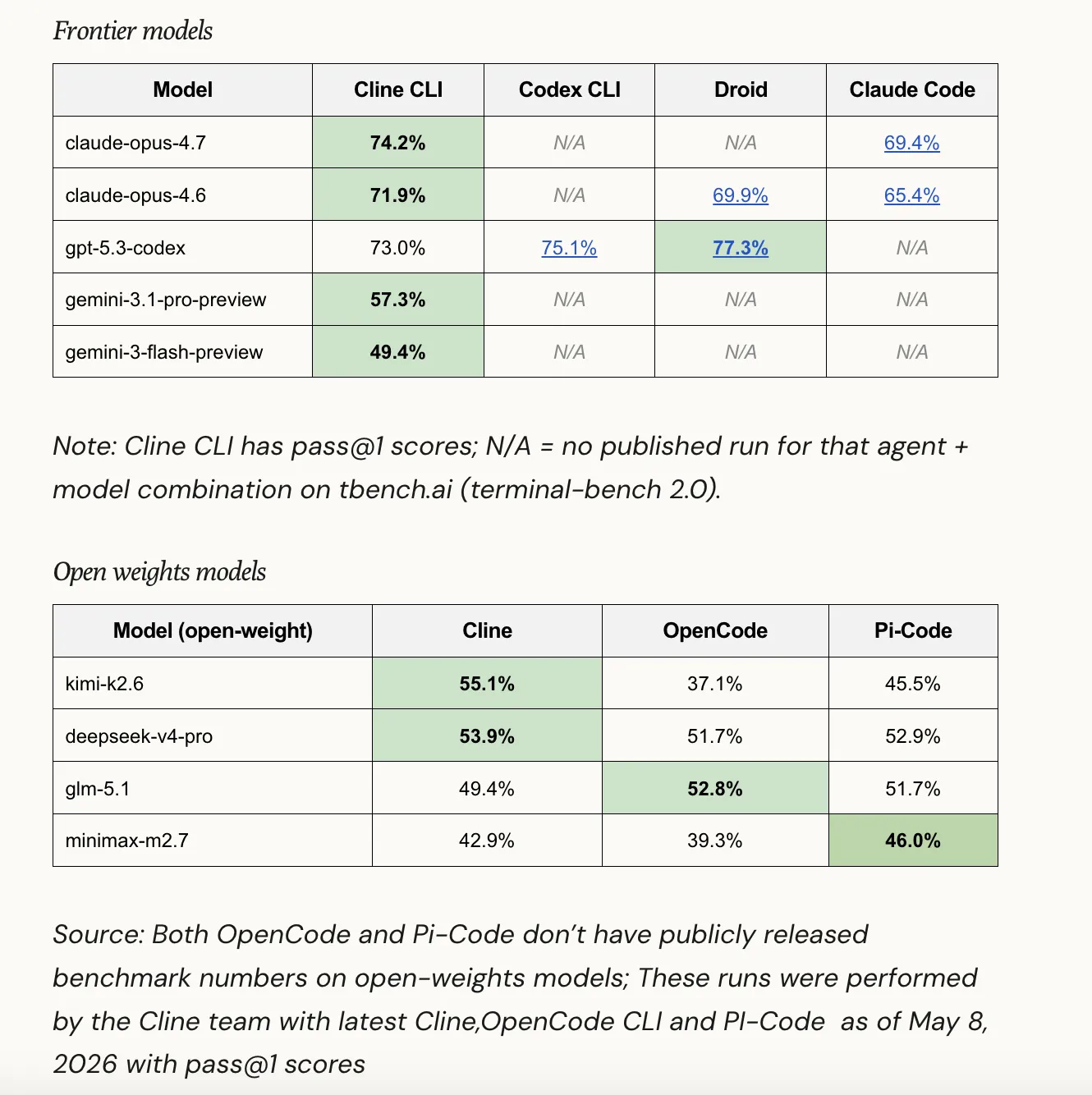
The company reports functional and performance improvements in Cline 2.0, including rewritten prompts, a simplified loop, tighter context management and improved tool and error handling. To illustrate gains, Cline published Terminal Benchmark 2.0 (tbench.ai) runs: the Cline CLI scored 74.2% on claude — opus-4.7 versus Anthropic’s published 69.4% for Claude Code on the same model; 71.9% on claude — opus-4.6 versus 65.4% for Claude Code; and 55.1% on kimi-k2.6 compared with OpenCode’s 37.1% and Pi‑Code’s 45.5% (pass@1, runs reported May 8, 2026).
For engineers who want to try the runtime, @cline/sdk is published to npm (npm install @cline/sdk) and requires Node.js 22 or newer. Teams can install only the components they need-for example @cline/llms for LLM proxying or @cline/agents for a stateless loop in browser/serverless contexts — and Cline says the new CLI completes tasks faster and at lower token cost in internal runs.
Sources
Replies (0)
No replies in this topic yet.
