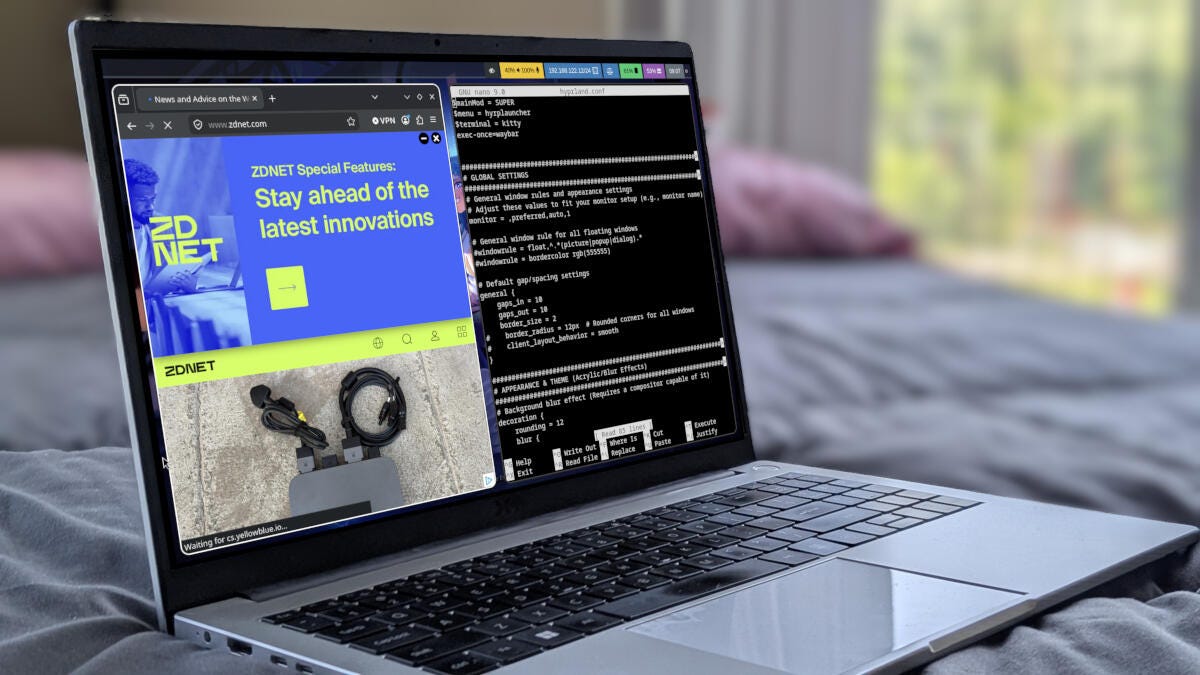
In a hands‑on experiment reported May 18, 2026, contributing writer Jack Wallen found that OpenAI’s Codex was the only model able to produce a remotely usable hyprland.conf for Hyprland 0.55.2 — though the file did not work out of the box and needed human edits. The result matters because it shows generative models can bootstrap a working configuration for a Linux window manager but cannot replace version‑specific expertise or dependency management.
Wallen ran the test on a fresh CachyOS installation that included Hyprland alongside KDE Plasma as a fallback. He prompted three models — Opera’s Aria, Ollama, and OpenAI’s Codex — asking each to produce a hyprland.conf targeting Hyprland 0.55.2. The brief specified using Waybar with a glassy, rounded‑corner theme in a purple/pink palette and requested keybindings: Super+t to open the terminal, Super+b to open the browser, plus default bindings for moving windows and changing window focus.
Only Codex produced an output that could be called remotely usable; Aria and Ollama did not produce configuration files that launched a functioning session without further intervention. After pasting Codex’s configuration into the system and running hyprctl reload to apply it, Wallen encountered a series of concrete errors that prevented a working desktop at first.
The generated file contained a set of version‑specific and dependency problems. It omitted a default terminal setting, used border_radius — a directive no longer valid in Hyprland 0.55.2 — and set rounding = 12px, which failed because the px unit triggered a syntax error. Windowrule entries produced by the model did not behave as written, and required packages referenced by the configuration were not installed on the fresh CachyOS image, causing further failures when reloading the compositor.
To reach a functional session, Wallen installed missing packages including kitty, Waybar, and rofi, and then removed or corrected the incompatible configuration options. After those edits the file served as a skeleton: the desktop launched, but the requested color scheme and overall polish were not fully applied. Wallen notes that each AI model warned in its output that placeholders and manual customization would likely be necessary.
The practical takeaway is straightforward: generative code models can accelerate producing a starting configuration, but they do not replace domain knowledge about version‑specific options, dependencies, and syntax. For reliable results, validate any generated hyprland.conf against the running Hyprland version, install required components before reloading, use hyprctl reload to surface errors, and expect iterative edits. Codex’s output from the test is available in the author’s GitHub repository for reference.
Sources
Replies (0)
No replies in this topic yet.
