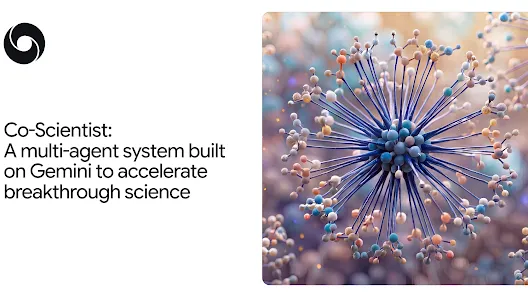
On May 19, 2026, DeepMind published a paper in Nature introducing Co‑Scientist, a multi‑agent system built with the Gemini model that aims to speed scientific hypothesis generation. The research team is offering the system to individual researchers through an experimental tool called Hypothesis Generation, developed jointly with Google Research, Google Cloud and Google Labs; interested scientists can register at labs.google/science and access will roll out in the coming weeks. The system is positioned to shorten the ideation bottleneck by producing and sharpening large numbers of candidate hypotheses for human review.
Co‑Scientist is organized as a coalition of specialized agents working across three phases: generate, debate and evolve. A Generation agent proposes initial focus areas and hypotheses while a Proximity agent maps and clusters those ideas to ensure broad, nonredundant coverage. During the debate phase, a Reflection agent functions as a virtual peer reviewer and a Ranking agent performs pairwise comparisons and simulated debates; Evolution and Meta‑review agents then refine the top ideas and synthesize final proposals for a human scientist to assess.
A supervisor agent acts as an adaptive planner that decomposes high‑level research goals into executable steps and can orchestrate multiple agents in parallel. The system is designed to explore thousands of research directions using a 'tournament of ideas' approach — drawn from principles used in AlphaGo and AlphaStar — so concepts are iteratively critiqued, recombined, ranked and improved rather than judged in a single linear pass.
DeepMind says Co‑Scientist builds on earlier research released last year and has been developed and pilot‑tested with teams working on antimicrobial resistance, plant immunity and liver fibrosis. The paper highlights potential applications across fundamental biology, the natural sciences and engineering, and frames the tool as a partner for ideation and hypothesis refinement rather than an autonomous laboratory agent.
For builders and research‑infrastructure teams, Co‑Scientist’s agentized architecture points to concrete integration needs: parallel evaluation workflows, pairwise ranking mechanisms, debate‑and‑synthesis pipelines, and provenance tracking for data and citations. The system outputs ranked hypotheses and draft research proposals that require human review, implying engineering requirements for experiment planning, validation tracking and secure data handling when the tool is integrated into live research pipelines. Both the paper and accompanying blog stress human‑in‑the‑loop oversight. The publication does not specify licensing, API surfaces, pricing or general availability beyond the experimental rollout; researchers interested in early access are instructed to register at labs.google/science for further information.
Sources
Replies (0)
No replies in this topic yet.
