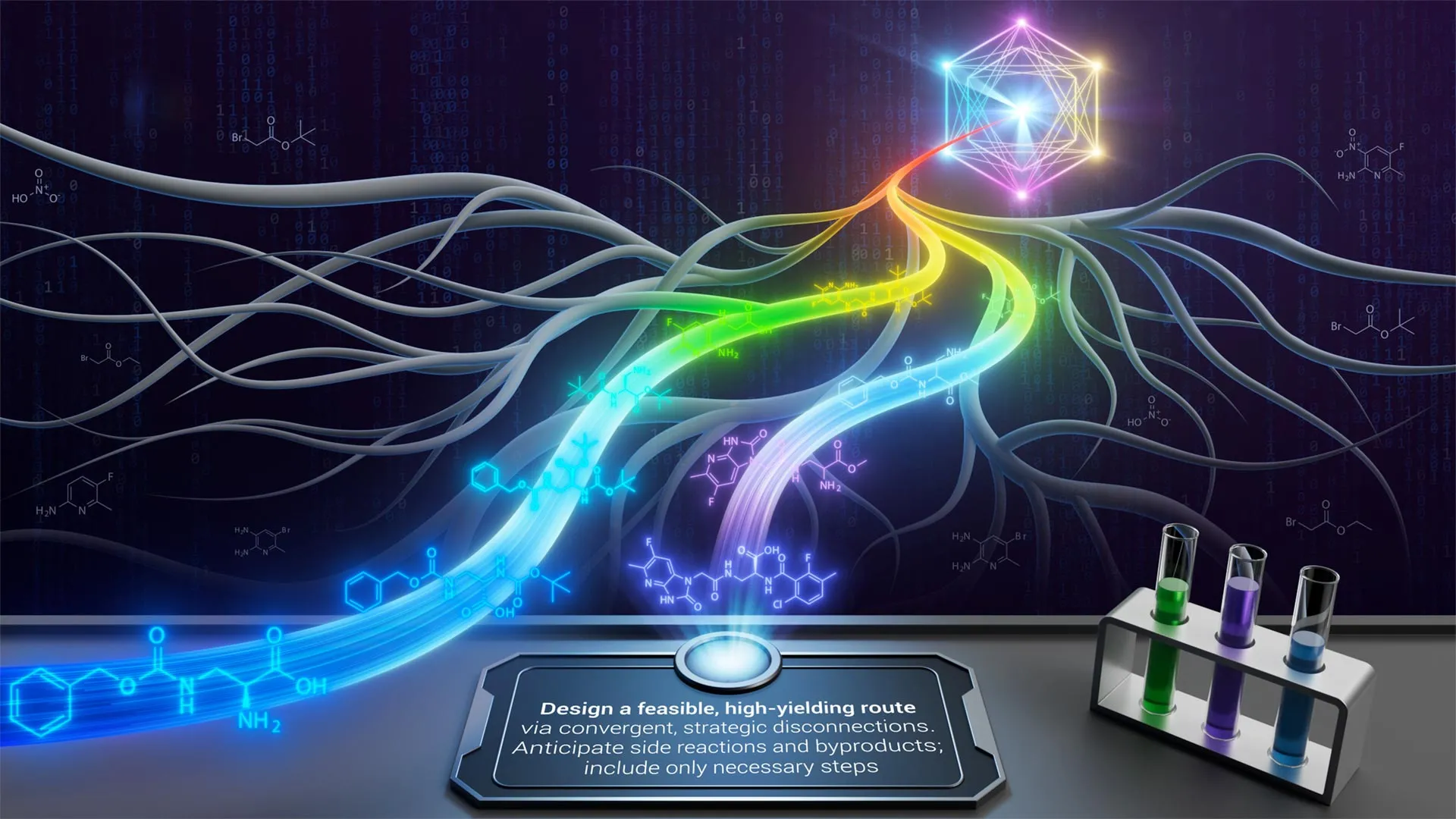
On May 5, 2026, researchers at EPFL published Synthegy in Matter: A hybrid system that combines conventional retrosynthesis search with large language models used as evaluators to steer planning via everyday — language instructions.
A team at École Polytechnique Fédérale de Lausanne (EPFL), led by Philippe Schwaller, has published Synthegy, a framework for chemical synthesis planning, in Matter on May 5, 2026. The authors position Synthegy not as a generator of structures alone but as a way to capture strategic human judgment, enabling chemists to inspect and steer retrosynthetic reasoning and mechanism analysis from a higher — level viewpoint. Andres M. Bran is listed as the paper’s first author.
Synthegy’s user workflow begins with a target molecule and a simple, everyday — language instruction. Existing retrosynthesis software generates many candidate routes; Synthegy translates each route into plain — text descriptions and then uses language models to evaluate how well each option matches the user’s instruction. The team demonstrates directives such as asking for the formation of a specific ring early in a sequence or instructing the system to avoid unnecessary protecting groups.
Architecturally, Synthegy pairs established search algorithms with large language models (LLMs) that serve as reasoning and scoring layers rather than as direct structure generators. In this evaluator role, the LLMs rank and filter routes produced by conventional tools, producing concise textual explanations for why certain pathways score higher. Those explanations are intended to help chemists triage large sets of machine — suggested options more quickly.
The framework extends beyond retrosynthesis into reaction mechanism analysis. Synthegy decomposes reactions into elementary electron — movement steps, explores alternative mechanistic possibilities, and uses the language model to assess the chemical plausibility of each step. Users can also supply additional textual context — for example, specific reaction conditions or expert hypotheses — which Synthegy uses to refine searches toward experimentally realistic pathways.
In internal testing, the system identified routes that aligned with complex strategic instructions from practicing chemists. The authors report a double — blind study involving 36 chemists to validate aspects of their approach. EPFL researchers and first author Andres M. Bran say the natural — language interface shortens iteration cycles and helps chemists navigate more complex synthetic ideas by letting them “just talk” to the planning tools.
For practitioners and tool builders, Synthegy offers a modular way to add human — readable guidance and explanation to existing retrosynthesis engines and mechanism explorers. By preserving the output of established search algorithms while layering LLM-based scoring and traceable explanations, the evaluator pattern aims to inject strategic judgment into route selection and reduce costly trial — and-error in synthesis planning.
Sources
Replies (0)
No replies in this topic yet.
