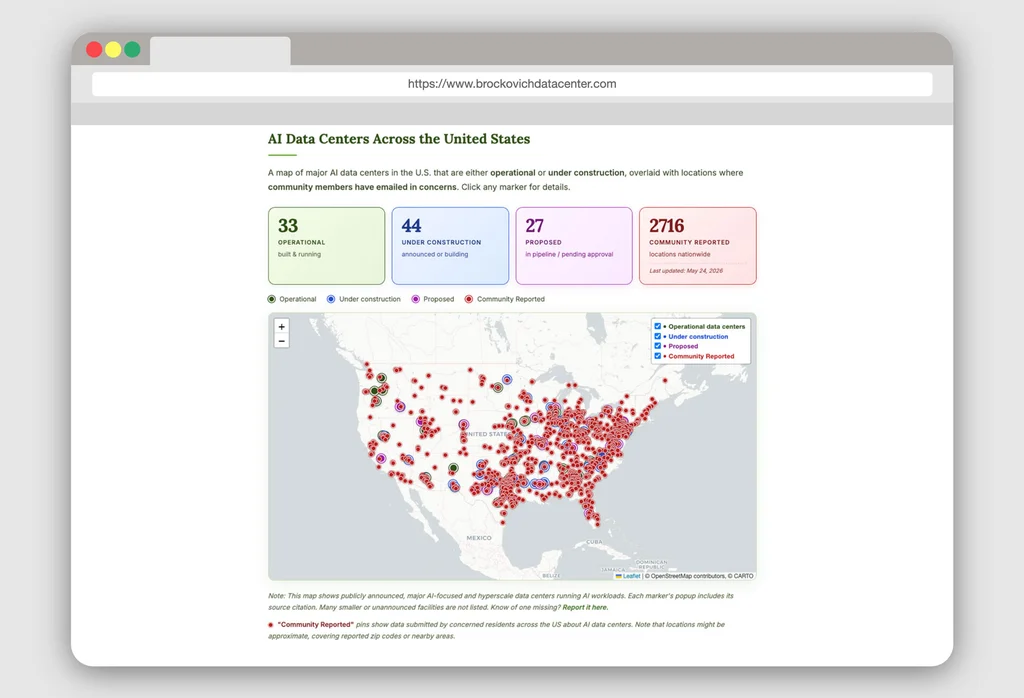
Erin Brockovich has launched the Brockovich AI Data Center Reporting website, a public, crowdsourced map that lists more than 4,000 major AI data centers across the United States and invites residents to "speak up and voice concerns about AI data centers in their communities." The site frames the trend as urgent: "The RACE to build AI infrastructures is unfolding town by town across America," and aims to "capture the real-world footprint" of that expansion.
The map’s crowdsourced reporting component currently contains 2,716 reports and classifies entries as "already operating, under construction, rumored or proposed projects," with a focus on locations where communities are actively voicing concerns. Report counts are concentrated in a few states: Texas leads with 612 entries, followed by Pennsylvania (195), Ohio (155) and Georgia (126), signaling regional hotspots of activity and public reporting.
Scientists and community activists featured around the project warn that large data centers can strain local resources by increasing energy demand and utility bills, tapping water supplies and contaminating local environments. Coverage of a recent Arizona State University study cited by the project also notes that data centers can produce "heat islands," boosting temperatures in already — warm cities by as much as 4 degrees.
For builders and site planners, the map makes visible not only where projects cluster but also reported patterns of conflict, delay and abandonment. Brockovich points out that responses vary: in some places data centers are welcomed, while in others they are delayed, contested or abandoned. That public transparency and organized reporting may complicate future siting, permitting and local resource planning for proposed projects.
Brockovich’s profile as an environmental activist — who rose to public attention after the 2000 film Erin Brockovich and her work on a class — action case that resulted in a $333 million settlement against Pacific Gas and Electric Co.—could amplify attention and mobilization around mapped projects, increasing scrutiny of both proposed and operating AI infrastructure.
Sources
Replies (0)
No replies in this topic yet.
