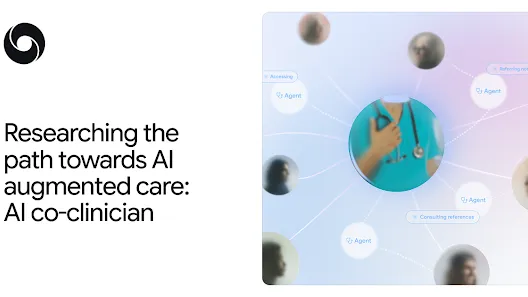
Google DeepMind officially launched its "AI co-clinician" research initiative on April 30, 2026, marking a significant stride towards integrating artificial intelligence more deeply into clinical practice. This ambitious undertaking arrives as health systems globally grapple with immense pressures, striving for better outcomes, lower costs, and an enhanced experience for both providers and patients. The World Health Organization projects a global shortfall of over 10 million health workers by 2030, underscoring the urgent need for scalable solutions that can amplify existing clinical expertise.
The initiative's core lies in developing an AI designed to function as a collaborative member of the care team, interacting with patients under the direct clinical authority of their physician—a model Google DeepMind has termed "triadic care." This vision extends Google DeepMind's prior work in medical AI, which evolved from mastering examination — style tests of medical knowledge with MedPaLM to matching physician performance in text-based simulated medical consultations with AMIE, including in real-world feasibility trials. The goal is to ensure AI agents can bring more support onto the field, extending clinicians' reach while ensuring they retain ultimate judgment and control, thus enhancing the quality, cost, availability, and overall experience of care delivery.
A key aspect of developing such an AI is ensuring its trustworthiness and factual grounding. To achieve this, Google DeepMind extensively designed and evaluated AI co-clinician in both clinician and patient — facing settings. For the clinician — facing evaluations, the "NOHARM" framework was adapted in collaboration with academic physicians to meticulously test for both "errors of commission" (incorrect information) and "errors of omission" (failure to surface critical information). In head-to-head blind evaluations, physicians consistently preferred AI co-clinician’s responses over those from leading evidence synthesis tools, indicating a significant step forward in clinical utility.
Further objective analysis reinforced these findings. Across 98 realistic primary care queries, which were curated from diverse sources and refined by a panel of attending physicians, the AI co-clinician system recorded zero critical errors in 97 cases. This performance notably improved upon two other AI systems widely used by physicians. The rigorous evaluation methodology involved comprehensive background research and the development of query — specific answer metrics, ensuring the assessment reflected the complexities of real-world clinical decision — making and precise characterization of scenario — specific errors.
Beyond synthesizing clinical evidence, the research initiative also focused on the challenging task of enabling AI systems to answer queries about medications and therapeutic interventions with the precision doctors demand. AI co-clinician was evaluated on the OpenFDA RxQA set of questions, a difficult benchmark designed to assess complex medication knowledge and reasoning. The system demonstrated significant progress, surpassing other frontier AI systems, especially when questions were posed in the open-ended manner characteristic of real clinical practice, rather than the multiple — choice format in which even primary care physicians previously scored modestly.
These combined results underscore the potential for advanced AI to provide helpful assistance as clinicians navigate the increasingly data-intensive requirements of care planning and management. While the research shows that AI can mirror human physician proficiency in certain aspects of clinical reasoning, opportunities for further improvement are recognized. The initiative is also investigating how AI co-clinician performs within patient — facing research contexts, including exploring its real-time multimodal capabilities within telemedical settings, suggesting a future where AI plays an even broader role in supporting healthcare delivery.
Sources
Replies (0)
No replies in this topic yet.
