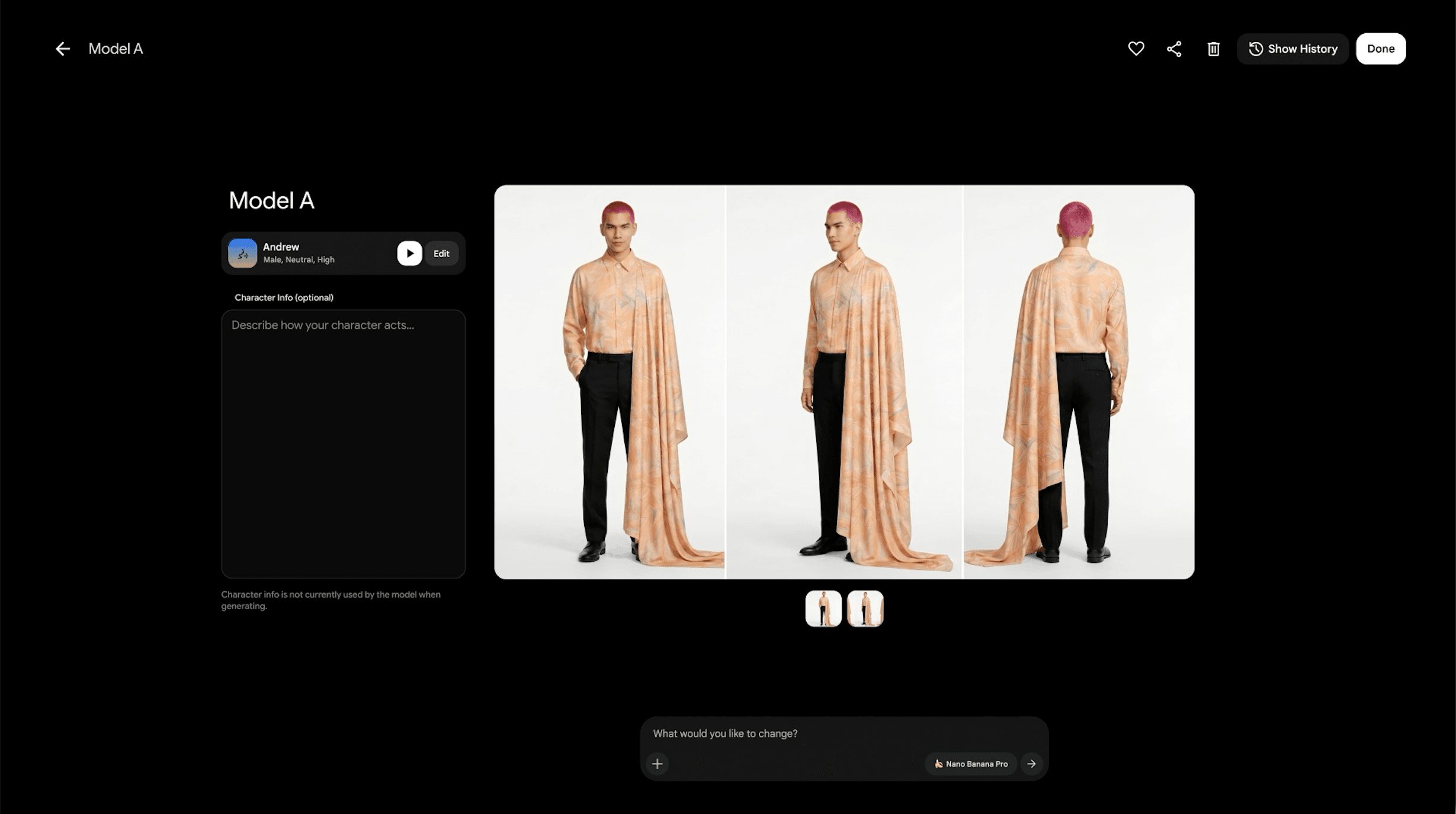
At its I/O developer conference in Mountain View, Google announced a major Flow update adding a selfie — based avatar workflow and a new video — generation model, Omni Flash, so creators can insert scanned likenesses of themselves into AI-generated clips.
At Google I/O in Mountain View, Google unveiled a significant update to Flow that lets creators scan a likeness of themselves and place that avatar into AI-generated video clips. Elias Roman, vice president of product management at Google Labs, demonstrated the new selfie — driven avatar workflow by scanning his face and inserting an AI version of himself into short videos, positioning the feature for creators who want to appear in clips without filming themselves.
The update replaces Flow’s previous video model, Veo, with a new model called Omni Flash. Google says Omni Flash delivers richer detail across clips and greater consistency for generated characters: in demos it reduced the tendency for characters to warp through successive generations and preserved identity details across edits, addressing instability issues that earlier Flow outputs sometimes produced.
Setting up a personal avatar happens in Flow’s settings: users scan a QR code with their phone, record themselves reading a string of numbers, and move their head to capture multiple angles. Google requires that avatars represent only the user who provided the scans; the initial Flow implementation does not permit generating videos of other people. Every video created with Omni Flash in Flow includes Google’s SynthID watermark.
The Flow update also adds creator — oriented workflow tools. Users can repeat custom instructions when generating videos and assemble automated processes — for example, sorting similarly styled clips into folders. In Roman’s demo he generated a lifelike avatar, then asked Flow to change the background and shirt color; Omni Flash applied those edits while maintaining the avatar’s visual and vocal identity.
The release is part of a broader Google push to build explicit creative tools. Flow launched last year under the experimental Google Labs division as an effort to focus on creative work rather than solely productivity or consumption. The selfie — avatar approach echoes recent social — focused experiments: OpenAI’s Sora used a similar selfie — deepfake style before it was shuttered after under seven months, and YouTube Shorts added a limited avatar option last month — moves that underscore competing efforts to give creators more generative — AI tooling.
Sources
Replies (0)
No replies in this topic yet.
