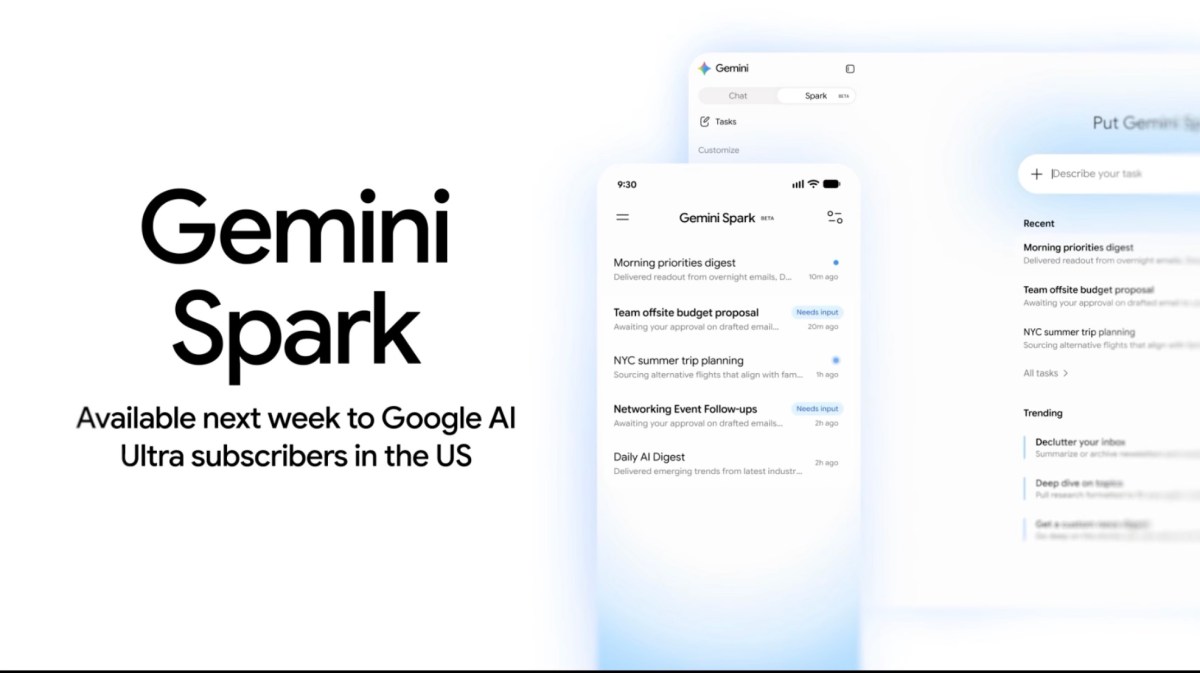
Google introduced Gemini Spark at its I/O developer conference, describing it as an agentic personal assistant designed to handle long-horizon tasks with minimal oversight and carry out actions under user direction. Technically, Spark combines Gemini base models with an agentic harness developed by Google Antigravity and, according to Sundar Pichai, “runs on dedicated virtual machines on Google Cloud,” allowing it to operate continuously without requiring a user’s laptop to stay open. If broadly deployed, Spark could streamline routine multi — step workflows by automating tasks that span email, documents and web interactions.
Spark ships with preconnected integrations across Google Workspace — including Gmail and Google Docs-so users reportedly will not need to set up separate permissions for those services. The agent can also interact with the web through Chrome and is reachable by a dedicated Gmail address, enabling it to ingest and act on email content directly. On mobile devices, Google plans to surface Spark’s activity through Android’s new Halo system to give users visibility into in-progress tasks.
Google said it will expose Spark to other services via its MCP interface and expects to add more third — party connections in the coming months, expanding the agent’s ability to operate across external apps and services. That roadmap signals an intent to move beyond native Workspace workflows and let Spark access broader web and app ecosystems under user authorization. The company positioned Spark against other agentic offerings, naming products such as Anthropic’s Claude Cowork and OpenAI’s ChatGPT agent as market peers. Google emphasized a potential competitive edge: native access to users’ emails and Workspace data that can reduce friction for common workflows like drafting and coordinating around documents and messages.
Spark is currently being tested internally, and Google expects to make the agent available to Google AI Ultra subscribers next week. Google Labs vice president Josh Woodward outlined practical use cases, including drafting status emails by pulling facts from mail, docs, sheets and slides, and enabling small businesses to monitor customer inboxes. Those examples illustrate the kinds of continuous, cross — document tasks Google sees Spark handling as it moves from internal testing toward public availability.
Sources
Replies (0)
No replies in this topic yet.
