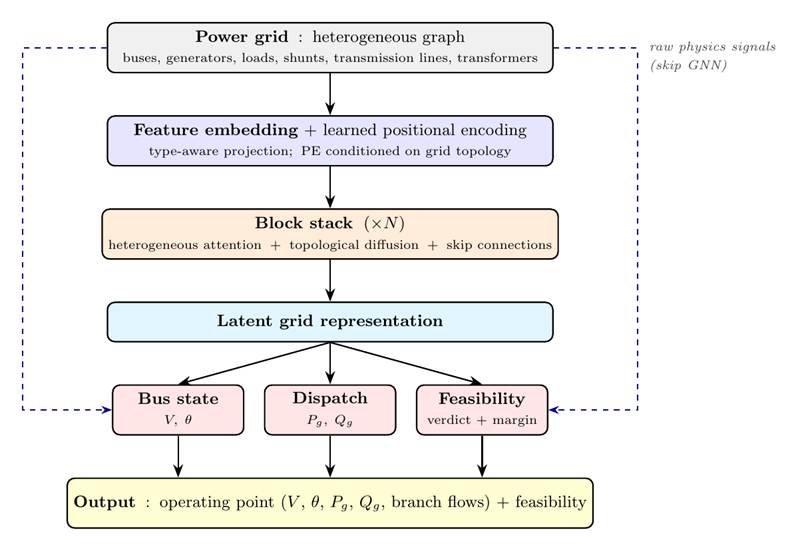
A new foundation model, GridSFM, approximates AC optimal power flow (AC‑OPF) for transmission grids in milliseconds, producing full AC system states rather than only dispatch numbers. That faster turnaround gives operators immediate visibility into congestion, voltage and stability indicators and includes a feasibility verdict showing whether physical and operational constraints are satisfied — a capability that can enable many more real‑time scenario evaluations and faster operational decisions.
GridSFM accepts standard AC‑OPF inputs — grid topology, generator and load specifications, and transmission line constraints — and returns an operating point, cost estimates and a feasibility outcome. Unlike black‑box dispatch predictors, it outputs the underlying system state, allowing direct interpretation of flows, voltages and potential constraint violations that matter for dispatch, market clearing and contingency planning.
The model targets systems from 500 to 80,000 buses and is offered in two tiers: an “Open for research” tier that scales up to 4,000 buses for experimentation, and a “Premier for production” tier that scales up to 80,000 buses for large transmission systems. This two‑tier rollout is intended to provide both a research sandbox and a production path without forcing groups to rebuild datasets or models from scratch.
Architecturally, GridSFM is implemented as a block‑structured discrete neural operator that represents the power system as a directed graph — buses and generators as vertices, transmission and AC lines as edges. Training pairs solver supervision (reference solutions produced with IPOPT via PowerModels.jl) with physics‑based penalty terms that enforce Kirchhoff’s voltage and current laws and operating constraints such as thermal limits, enabling the model to learn from both feasible and infeasible regimes while preserving physical fidelity.
The release addresses a core computational bottleneck in grid operations: AC‑OPF is a non‑convex optimization that computes the least‑cost generator dispatch subject to power‑flow physics, voltage limits, thermal constraints and stability conditions. Exact AC‑OPF solves at utility scale can take up to hours, forcing operators to limit scenario counts or rely on simpler approximations that can misestimate flows and binding constraints under stress.
Those misestimates carry substantial system‑level consequences: the source cites roughly $20 billion per year in congestion costs and about 3.4 terawatt‑hours of renewable curtailment tied to suboptimal dispatch and congestion. By delivering millisecond inference and enabling orders of magnitude more scenario evaluations in real time, GridSFM aims to shift operations from reactive responses toward proactive optimization that can better inform dispatch, market clearing and contingency planning.
GridSFM follows an earlier open transmission‑topology dataset release and is offered as a foundation for the research and engineering community to build advanced power‑grid simulators and planning tools. The combination of solver supervision and physics penalties is designed to preserve physical realism while providing rapid inference, supporting both experimentation at research scale and production deployment on large transmission systems.
Sources
Replies (0)
No replies in this topic yet.
