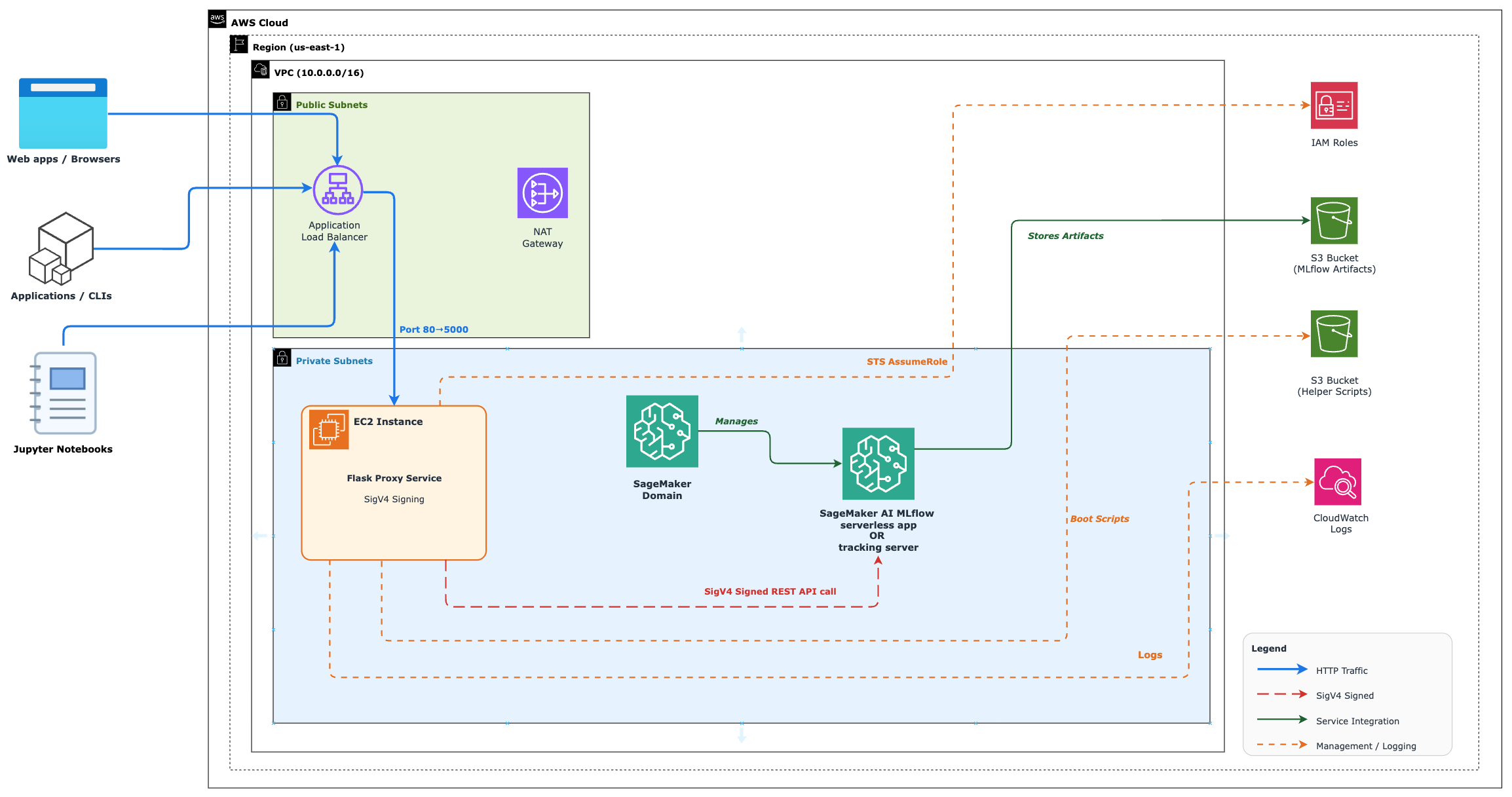
A new technical guide demonstrates how to give legacy enterprise systems HTTPS access to Amazon SageMaker MLflow without requiring the MLflow SDK on client machines, enabling teams to keep existing corporate networking, SSL/HTTPS requirements, and security controls while using SageMaker's MLflow capabilities. This approach matters for organizations migrating to the cloud that need to preserve compliance, firewall rules, and minimal client — side changes.
The reference architecture centers on three components: an Application Load Balancer (ALB) to handle incoming HTTPS traffic and optional custom domains, a Python Flask — based MLflow proxy that intercepts and transforms requests, and the Amazon SageMaker MLflow service as the backend. The guide also notes SageMaker MLflow supports two deployment modes — MLflow Tracking Server and MLflowApp (a serverless MLflow application)—which provide backend metadata and model storage for experiments.
Request flow is described step-by-step: clients send HTTPS requests to the ALB, which can provide SSL termination and route traffic to the proxy. The Flask proxy then performs IAM-based authentication, rewrites incoming URLs into the required AWS API paths, and pre-signs requests before forwarding authenticated calls to SageMaker MLflow. Responses from SageMaker are routed back through the proxy to the original client, keeping the client interaction strictly HTTPS.
On the proxy side, responsibilities include managing AWS authentication and request signing, transforming incoming URLs into signed AWS API calls, and mapping MLflow REST API endpoints to SageMaker operations. The implementation is presented as lightweight and Python — based so that the complexity of AWS request construction is handled server — side, reducing per-client implementation and maintenance overhead.
Security and integration considerations receive focused treatment in the walkthrough: it shows how to configure AWS Identity and Access Management (IAM) for secure proxy permissions, how to use pre-signed URLs to control resource access, and how to preserve existing enterprise security patterns. While the example uses an ALB for routing and SSL termination, the authors note that other routers such as Nginx can be substituted to fit infrastructure requirements.
For builders, the practical implications are concrete: exposing standard HTTPS endpoints lets non — SDK clients interact with SageMaker MLflow, helping teams meet compliance and networking constraints, integrate with legacy enterprise systems, and lower the operational burden of distributing and updating SDKs. The proxy effectively acts as a bridge that transforms ordinary HTTPS requests into authenticated AWS calls that SageMaker MLflow can process.
Sources
Replies (0)
No replies in this topic yet.
