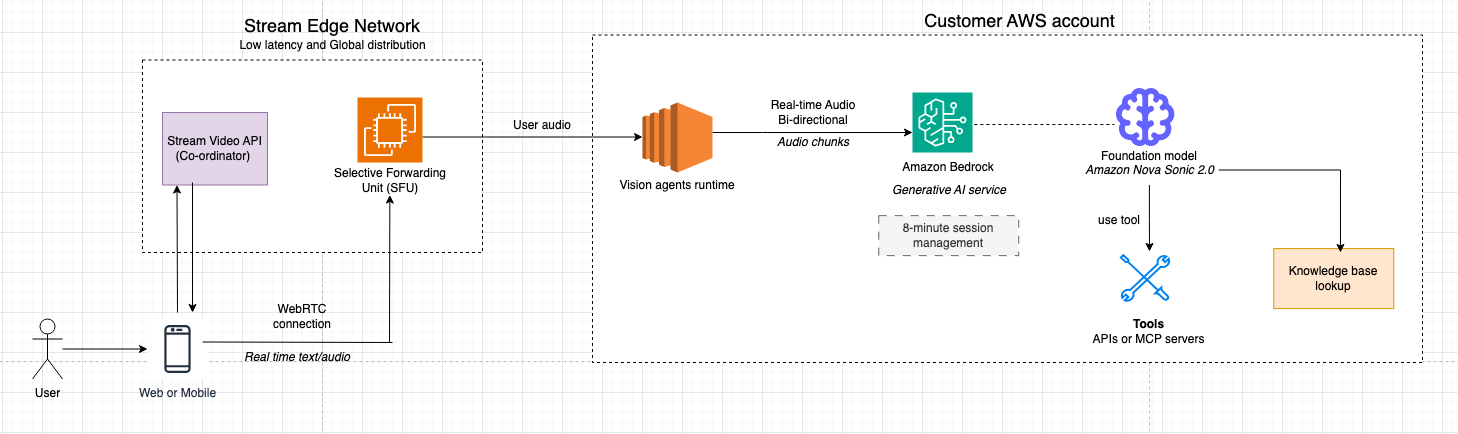
A technical guide details how to integrate Stream’s Vision Agents open‑source framework with Amazon Nova 2 Sonic on Amazon Bedrock and Stream’s global Edge Network to produce low‑latency, production‑grade real‑time voice agents. The walkthrough presents an end‑to‑end integration, complete with runnable code examples and patterns for deploying interactive voice applications across web, mobile and desktop clients. This matters because the stack targets common engineering barriers that slow voice agent rollouts.
The integration stacks three primary components. Amazon Nova 2 Sonic, hosted via Amazon Bedrock, provides a speech‑to‑speech foundation model that supports real‑time bidirectional audio streaming, native turn detection and function calling. Stream’s Vision Agents supplies an extensible Python framework with a plugin architecture, more than 25 integrations and client SDKs for React, iOS, Android, Flutter and React Native. Stream’s Edge Network acts as the real‑time transport layer between clients and models.
The guide focuses on practical engineering challenges the stack is designed to solve. It explains how to coordinate speech‑to‑text (STT), language model inference and text‑to‑speech (TTS) without excessive handoffs, while keeping end‑to‑end latency below perceptible thresholds. The post also addresses unreliable networks, browser compatibility, session timeouts and WebRTC lifecycle management, showing how Vision Agents abstracts provider‑specific RTC details to reduce boilerplate for reconnection and session handling.
Amazon Nova 2 Sonic is presented as handling the full speech pipeline so teams can avoid running separate STT and TTS services; it also exposes function calling and supports native turn detection to preserve conversational flow. Stream’s Edge Network is cited for performance characteristics — typical sub‑500 ms join times and under 30 ms audio latency — while Vision Agents ties model outputs to client SDKs and backend glue code, simplifying integration work for developers.
For builders, the combined stack promises faster time to production and fewer bespoke infrastructure components. The guide demonstrates patterns for automatic reconnection, function calling workflows, multilingual voice support and integration with telephony or API‑driven actions. Each pattern is accompanied by code snippets that can be executed to reproduce the setup and to extend it for specific use cases.
The examples and deployment notes emphasize extensibility and cross‑platform reach: teams can reuse the same Vision Agents workflows across web, mobile and desktop apps and adapt plugins or SDKs as their use cases evolve. The walkthrough highlights sample applications such as support agents and workflow automation to illustrate how the stack reduces custom plumbing and accelerates real‑world deployments.
Sources
Replies (0)
No replies in this topic yet.
