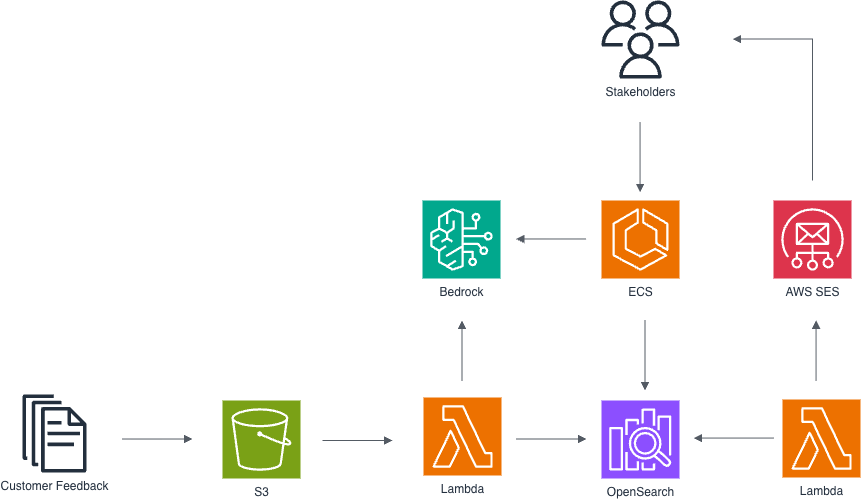
Hapag‑Lloyd’s Digital Customer Experience and Engineering team has replaced a biweekly, spreadsheet — driven feedback review with an automated pipeline that turns raw customer comments into actionable insights for product managers. Where PMs once exported CSVs and spent hours or days labeling sentiment and grouping themes, the new workflow collects feedback automatically, applies AI to produce sentiment labels, thematic clusters and concise summaries, and delivers results through an application layer so teams can act more quickly on user input.
The AI layer uses a foundations — as-a-service model offering multiple high-performing models from third‑party and Amazon providers, combined with open-source orchestration tools such as LangChain and LangGraph. Engineers assemble prompt chains and select models tailored to tasks like summarization and theme extraction while keeping model access and billing centralized. This architecture lets the team balance accuracy, cost and latency by choosing the most appropriate model for each step of the pipeline.
Operationally, the change reduces time-to-insight and removes repetitive analysis work from product teams. Automated triage and summarization free PMs to focus on strategy, experimentation and UX improvements instead of manual categorization. The company positions the implementation as a move toward becoming AI-native, embedding AI as a core capability to accelerate product delivery and increase customer value.
The implementation follows an AWS-centric design with serverless and container components: ingestion runs in AWS Lambda reading files from Amazon S3; AI inference is routed through a foundation — model service; indexing and query capabilities are provided by Elasticsearch; and stakeholder access is served by containers on Amazon ECS. The pipeline also supports email notifications, queryable indexes for ad-hoc exploration and reporting, and structured logging to support review ceremonies and traceability of analysis results.
Hapag‑Lloyd frames the project against its global scale: a modern fleet of 313 container ships with roughly 2.5 million TEU transport capacity, 3.7 million TEU container capacity overall, about 14,000 employees in liner shipping, and offices in more than 140 countries supporting 133 liner services to over 600 ports. That scale produces a steady stream of customer comments, making an automated, scalable feedback — processing system valuable for timely product and service decisions.
Sources
Replies (0)
No replies in this topic yet.
