Cybersecurity startup LangGuard has deployed a real-time governance engine to monitor and secure autonomous artificial intelligence systems, marking one of the first production deployments of Databricks’ new Lakebase infrastructure. The integration addresses a critical bottleneck in generative artificial intelligence adoption. According to a November 2025 McKinsey survey titled The State of AI in 2025, fewer than ten percent of companies have successfully scaled autonomous AI agents into production within any business function. This widespread failure stems not from a lack of ambition, but from an invisible governance gap created when agents generate their own logic at runtime and bypass traditional security controls.
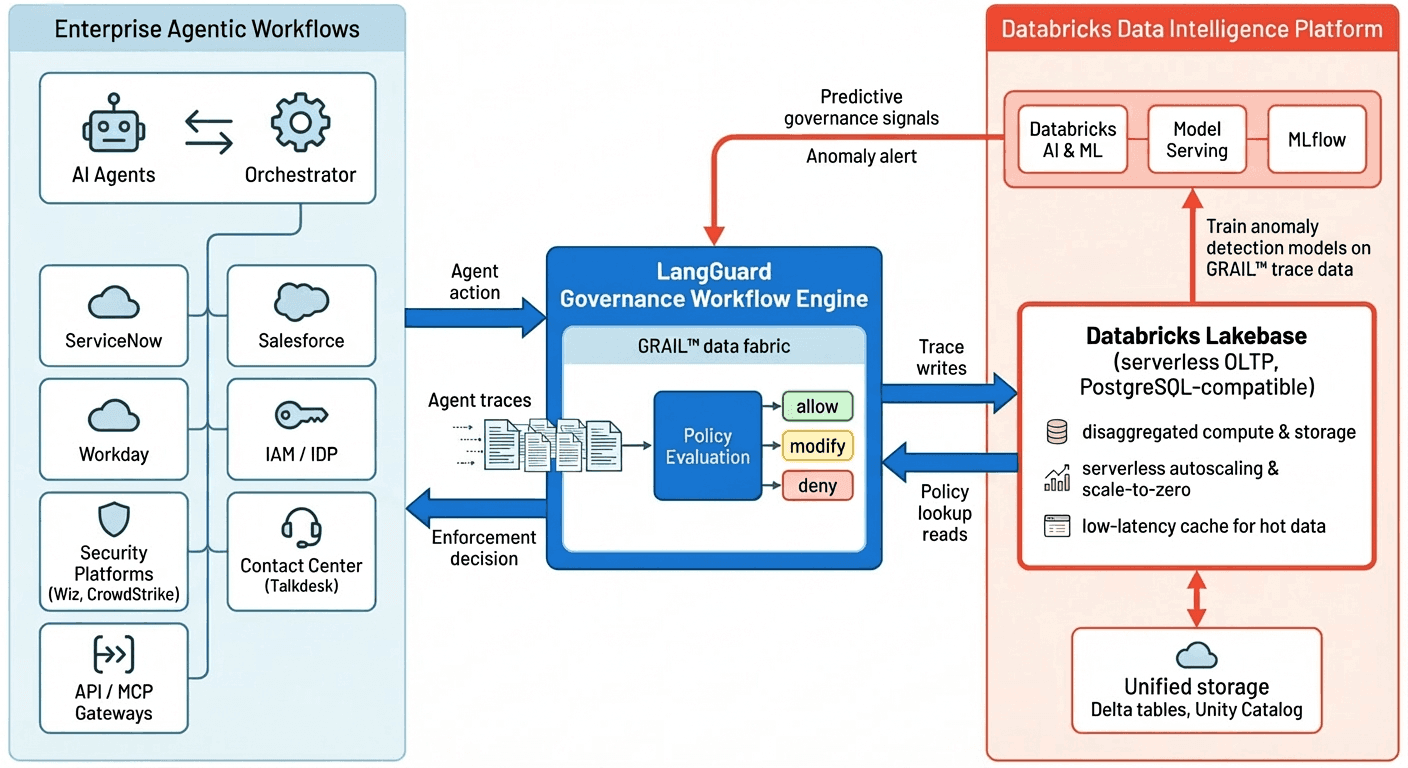
To close this security gap, LangGuard introduced a patent — pending runtime enforcement layer powered by its proprietary data fabric, Governance AI Run-time Links, or GRAIL. This architecture captures every agent action as multidimensional trace data to construct a live knowledge graph of workflow behavior and context. When an autonomous agent attempts to invoke a tool, access a dataset, or call a foundation model, the system evaluates the action against established policies before execution. This process operates in continuous synchronization with Databricks’ Unity Catalog and AI Gateway, which serve as the unified systems of record for enterprise data, models, and access policies.
Managing these autonomous operations in real time is highly complex due to the vast scale of modern enterprise deployments. A single agentic workflow might involve dozens of coordinated agents, hundreds of tool invocations, and policies managed across fifteen or more distinct enterprise systems of record. These integrations frequently span IT ticketing software like ServiceNow, customer relationship management platforms such as Salesforce, human resources systems like Workday, and cloud security tools including Wiz and CrowdStrike. Governing these varied touchpoints without introducing latency that degrades agent performance requires purpose — built infrastructure capable of evaluating every policy decision instantaneously.
The necessity for low-latency, highly scalable operations led LangGuard to build upon Databricks Lakebase, the industry's first fully managed, serverless Postgres database constructed on the lakehouse architecture. Traditional databases couple compute and storage, forcing companies to provision and pay for peak capacity continuously. Lakebase resolves this inefficiency by fully decoupling compute from storage, allowing the system to scale to zero between unpredictable bursts of operational security data. Additionally, the platform provides low-latency query execution for hot operational data and instant database branching to enable the safe testing of new governance policies before they are deployed to live environments.
The architectural decisions behind this deployment were heavily influenced by the LangGuard development team's extensive background in enterprise security. The engineers previously spent years building IBM QRadar, a widely deployed Security Information and Event Management platform recognized as a multiple — time Gartner Magic Quadrant leader. Drawing from their experience engineering a system that ingests and correlates petabytes of security telemetry daily, the team understood that traditional infrastructure could not meet strict reliability requirements without excessive costs. By utilizing Lakebase, LangGuard secured a database framework capable of handling millisecond — level decision latency while eliminating unacceptable spending on idle server capacity.
Sources
Replies (0)
No replies in this topic yet.
