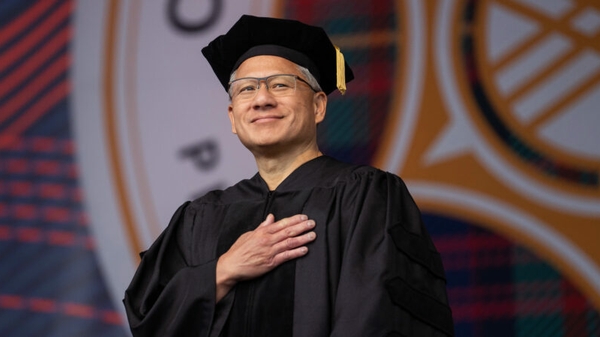
NVIDIA founder and CEO Jensen Huang delivered the keynote at Carnegie Mellon’s 128th commencement, telling the Class of 2026 that AI ushers in a new industrial era and urging graduates, builders and policymakers to advance capabilities alongside safety.
Jensen Huang, founder and CEO of NVIDIA, delivered the keynote to Carnegie Mellon University’s Class of 2026 at the school’s 128th commencement on Sunday, addressing thousands at Gesling Stadium on a rainy morning. Wearing academic regalia, Huang acknowledged the crowd, asked graduates to wish their mothers a happy Mother’s Day, and framed his remarks around a single claim: this is the beginning of an AI-driven industrial era, and the careers of today’s graduates start with that revolution.
Huang compared artificial intelligence to previous platform shifts — personal computers, the internet, mobile and cloud — arguing that the current moment marks a distinct new industry and a new era of science. He told graduates that no prior cohort had entered the world with “more powerful tools,” and said intelligence will become foundational across every industry, not just within computing. On infrastructure and the economy, Huang called AI the driver of the largest technology infrastructure buildout in human history and described it as a once-in-a-generation opportunity to reindustrialize America and restore manufacturing and building capacity. That buildout, he said, will create demand across a wide range of trades and technical roles by making intelligence broadly accessible.
Huang named examples of workers who could benefit as intelligence spreads — electricians, plumbers, ironworkers and technicians — and argued that democratizing AI could extend opportunity beyond traditional tech occupations. His point was that new capabilities should translate into broader economic participation, not just concentrated gains for a few sectors. Addressing practical workforce impacts, Huang said AI tends to automate specific tasks while elevating the purpose of jobs. He pointed to radiology as an example: AI can automate the task of reading scans, allowing clinicians to devote more of their time to patient care. He urged graduates to engage deeply with AI so they can press any advantage the new era offers.
Turning to governance and safety, Huang called for a simultaneous, clear — eyed push on multiple fronts: advancing capabilities safely, creating thoughtful public policy, making AI broadly accessible and encouraging widespread engagement. He appealed directly to scientists and engineers to pair capability work with safety work, and asked policymakers to design guardrails that protect society without stifling innovation. Huang closed by describing the moment as a rare opening for graduates and builders to shape what comes next, combining an invitation to participate in infrastructure and industry rebuilds with a call for responsibility from technical and policy communities alike.
Sources
Replies (0)
No replies in this topic yet.
