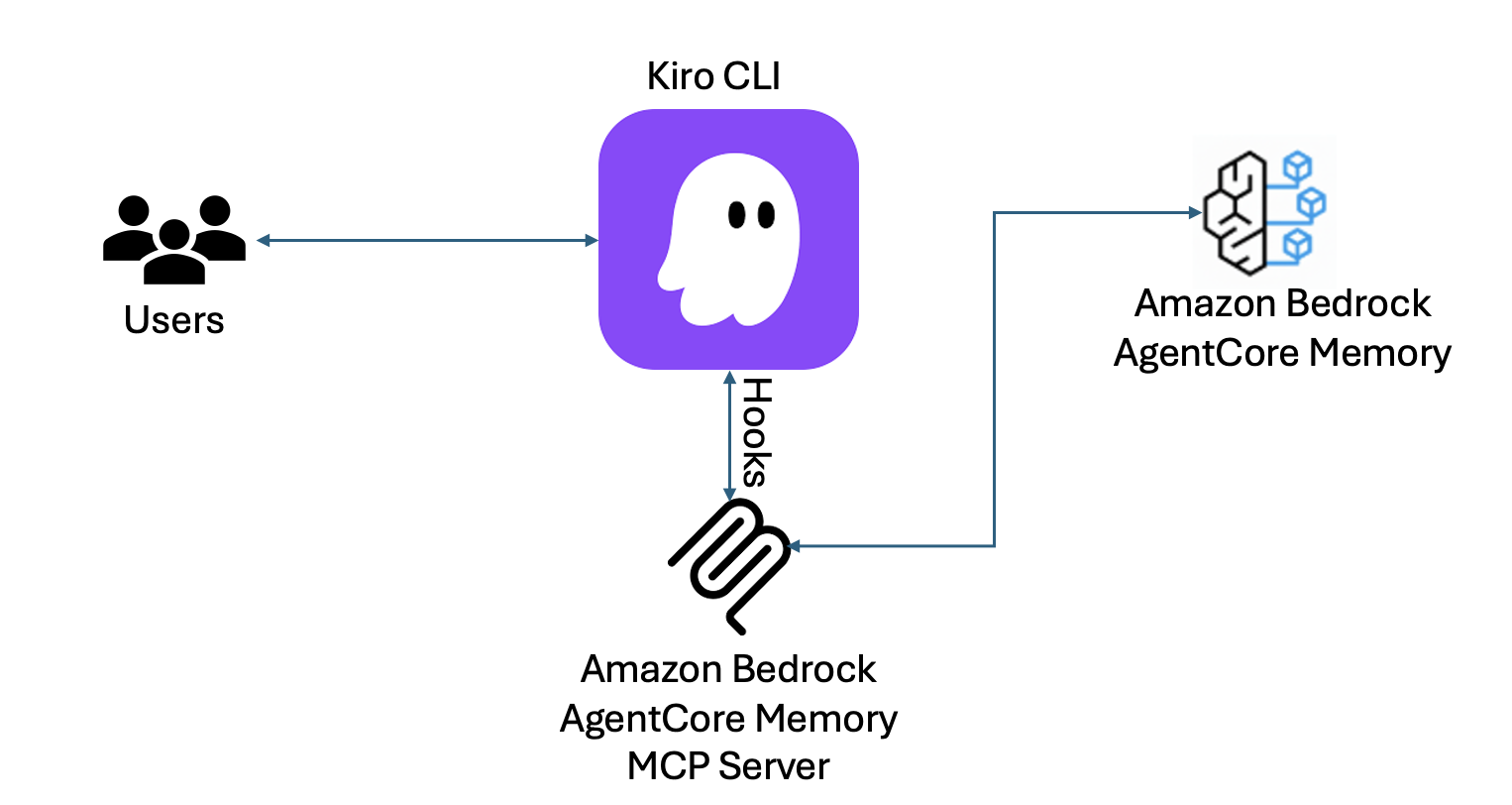
A technical walkthrough and sample repository show how to add session — persistent conversational memory to Kiro CLI by implementing a custom Model Context Protocol (MCP) server that interfaces with Amazon Bedrock AgentCore Memory.
Kiro CLI can now persist terminal agent conversations by routing memory operations through a custom Model Context Protocol (MCP) server that uses Amazon Bedrock AgentCore Memory as the backend, enabling terminal — based AI agents to recall prior interactions, preferences, and project details across sessions. This matters for developers who rely on terminal agents for ongoing workflows — persistent memory reduces repeated context setup and helps agents behave more consistently over time.
The implemented solution has three cooperating parts. Amazon Bedrock AgentCore Memory serves as the persistent store, offering built — in semantic search plus support for short — term and long-term memory. A custom MCP server exposes AgentCore Memory operations through the MCP interface. Kiro CLI connects to that MCP server over STDIO to save and retrieve conversation history, with the MCP server grouping accessible operations into conversation, monitoring, and management categories for runtime use.
Conversation tools on the MCP server let users search history by topic or timeframe, store conversations with session tracking, retrieve full conversation content, and list stored sessions. Monitoring tools surface memory usage statistics and MCP server configuration so builders can observe usage and performance. Management tools enable deleting individual sessions or purging stored data when needed. Implementing those tool groupings on the MCP server makes memory operations available to any MCP-compatible client without changing the clients themselves.
To keep stored conversations findable even while semantic indexing is in progress, the walkthrough documents a two-stage retrieval strategy. The server first performs a semantic lookup using the retrieve_memory_records API to return conceptual matches. If semantic results are insufficient, it falls back to event — level content matching that scans raw conversation payloads stored in sessions. That cascading approach supports natural prompt timeframes such as “recent,” “last night,” or “yesterday,” and reduces the chance of losing access to recent conversational context during semantic processing.
Practical prerequisites for following the guide include an AWS account with AWS CLI access, an IAM user configured with least — privilege permissions, an AWS Builder ID, and a configured Kiro CLI on the developer machine. The sample repository, named sample — amazon-bedrock-agentcore-memory-mcp-server, includes terminal steps showing how to clone the code, create a Python virtual environment, and install dependencies as part of the demo.
For builders, the pattern positions the MCP server as a reusable bridge that allows MCP-compatible tools to leverage managed agent memory: it preserves both working memory and long-term insights for agentic IDE workflows and large codebases, exposes monitoring and management APIs for tracking and cleaning stored data, and uses a two-stage retrieval design to improve reliability of conversational recall.
Sources
Replies (0)
No replies in this topic yet.
