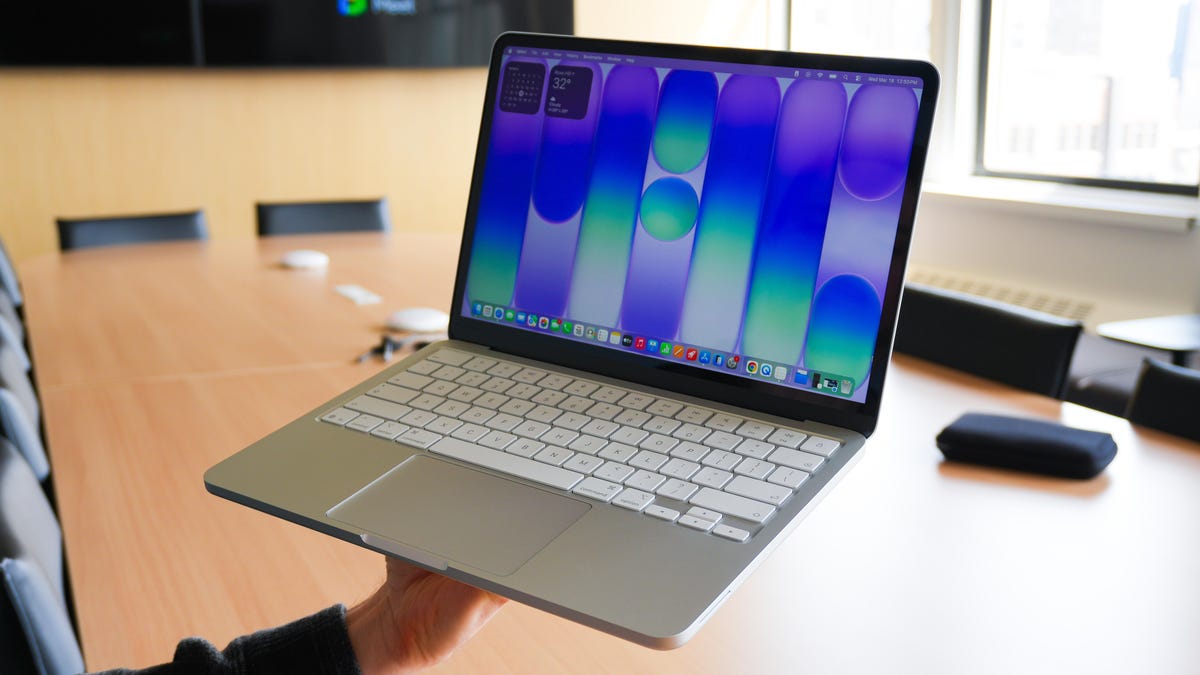
Apple’s $599 MacBook Neo, released in March 2026, has sold faster than the company projected and produced backorders on Apple’s official store, immediately reshaping expectations for sub‑$600 notebooks. That brisk demand matters because it establishes a new baseline for value and finish at the entry level, forcing PC vendors and Chromebook makers to respond if they want to compete for budget buyers.
On paper the Neo’s appeal is straightforward: it pairs a sub‑$600 price with what reviewers describe as Mac‑class qualities. The laptop uses Apple’s A18 Pro chip (a 2024 model), and early coverage frames its performance as punching above its price point. Competing Windows machines now appearing at similar tags seek to match headline specs but not always the overall package.
A concrete example is LG’s Gram Book 15, listed at $599 with 8GB of RAM, 512GB of storage and an Intel Core Ultra 5 115U drawn from Intel’s 2024 Meteor Lake family. The Gram Book 15 advertises a broader complement of ports than the Neo, illustrating how rivals are trying to carve out differentiation through connectivity and conventional PC features even at the same price.
But the broader budget PC market still shows familiar weaknesses the Neo highlights: many low‑end laptops ship with lower‑resolution displays, cheaper plastic chassis instead of metal, and modest processors that leave day‑to‑day performance unimpressive. Early comparisons place several existing Windows laptops and Chromebooks beneath the Neo on perceived value and fit‑and‑finish, making the Neo a new reference point for what a $600 notebook should deliver.
Microsoft and OEM partners appear to be preparing follow‑ups, and coverage has identified a small set of new Windows laptops and Chromebooks as potential rivals. Commentary also suggests Google may be better positioned to respond: Chrome OS devices already compete at aggressive price points and can offer a cohesive low‑cost experience without trying to match full macOS hardware parity.
For builders and OEMs the immediate implication is practical: winning on paper with matching RAM and storage won’t be enough. Vendors will likely need to improve display quality, upgrade materials and prioritize real‑world processor performance, plus consider ports and ergonomics, to close the gap with the Neo. The device’s strong sales and backorders signal clear consumer appetite for higher‑quality, lower‑priced notebooks and raise expectations for chassis, screens and usable speed in the $600 tier.
Sources
Replies (0)
No replies in this topic yet.
