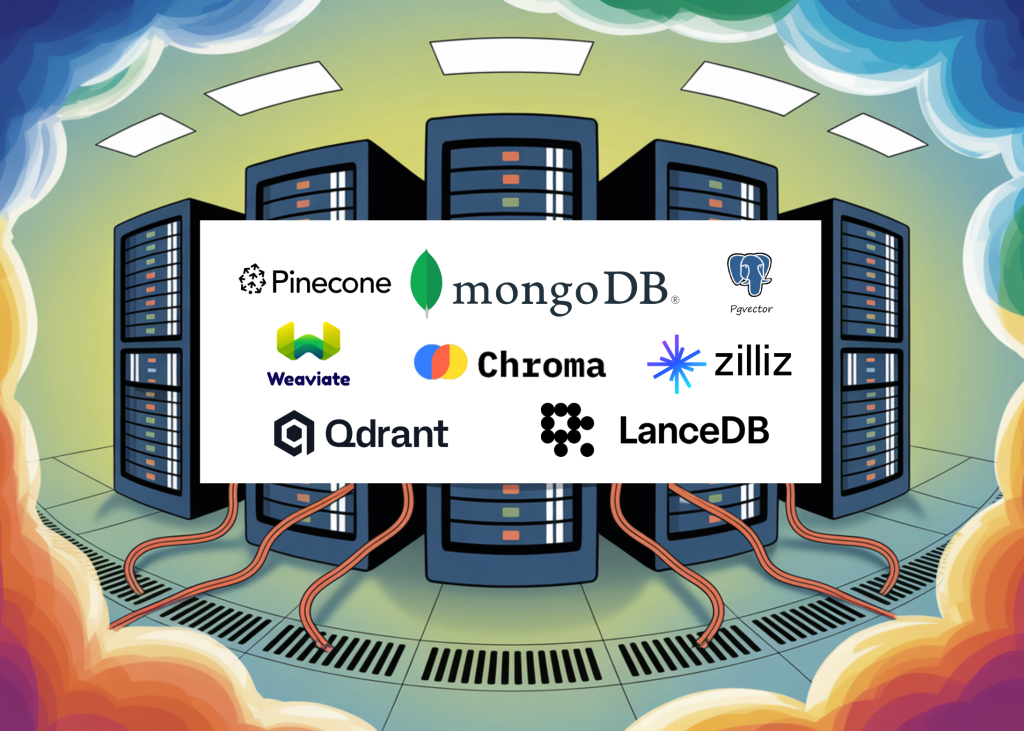
An updated May 2026 guide compares nine production vector databases across architecture, pricing, scale and operational tradeoffs, highlighting concrete limits and recent product changes that affect RAG, semantic search and agentic AI deployments.
An updated May 2026 guide compares nine production vector databases and concludes that vector stores have become a core retrieval layer for RAG pipelines, semantic search and agentic AI. The review frames the vendor and architecture choice as a tradeoff among scale, cost and operational complexity, not an optional add‑on — a practical distinction as enterprises push LLMs into production.
The report captures concrete product details for managed and managed/OSS providers. Pinecone (managed) lists free, $20, $50 and $500‑minimum tiers, supports billions of vectors, added a $20/mo Builder tier in 2026, and shipped Nexus and KnowQL during a May 2026 launch week. Milvus / Zilliz Cloud (OSS + managed) targets 100B+ vectors using the Cardinal engine, which the vendor says delivers roughly 10× throughput versus HNSW and 3× faster index builds. Qdrant (Rust native) offers a free tier, cites self‑host economics around $30–$50/mo, and raised a $50M Series B in March 2026.
Platform differences that affect integrations are highlighted as well. Weaviate emphasizes hybrid BM25 plus dense search and changed its paid tiers, making Flex a $45/mo minimum after retiring a $25 tier in October 2025. pgvector is a PostgreSQL extension (free) recommended for teams under roughly 10 million vectors; it supports HNSW and IVFFlat indexing while retaining full ACID behavior. MongoDB Atlas Vector Search provides an M0 free tier (512MB), a Flex cap tier ($0–$30/mo, GA February 2025), dedicated tiers starting around $57/mo, HNSW indexing up to 4,096 dimensions, and an Automated Embedding option (Voyage AI).
For prototyping and alternative architectures the guide calls out Chroma and LanceDB. Chroma (OSS + cloud) is positioned as the fastest path from zero to a working LLM app-it runs in‑process or client/server and targets small‑to‑medium scale use cases. LanceDB (OSS + cloud) is presented as a serverless, object‑storage (S3/GCS) backed option with a columnar on‑disk format designed for multimodal retrieval and lower operational overhead.
The market context explains why these distinctions matter. The vector database market was pegged at $1.97B in 2024 with a projected $10.6B by 2032 (CAGR ≈ 23.38%). As organizations embed LLMs into software, builders face explicit choices: fully managed services reduce ops burden but raise recurring costs; OSS or PostgreSQL‑native options limit vendor lock‑in at the expense of infra work; and object‑storage approaches alter cost profiles for serverless deployments.
The guide closes with concrete recommendations for engineers and architects: use pgvector for sub‑10M vectors inside PostgreSQL; Qdrant or Chroma for low‑cost, fast prototyping; Milvus / Zilliz Cloud for GPU‑accelerated, 100B+ deployments; Pinecone for turnkey billion‑vector managed use; and LanceDB when serverless, multimodal retrieval on object storage is a priority. It also flags indexing engines (HNSW, IVFFlat, Cardinal) and dimensional limits (for example MongoDB’s 4,096 dims) as key operational knobs that will materially affect latency, throughput and cost.
Sources
Replies (0)
No replies in this topic yet.
