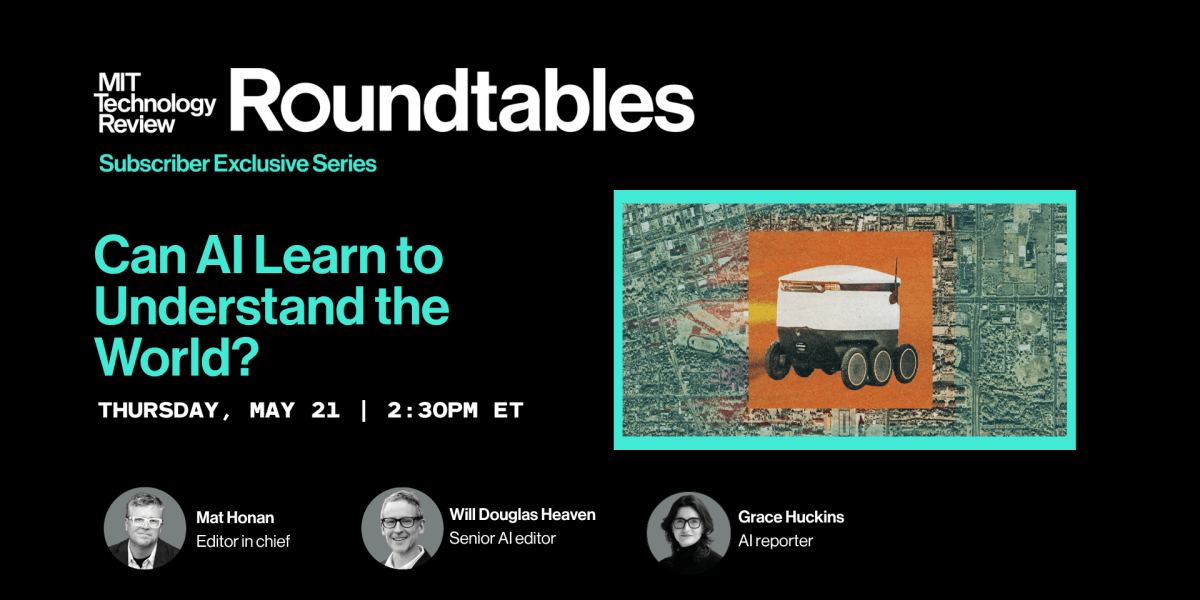
On May 21, 2026 a recorded roundtable convened Mat Honan (Editor in Chief), Will Douglas Heaven (AI Senior Editor), and Grace Huckins (AI Reporter) to examine efforts to give AI systems grounded, persistent models of the external world. Panelists framed these so‑called "world models" as a technical strategy to move beyond the prediction‑based limits of current large language models and to make systems more capable of reliable action in physical environments.
If the approach succeeds, practitioners in robotics, mapping and delivery systems would be among the first to see practical changes. The session is available to listen to or watch and it referenced several related pieces, including the features "How Pokémon Go is giving delivery robots an inch‑perfect view of the world," "10 Things That Matter in AI Right Now: World Models," and "Yann LeCun has a bold new vision for the future of AI." Access to the audio/video and some coverage was noted as limited to alumni and subscribers.
Speakers situated their discussion against broader signals about the pace and stakes of AI development. They cited Stanford’s 2026 AI Index, which reports accelerating progress and rising difficulty in keeping pace with advances, and observed that world models have moved toward the center of both technical and policy debate. The roundtable was presented alongside reporting on competitive and governance tensions in the sector, underscoring the subject’s prominence.
Rather than making definitive claims, the panel explored practical implications. They suggested that if world models can deliver persistent, actionable representations of physical environments, systems could navigate, map and manipulate the real world more reliably. The conversation cast world models as a potential route to address key shortcomings of LLMs while flagging outstanding questions about real‑world deployment, access and oversight.
Sources
Replies (0)
No replies in this topic yet.
