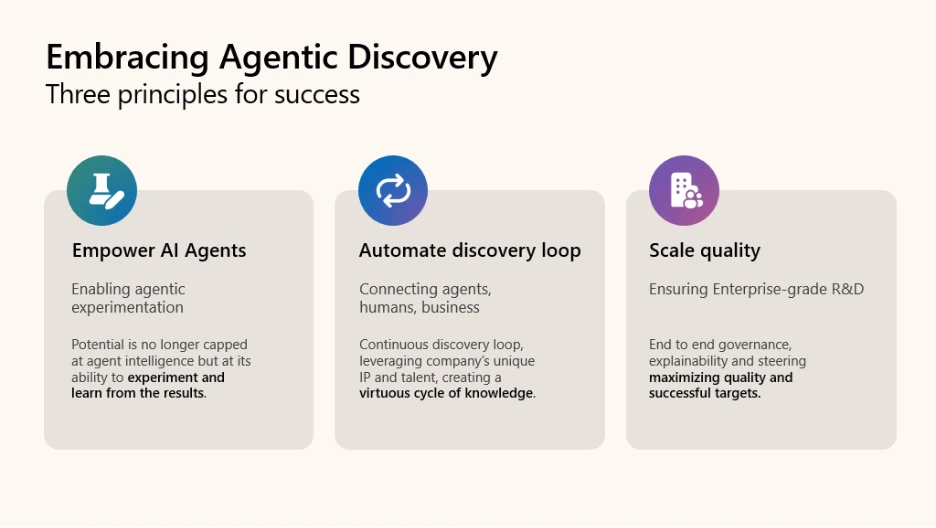
Microsoft Corporation announced a significant expansion of access to the preview version of its specialized platform, Microsoft Discovery, designed for research and development (R&D) organizations. Since the tool's closed-mode launch last year, the company has significantly refined its functionality, based on early user feedback. The updated platform elevates the concept of artificial intelligence, offering enterprises agentic AI. This technology enables the creation of autonomous teams of specialized AI agents that, under human supervision, perform key research and engineering tasks, forming a continuous cycle of scientific discovery.
The need for such a comprehensive tool is dictated by the growing complexity of modern scientific developments. The creation of sustainable materials, new energy sources, or effective medical drugs requires lengthy testing cycles. Engineers constantly have to change formulas when new data emerges, adapt materials to changing regulatory requirements, or adjust projects due to low production performance. Previous generations of AI only partially alleviated routine tasks by accelerating information search, but they lacked the depth of logical reasoning needed to solve interdisciplinary problems.
The technological foundation for deploying the platform is Microsoft Azure's enterprise cloud infrastructure. Using this foundation ensures adherence to strict standards of security, transparency, regulatory compliance, and governance, which is critically important for working with confidential data in real-world R&D environments. The Microsoft Discovery system itself is an extensible environment that combines the orchestration of numerous AI agents, a knowledge graph, and high-performance computing. This approach enables the automation of research cycles and ensures high quality of results when scaling complex engineering processes.
At the core of the system lies the Discovery Engine mechanism, which algorithmically simulates the classic scientific method. Within this core, specialized AI agents analyze vast amounts of information, connecting an organization's proprietary research data with publicly available global scientific literature. Based on the collected material, agents independently generate hypotheses, and then test and verify them within a broad search space. The results of these verifications are analyzed and fed back into the system to initiate new iterative cycles, progressively narrowing the search area and identifying the most viable concepts.
A significant advantage of the updated platform is its ability to interact with a wide range of digital, physical, and analytical tools. In a virtual computing environment, agents utilize high-performance clusters and specialized Large Quantitative Models (LQMs), and in the future, developers are considering integration with quantum technologies as they adapt for commercial needs. At the physical level, the platform ensures compatibility with real laboratories, as it can generate testing procedures and directly interact with robotic systems, measuring equipment, and Internet of Things devices under the supervision of scientific staff.
Initial system testing results have demonstrated high demand for such solutions among specialists from various scientific fields. The platform has already received positive feedback from engineers and researchers working in biological sciences, chemistry, materials science, physics, and semiconductor design. Integrating Microsoft Discovery into their work enables teams to accelerate the journey from initial hypothesis formation to the development of a ready candidate. Delegating complex routine tasks frees up experts' time, allowing organizations to more confidently achieve desired outcomes in new research.
Sources
Replies (0)
No replies in this topic yet.
