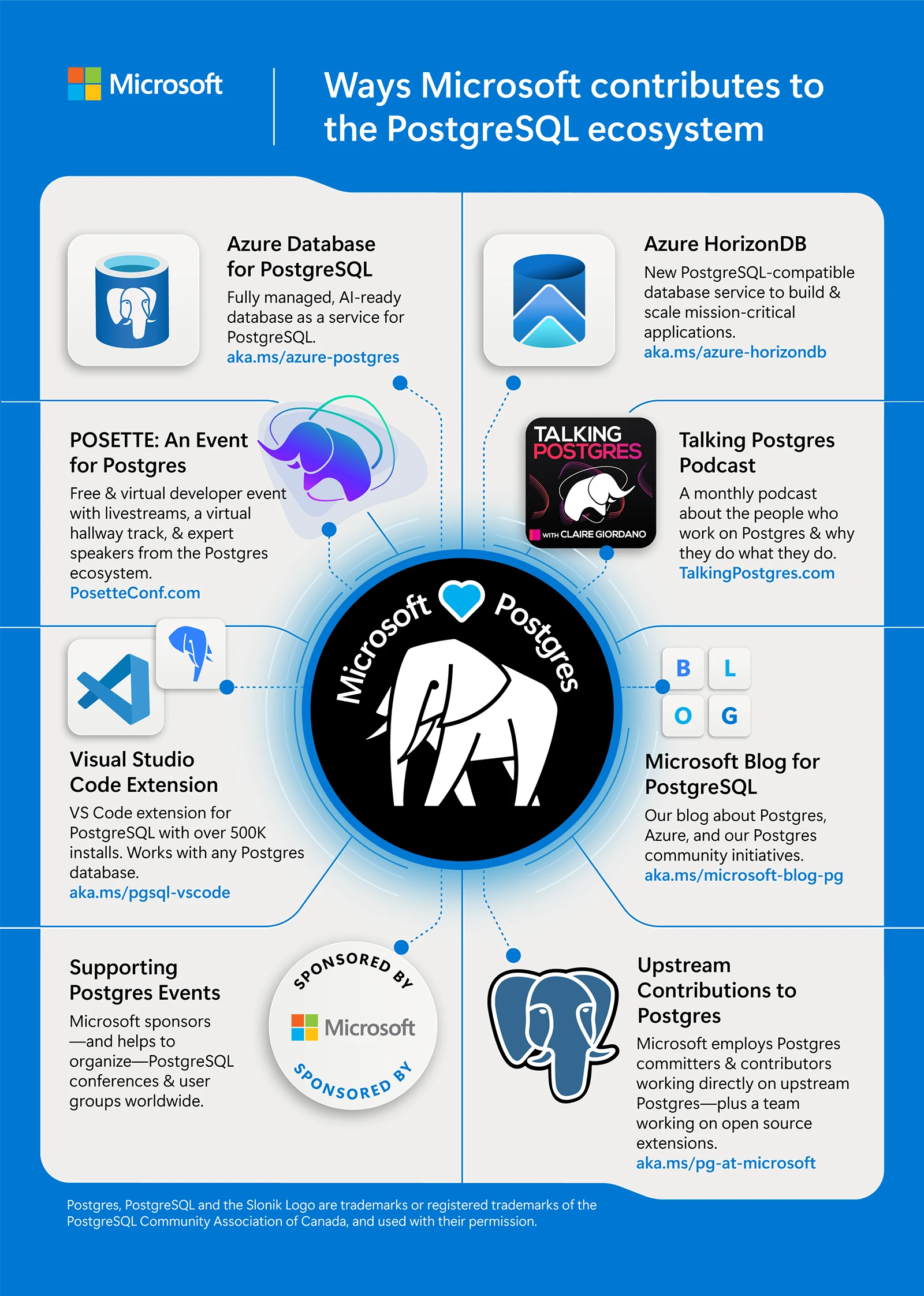
Microsoft announced a sustained investment in PostgreSQL that pairs upstream engineering contributions with cloud services and developer tooling. The company reports 345 commits to the latest PostgreSQL release and says a team of its committers and contributors now works directly on the upstream project, positioning those efforts to benefit builders running Postgres from development through large — scale production.
On the technical side, Microsoft points to upstream changes in PostgreSQL 18 that were informed by large deployments, specifically work around asynchronous I/O, vacuum behavior, and query planning. In parallel, Azure offerings and developer — facing tools are being used to surface those improvements for customers, and Microsoft highlights integrations such as vector search and model invocation aimed at AI-enabled application patterns.
Microsoft frames its work around three market trends: Postgres is increasingly the default for new workloads and migrations; databases are being embedded into AI feedback loops; and different workloads require different scaling approaches. That analysis underpins the company’s decision to support multiple deployment models rather than a single managed product, and it emphasizes extensibility as a competitive advantage for Postgres in modern stacks.
For developers, Microsoft says the combined approach should reduce architectural compromises when combining transactional SQL with AI features. The company raises specific developer questions its work aims to address, including how to co-locate vector data with transactional rows, how to run similarity search under SQL predicates, and how to integrate inference and ranking without heavy glue code. Azure Database for PostgreSQL and Azure HorizonDB are presented as platforms where teams can explore those patterns while keeping familiar Postgres workflows.
On operations, Microsoft stresses choice: a single — node, open-source-aligned Postgres experience for lift-and-shift scenarios, and cloud — native options that provide scale — out compute, shared storage, multi — zone replication and low-latency global resilience for applications that need it. Those options are intended to let organizations match deployment characteristics to workload requirements. Taken together, Microsoft argues that upstream patches, managed services, developer tools, and community programs should make Postgres more capable for both traditional production databases and emerging AI-driven use cases, enabling teams to adopt AI patterns without abandoning the Postgres ecosystem.
Sources
Replies (0)
No replies in this topic yet.
