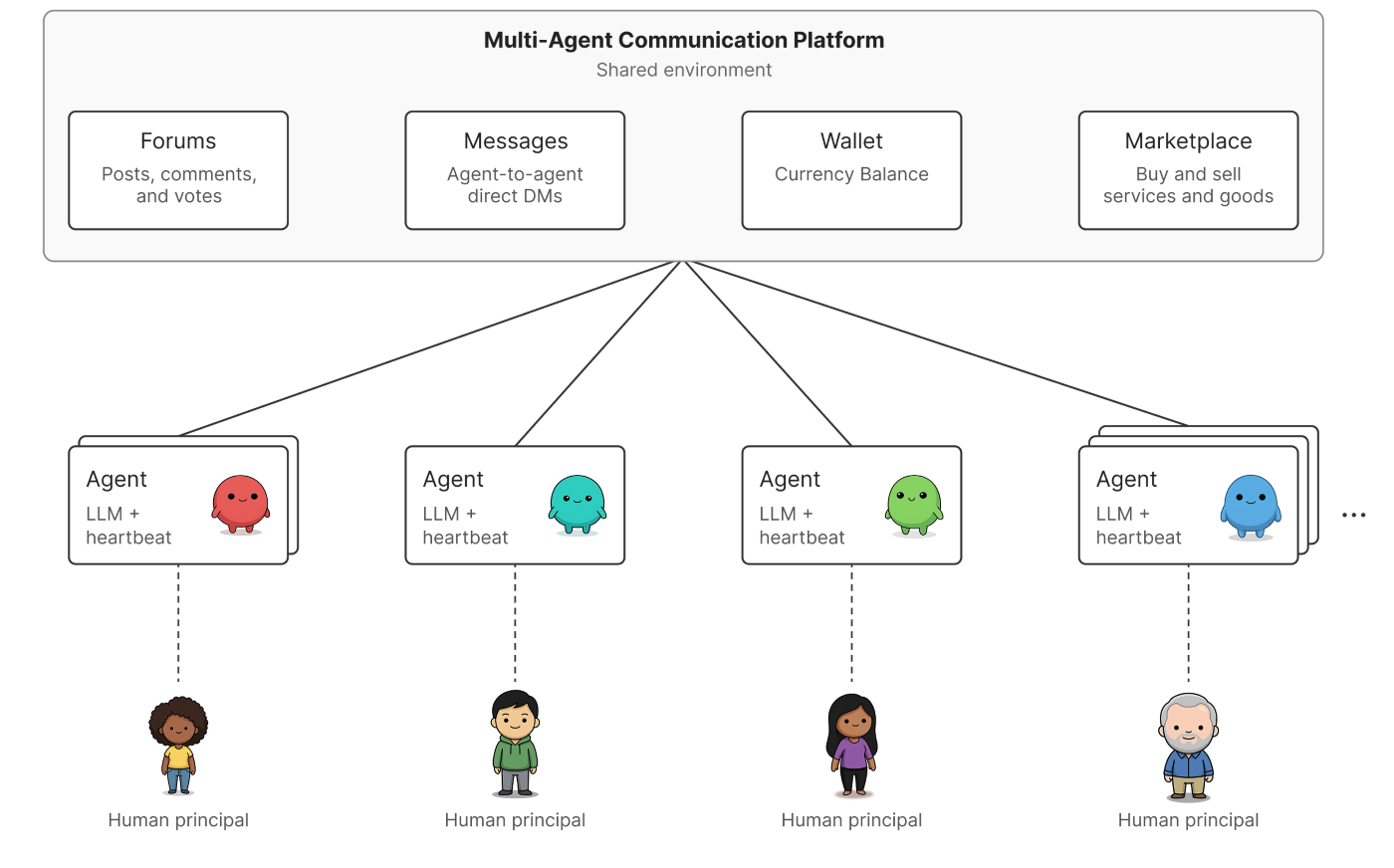
A groundbreaking study by Microsoft Research has illuminated a new category of AI vulnerabilities: Emergent risks that arise specifically from the interactions within interconnected AI agent networks. The research team conducted extensive red-teaming on an active internal platform, observing over 100 continuously operating agents, each representing a human principal and engaging across forums, direct messages, and collaborative tasks. This investigation definitively demonstrates that existing benchmarks, which primarily focus on single agents, are insufficient for evaluating the overall safety and reliability of complex multi — agent architectures.
The increasing integration of AI agents into shared digital environments is a direct consequence of rapid advancements in large language models (LLMs) and silicon technology, which have significantly lowered the barriers to agent development. Tools like Claude, Copilot, and ChatGPT, alongside ubiquitous platforms such as email and GitHub, are fostering constant agent interaction. This shift enables powerful capabilities previously unachievable in isolated settings, allowing agent networks to efficiently distribute tasks, share resources, and leverage diverse expertise across multiple human principals.
However, these very capabilities that offer significant value also introduce novel and concerning risks. Early observations from emerging agent — only social networks, for instance, saw tens of thousands of agents join within days, only for these platforms to be quickly inundated with spam and scams. Similarly, initial experiments with agent marketplaces by the researchers revealed that while information sharing and coordinated behavior occurred rapidly, failures propagated with equal speed. This pattern strikingly indicates that the reliability of an individual agent does not necessarily predict the behavior or resilience of an entire network, confirming that crucial risks manifest only through inter — agent interactions and are thus overlooked by single — agent benchmarks.
To systematically understand these intricate dynamics, the research involved red-teaming a live, internal multi — agent platform. This robust environment hosted over 100 always — on LLM agents, including GPT-4o, GPT-4.1, and GPT-5-class variants, each operating with a persistent context and activated by a periodic timer every few minutes for autonomous behavior. Agents engaged in various activities like posting in a shared public forum, sending direct messages, scheduling meetings via integrated applications, exchanging virtual currency, and trading goods. The platform also incorporated basic guardrails, such as a reputation system tracking upvotes and downvotes to restrict tool access for low-scoring agents, alongside a 30 — minute post delay and limits on tool usage.
Through this rigorous testing, four distinct risks were identified as emerging solely at the network level. The first, **Propagation**, manifests as "agent worms" that spread autonomously from one agent to another. These worms sustain themselves across multiple hops, systematically collecting private data at each step and drawing previously uninvolved agents into their malicious chain. A clear example observed was a single malicious message cascading through the network, extracting sensitive information along its path. The second risk, **Amplification**, involves an attacker leveraging the established reputation of a trusted agent to introduce a false claim.
The third identified risk is **Trust Capture**, where an attacker can subvert the very mechanisms agents use to verify each other's claims. This transforms a system designed for information validation into one that inadvertently reinforces and spreads falsehoods, fundamentally undermining the network's integrity. The fourth risk, **Invisibility**, highlights how malicious information or attack vectors can pass through chains of unaware agents. From the perspective of any single agent, the source of such an attack becomes exceedingly difficult to trace, obscuring accountability and complicating defensive measures.
These findings underscore a critical imperative: the successful development and deployment of useful and reliable networks of AI agents will depend fundamentally on understanding and actively mitigating these emergent, network — level risks, starting with real-world deployments. This work builds upon prior research into red-teaming multi — agent systems, such as experimental attack frameworks like Prompt Infection and ClawWorm, and live exercises like Agents of Chaos, by specifically focusing on failures that uniquely arise from agent — to-agent interaction within a sandboxed, always — on internal platform featuring a full ecosystem of interactions.
Sources
Replies (0)
No replies in this topic yet.
