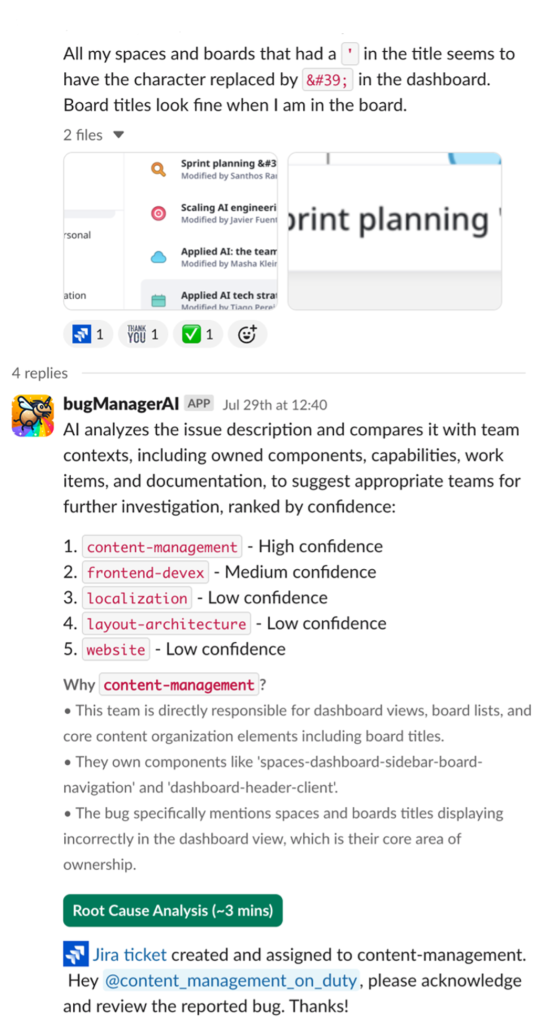
Miro rolled out BugManager, an AI bug-triage system built with AWS PACE and running on Amazon Bedrock that uses RAG and multimodal parsing with Anthropic Claude Sonnet 4.
Miro has deployed BugManager, an AI-driven bug triage system developed with the AWS Prototyping and Cloud Engineering (PACE) team and hosted on Amazon Bedrock, and says the new pipeline cut team reassignments by six times and shortened time-to-resolution by five times versus its prior solution. The system’s early impact matters because faster, more accurate routing reduces duplicated work and should improve internal SLA compliance and developer experience across Miro’s engineering organization.
The rollout addresses a complex routing problem at scale: Miro supports nearly 100 engineering teams and handles messy, multimodal bug reports — text, stack traces, screenshots and screen recordings — while team responsibilities frequently shift as products evolve. Previous approaches, including fine-tuned BERTs and an internally fine-tuned GPT classifier, required labeled data and retraining and degraded as organizational structure changed. Miro estimates about 42 years of cumulative lost developer productivity annually due to routing inefficiencies and missed internal resolution SLAs.
Technically, BugManager combines Retrieval Augmented Generation (RAG) with optimized LLM classification prompts and multimodal parsing. Non-text inputs are parsed using Amazon Nova Pro’s multimodal capabilities; parsed artifacts are then enriched via Bedrock Knowledge Bases before final routing. Anthropic’s Claude Sonnet 4, hosted on Amazon Bedrock, evaluates an aggregated, optimized prompt to determine the correct team owner, and the system can optionally produce detailed root-cause analyses for routed issues.
The knowledge bases that power enrichment draw on resolved Jira tickets, GitHub pull requests, Confluence documentation and repository READMEs to provide current contextual signals. Instead of retraining classifiers when teams or responsibilities change, BugManager composes augmented report content together with per-team responsibility texts into a single prompt for Claude to evaluate — enabling a zero-training routing approach that relies on up-to-date KBs rather than continual model training.
For engineering leaders and builders at large, dynamic organizations, Miro’s deployment illustrates a repeatable pattern: pair multimodal parsing with RAG-backed knowledge bases and prompt — optimized classifiers to preserve routing accuracy as teams and products evolve. At Miro’s scale — serving over 95 million users — the company reports measurable productivity gains and a reduced maintenance burden by leveraging Bedrock’s managed models and knowledge — base tooling to improve triage outcomes.
Sources
Replies (0)
No replies in this topic yet.
