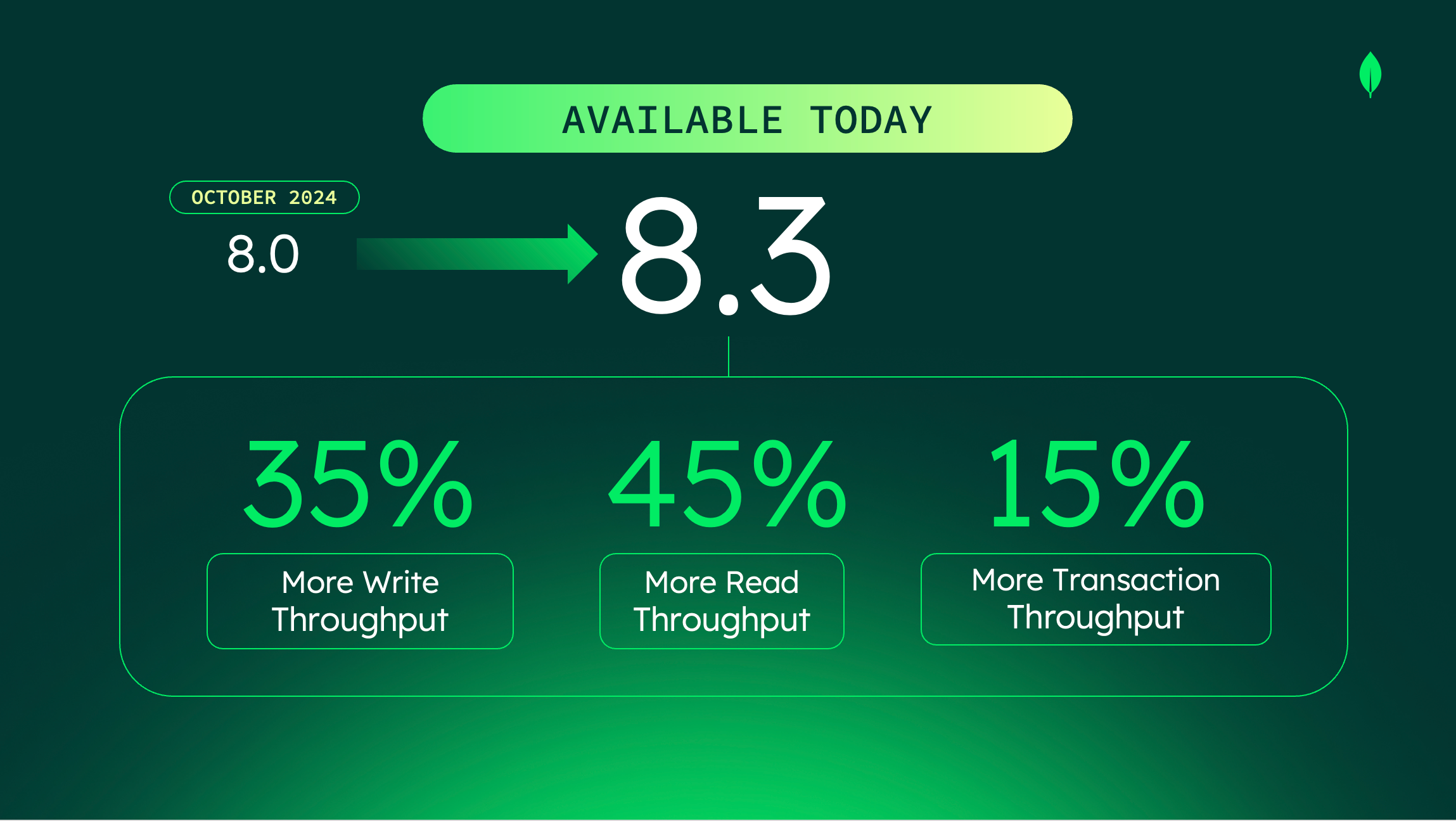
MongoDB announced version 8.3 as generally available on May 7, 2026 at its.local London event, positioning the release specifically for AI production needs that demand sub‑100 millisecond retrievals, sub‑second context updates and zero downtime. That focus matters because retrieval‑heavy agents and memory systems have moved from edge cases to baseline expectations for customers running AI at scale.
Technically, 8.3 is the fourth major MongoDB release in 19 months. The company says earlier upgrades from 8.0 already delivered a 36% improvement in reads and a 59% increase in update throughput for customers who moved forward; 8.3 itself is claimed to add roughly 35% to write throughput, about 45% to reads and around 15% to ACID transaction performance over 8.0. MongoDB emphasizes these gains can be realized without changes to application code.
Deployment and networking changes are aimed at compliance and latency constraints in multi‑region architectures. MongoDB Atlas runs across 130 regions on AWS, Google Cloud and Microsoft Azure and supports clusters that span multiple cloud providers. Separately, MongoDB announced general availability of cross‑region connectivity for AWS PrivateLink, which keeps traffic between Atlas clusters in different AWS regions on the AWS private backbone rather than traversing the public internet.
The company cited customers to illustrate the use cases driving the release: Adobe was named for operating demanding AI workloads with sub‑100ms retrievals and sub‑second context updates, while Avalara and Iron Mountain were highlighted as examples of organizations choosing Atlas’s cloud‑agnostic deployment path. MongoDB also noted a customer base exceeding 65,200 and underscored the cadence of four major releases in 19 months.
For builders, the practical implications are concrete. Improved throughput and transaction performance without code changes can accelerate rollouts of retrieval‑heavy agents, embeddings and memory systems. The PrivateLink option reduces exposure to the public internet, which can simplify security and compliance reviews for multi‑region deployments. MongoDB additionally pointed to embeddings and memory as gating factors for agent accuracy and speed, beyond model size alone.
MongoDB framed the rapid release cadence as a commitment to keep the data layer aligned with evolving AI workloads rather than a one‑off marketing claim. Teams evaluating upgrades should weigh the stated performance gains, the zero‑code‑change migration path and the new cross‑region networking controls when planning rolling upgrades or new Atlas deployments.
Sources
Replies (0)
No replies in this topic yet.
