A technical guide shows how to prompt Amazon Nova 2 Lite for content moderation using structured (XML/JSON) and free-form prompts aligned to the MLCommons AILuminate Assessment Standard v1.
Amazon's Nova 2 Lite can be prompted to run policy — driven content moderation pipelines, allowing teams to apply a formal hazard taxonomy at low cost and scale. A new technical guide demonstrates both structured and free-form prompting approaches, benchmarks Nova 2 Lite against multiple foundation models using three public datasets, and stresses that these workflows require no model fine‑tuning. This approach matters for builders seeking faster, cheaper moderation with configurable policy controls.
The guide uses the MLCommons AILuminate Assessment Standard v1.1 as an example policy framework. That standard defines a 12‑category hazard taxonomy organized into three groups — Physical, Non‑Physical, and Contextual hazards — and the blog lists sample categories such as Violent Crimes, Non‑Violent Crimes, Suicide and Self‑Harm, Hate, Specialized Advice, and Privacy. It also notes the full taxonomy contains six additional categories with complete definitions in the standard.
Prompting methods include structured prompts (XML or JSON) intended to produce machine‑readable outputs and free‑form prompts designed for human review workflows. Examples in the guide use few‑shot learning, embedding input/output examples in the prompt to teach expected response patterns, and rely on a stable prompt structure that lets teams swap in custom category definitions without retraining the model.
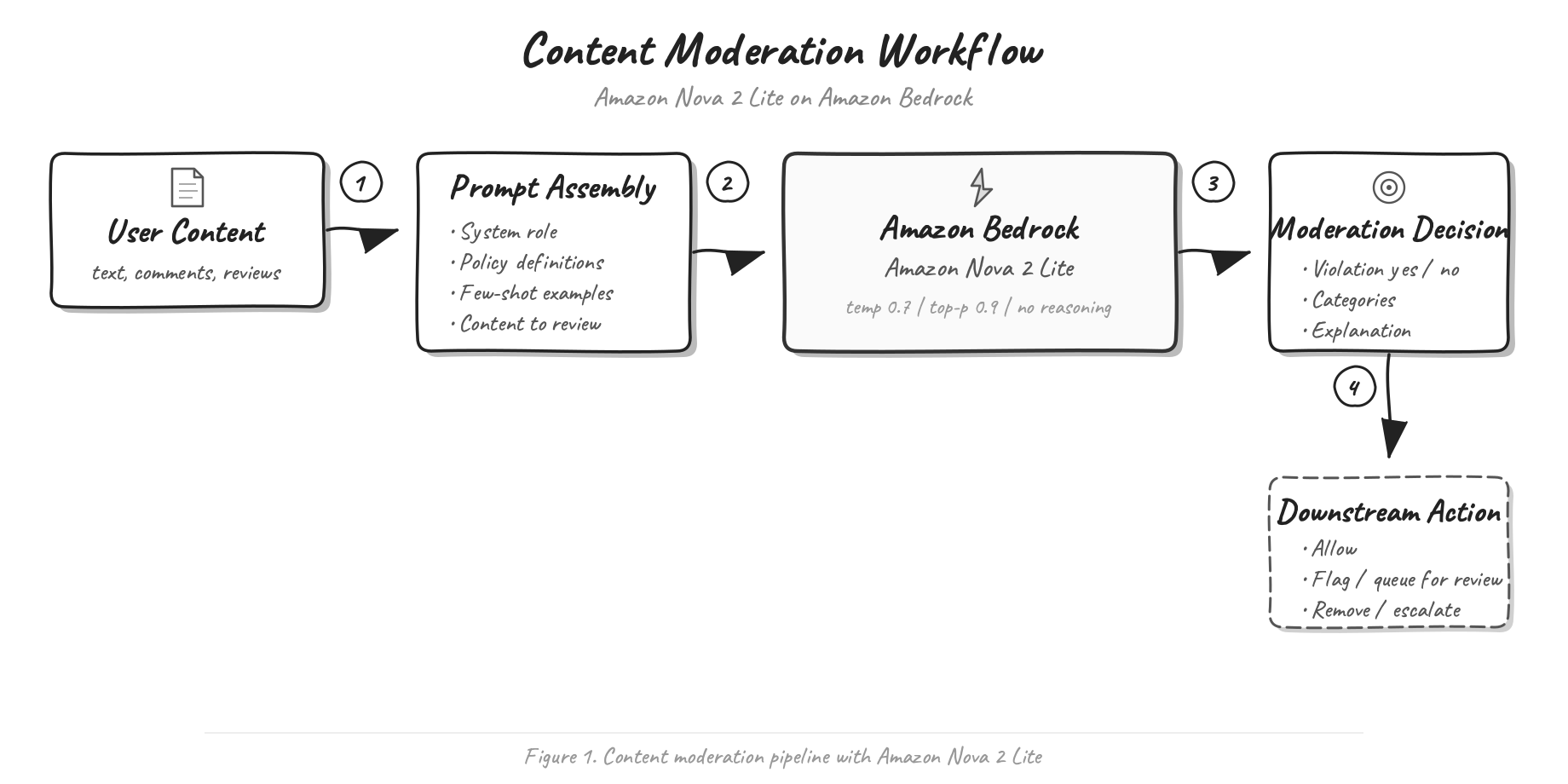
The recommended moderation pipeline has four stages: ingest user content; assemble a prompt that includes a system role, policy definitions, and optional few‑shot examples; send the prompt to Nova 2 Lite on Amazon Bedrock; and process the moderation response. The response format is expected to include a violation flag (yes/no), one or more violated categories, and an optional explanation that can be used to drive allow, flag, remove, or escalate actions.
Operational guidance covers inference settings and trade‑offs. The authors recommend default settings of temperature 0.7 and top‑p 0.9 (nucleus sampling) as a balance of consistency and variety across diverse content. For deterministic requirements they advise testing lower temperatures (for example, 0), and for high‑throughput systems they suggest disabling reasoning mode during tests to reduce latency and cost while validating accuracy for the target content.
For builders, the guide frames Nova 2 Lite as a very low‑cost, multimodal model with fast inference suitable for scaled moderation. It recommends using structured XML/JSON prompts when formatted outputs must feed automation, including few‑shot examples to standardize replies, and running the provided benchmarks plus bespoke tests on selected datasets and policies before deployment to ensure the prompt and configuration meet your risk and throughput needs.
Sources
Replies (0)
No replies in this topic yet.
