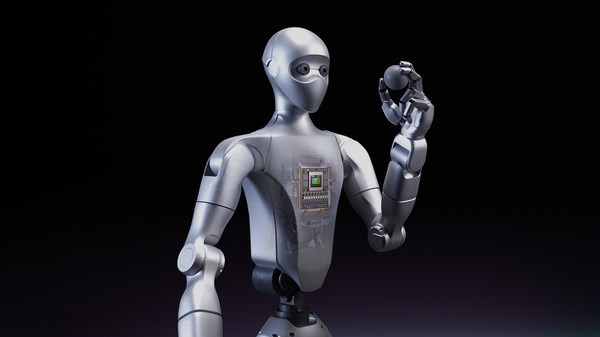
NVIDIA unveiled the Isaac GR00T Reference Humanoid Robot at GTC Taipei, presenting an open reference design that combines a Unitree H2 Plus chassis, dual Sharpa Wave five-finger tactile hands, onboard Jetson AGX Thor compute, and the Isaac GR00T software platform — a packaged starting point intended to speed academic and research teams’ entry into humanoid robotics. The move aims to shorten integration time and broaden access to advanced hardware and a unified software stack for university labs and research centers.
The physical platform centers on a Unitree H2 Plus humanoid listed as nearly 6 feet tall and weighing about 150 pounds. NVIDIA reports the body provides 31 degrees of freedom while the Sharpa hands add 22 more, for a combined 75 degrees of freedom across the body and hands to support human — scale testing and dexterous manipulation.
Sensing is configured for whole — body work: a head-mounted stereo camera offers a 140° horizontal and 102° vertical field of view, wrist cameras support close — range manipulation, and an inertial measurement unit aids stabilization and motion feedback. Mechanical specs target forceful interactions and payload handling, with arm torque up to 120 N·m, leg torque up to 360 N·m, a rated arm payload of 7 kg and a peak payload capability of 15 kg for heavier lifts.
Onboard compute is provided by an NVIDIA Jetson AGX Thor T5000 module, featuring a Blackwell GPU rated at 2,070 FP4 teraflops, a 14 — core Arm CPU, and 128 GB of unified memory. The module supports a configurable power envelope of 40 — 130 W for real-time sensor processing and inference. The robot carries a 15 Ah (0.972 kWh) battery rated for about three hours of operation and includes Ethernet, Wi‑Fi 6, Bluetooth 5.2, USB, multi — microphone and speaker audio, plus an on-remote emergency stop.
Isaac GR00T supplies the open software stack and development workflows that complete the reference design, covering data capture and generation, robot model evaluation, simulation, training and deployment. NVIDIA says the platform includes open software and pretrained models intended to reduce fragmented toolchains and shorten the path from hardware bring — up to validated robot skills.
NVIDIA named several early academic users and collaborators — Allen Institute for AI (Ai2), ETH Zurich, the Stanford Robotics Center and UC San Diego’s Advanced Robotics and Controls Laboratory — who will use the reference design to advance humanoid research. For builders, the combined package of body, hands, sensors, Jetson AGX Thor compute and Isaac GR00T workflows is positioned to reduce integration work and provide a reproducible baseline for experiments in control, perception and manipulation, enabling faster iteration toward physical AI research outcomes.
Sources
Replies (0)
No replies in this topic yet.
