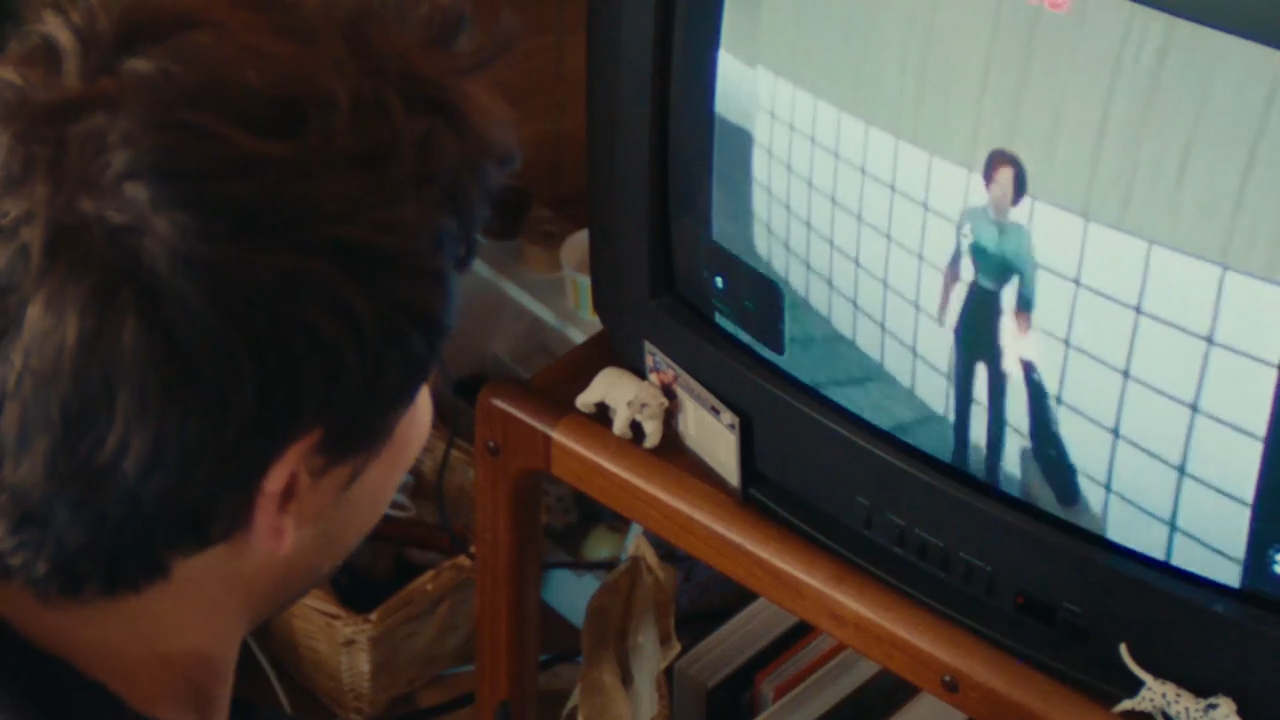
Odyssey published Agora-1 on May 19, 2026: A research world model that runs a live, learned simulation of the Nintendo 64 title GoldenEye and lets up to four agents act in the same generated environment at once. The system preserves a running game state rather than generating pre‑rendered clips, which means each participant’s inputs update a shared simulation in real time — a change that matters for multi‑agent research and interactive applications where consistent, synchronized worlds are required.
Agora-1 is built as two explicit components. A simulation model continuously computes a shared internal game state by combining player actions with rules derived from the original game’s mechanics. A second, diffusion‑based rendering model converts that state into separate visual perspectives for each participant on the fly. Because rendering is driven by an explicit state representation, the system presents independent views that remain coherent with the underlying simulation as agents move and interact.
Because state is managed explicitly rather than implied in short video outputs, Odyssey says Agora-1 can spawn new levels and retain the source game’s mechanics and physics across interactions. That persistent state handling lets participants rejoin, change vantage points, or continue a session without breaking consistency, enabling sustained experiments with multi‑agent behaviour and decision making within a faithful, learned recreation of the original title.
Odyssey also introduced Starchild‑1, an interactive audio — video world model that synchronizes visuals and sound and responds to ongoing text input. Starchild‑1 targets single‑user interaction rather than synchronous multi‑agent play and the company reports it runs on modern hardware at up to 24 frames per second; public access is limited to video samples and a technical paper rather than a live demo.
The team positions Agora-1 to address shortcomings in earlier research platforms. Odyssey cites prior approaches such as Multiverse and Solaris, which struggled to keep consistent shared worlds when players lost sight of one another, and contrasts Agora-1 with many recent generative products that output fixed short videos with no interactive control (for example, OpenAI’s Sora and Google’s Veo 3). Google’s Genie 3, while richer for single users, also does not support synchronous multi‑user interaction in the way Agora-1 is designed to do.
Odyssey frames Agora-1 as a testbed for training AI agents and for collaborative robotics scenarios where multiple robots must reason together about actions and shared space. The project is led by CEO Oliver Cameron and CTO Jeff Hawke, and Odyssey has published an early research preview on its website so builders can experiment with the model’s shared state handling and multi‑perspective rendering.
Sources
Replies (0)
No replies in this topic yet.
