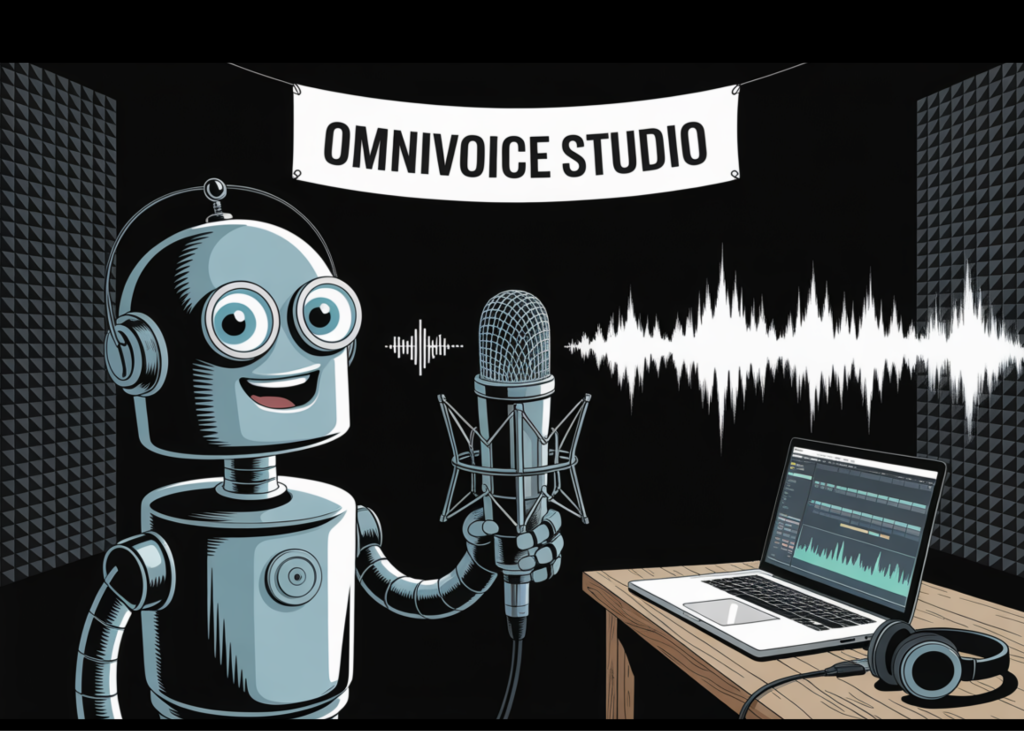
OmniVoice Studio launches as a desktop, open‑source alternative to cloud‑based voice services, running a suite of speech and audio tasks entirely on local hardware so audio never needs to leave the machine. The app combines voice cloning, video dubbing, live dictation and other audio workflows without requiring API keys, a cloud account or a paid subscription, an approach aimed at developers and privacy‑conscious users who need offline control.
The application packages six primary capabilities. Its voice‑cloning feature can recreate a voice from a three‑second reference clip using zero‑shot conditioning of a diffusion‑based TTS model, and a voice‑design panel lets users tweak gender, age, accent, pitch, speed, emotion and dialect. The video‑dubbing pipeline accepts a YouTube URL or a local file, runs WhisperX for transcription and alignment, translates text where applicable, synthesizes replacement audio and exports a dubbed MP4.
A systemwide dictation overlay (on macOS triggered by ⌘+⇧+Space) streams results over WebSocket and can auto‑paste; a Batch Queue processes up to 50 videos with per‑job progress; and an MCP Server exposes the app’s features to clients like Claude or Cursor.
Under the hood, OmniVoice Studio pairs a React frontend with a FastAPI backend that exposes 97 API endpoints, streams status updates via Server‑Sent Events and uses SQLite for local data storage. The audio stack relies on four core machine‑learning components: WhisperX for automatic speech recognition with word‑level alignment (supporting 99 transcription languages), Demucs for source separation, Pyannote for speaker diarization (used alongside WhisperX) and AudioSeal to embed an invisible neural watermark that survives compression as provenance metadata.
The project offers a pluggable multi‑engine TTS backend and ships six built‑in engines: OmniVoice (600+ languages), CosyVoice 3 (9 languages plus 18 dialects, Apache‑2.0), MLX‑Audio (Apple Silicon only; includes Kokoro and Qwen3‑TTS), VoxCPM2 (30 languages, Apache‑2.0), MOSS‑TTS‑Nano (20 languages, real‑time on CPU) and KittenTTS (English, CPU‑only, MIT). Developers can add a custom engine in roughly 50 lines of Python by subclassing TTSBackend in backend/services/tts_backend.py and registering it in the _REGISTRY.
OmniVoice positions itself against established cloud providers by emphasizing local execution and broader language coverage: the project claims up to 646 TTS languages and leverages WhisperX’s 99 transcription languages. By contrast, some cloud services route every processed audio file through remote servers, charge subscription tiers (noted examples span roughly $5 to $330 per month) and document narrower language support. Translation coverage in OmniVoice varies by language pair, but the overall design targets developers who need offline workflows, extensive language reach and a privacy‑focused, no‑subscription option.
Sources
Replies (0)
No replies in this topic yet.
