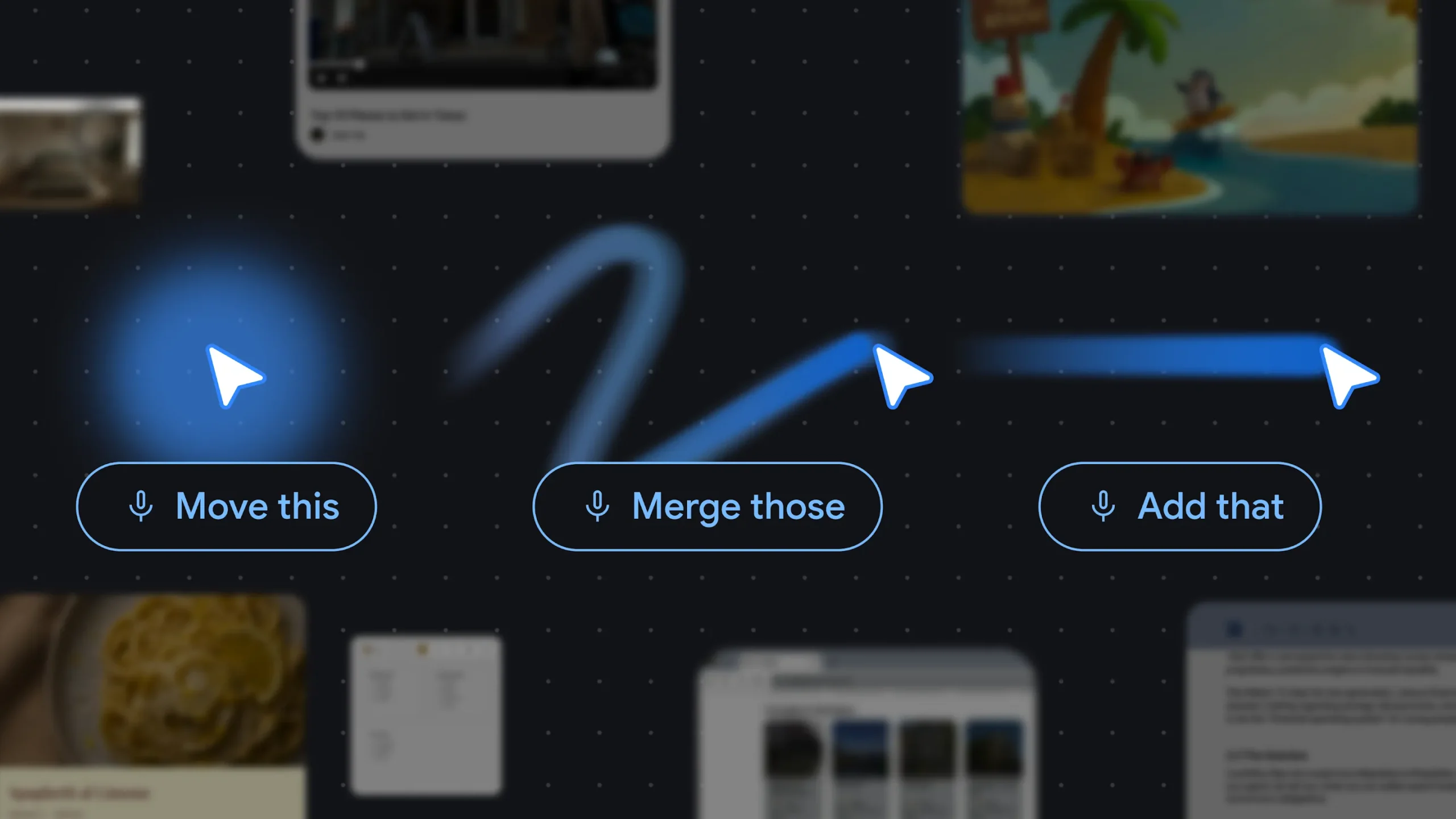
Deepmind researchers Adrien Baranes and Rob Marchant published a proposal on May 13, 2026 to treat the mouse pointer as a primary variable in context engineering. Their pitch reframes the cursor from a simple selector into an active, context‑capturing signal that collects nearby visual and semantic information and passes it directly to models. The change aims to let AI attend to the user's immediate environment rather than forcing users to copy or drag content into separate AI interfaces.
The researchers describe pointer engineering as a reversal of the typical AI workflow: instead of moving the user's world into an AI app, the pointer moves AI attention into the user's world. In practice, that means the cursor would capture the relevant webpage region, surrounding text, and semantic cues in situ, allowing users to ask questions or issue commands tied to what they are pointing at. Deepmind positions this as a low‑friction way to support short, chat‑like interactions without the manual steps now required to build context for a model.
Deepmind says these pointer principles are already being integrated into Gemini in Chrome, where users can select parts of a page and ask questions directly, and that an upcoming Googlebook product will ship the feature under the name 'Magic Pointer.' Because the pointer hands context to the model at cursor granularity, questions and clarifications can be resolved without moving content into separate windows or assembling screenshots first. That shift could streamline common workflows like quick clarifications, lookups, and minor edits.
The team is explicit that pointer engineering is not a universal replacement for prompt engineering. For nuanced tasks, multi‑step planning, or situations that demand precise textual specifications, traditional prompts and instructions remain necessary. Deepmind contrasts pointer engineering with existing visual — anchor tools — screenshots, red arrows, hand‑drawn annotations — arguing it reduces friction for brief interactions rather than supplanting advanced use cases.
For builders and product teams, the proposal implies immediate UI and integration work: pointer‑aware context pipelines, entity extraction at cursor granularity, and multimodal input handling that can combine selection, speech, and gestures. Because the approach is being tested inside Chrome and Googlebook flows, engineers should expect forthcoming APIs and UX patterns focused on low‑effort context handoff, while continuing to support traditional prompt and instruction engineering for complex workflows.
Sources
Replies (0)
No replies in this topic yet.
