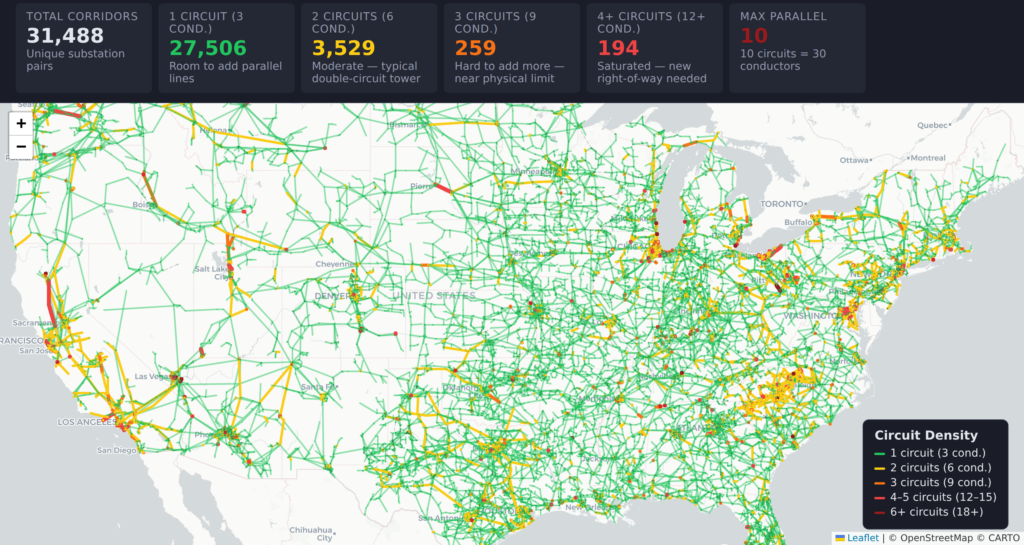
Researchers have released an open-data pipeline and dataset that create geographically grounded, electrically coherent transmission models across 48 U.S.
A new open-data pipeline and accompanying dataset have been released that approximate U.S. transmission topology using only publicly available geographic, energy and demographic inputs. The release includes models spanning 48 U.S. states and interconnection — scale constructs, notably a full Eastern Interconnection model containing 21,697 buses. This matters because the outputs are explicitly structured to support alternating current optimal power flow (AC‑OPF) at scales researchers and planners rarely can study with public data.
The collection provides a wide range of problem sizes: individual state or local system models in the set can be as small as 11 buses while interconnection instances reach tens of thousands. Outputs preserve inferred transmission corridors, substations and generator locations drawn from open sources, and are assembled to be electrically coherent so that physics — based analyses behave plausibly across realistic network layouts. Beyond topology, the project delivers transparent feasibility reporting and surfaces parameter uncertainty where operational details are missing from public records. Rather than hiding gaps, the pipeline documents uncertainty and flags infeasible configurations, giving users explicit information about which elements are well grounded in observations and which depend on inferred assumptions.
Methodologically, the pipeline ingests open geographic, energy and demographic datasets and constructs transmission — level topologies at state, multi — state and interconnection scales. The authors report validation across the continental U.S. in regions where public data density is sufficient, and they designed the approach to generalize to other regions with comparable open data sources. The release responds to longstanding limits on access to realistic transmission — level grid data, which in many countries is treated as critical infrastructure and tightly controlled. Those restrictions have forced researchers to rely on small academic test networks, synthetic benchmarks, or datasets accessed through slow approval processes, non-redistribution agreements, or commercial licenses that restrict reuse and scaling.
For builders and researchers, the dataset lowers a barrier to entry for data-driven and AI‑based power — systems work: it enables examination of congestion patterns, study of where transmission capacity is physically constrained, evaluation of how new bulk demand might be sited, and analysis of how upgrades propagate through real network layouts. expansion planning and large — load siting studies such as datacenter placement.
Sources
Replies (0)
No replies in this topic yet.
