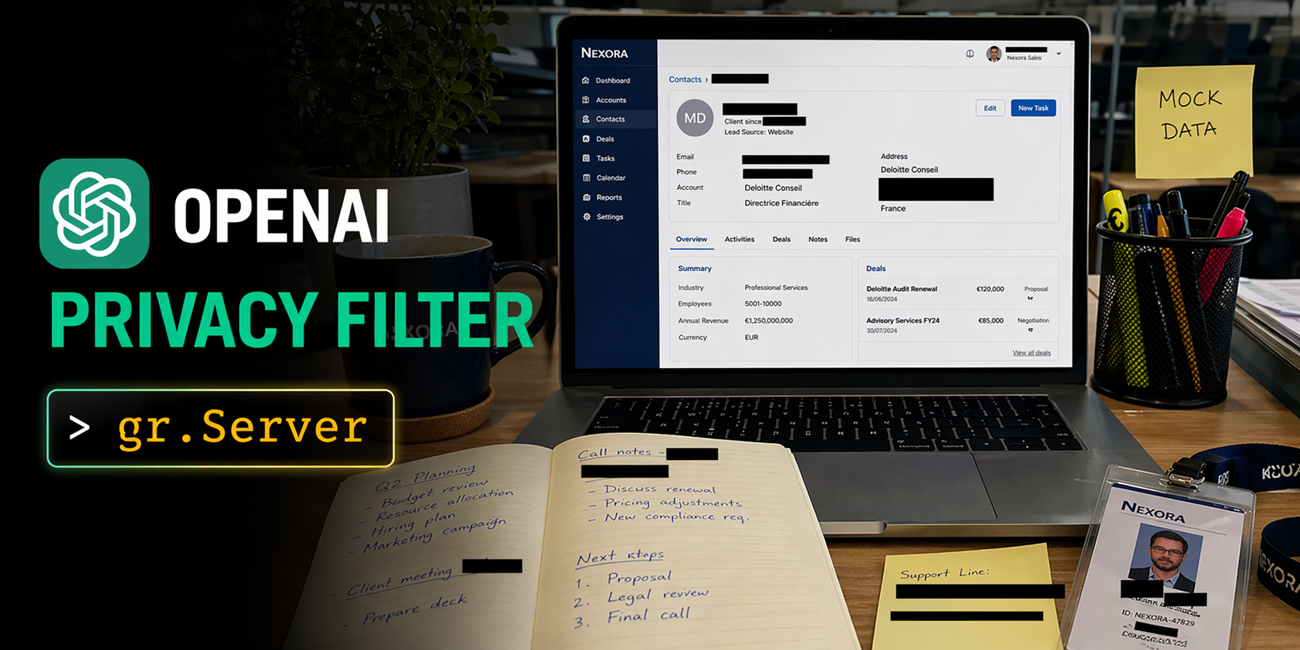
OpenAI has introduced Privacy Filter, a robust, open-source personally identifiable information detector launched directly on the Hugging Face Hub on April 27, 2026. Released under an accommodating Apache 2.0 license, this newly deployed model represents a significant step forward in data redaction capabilities. The release prompted Hugging Face engineers Yuvraj Sharma, Freddy Boulton, and Abubakar Abid to rapidly develop a suite of applications demonstrating the tool's practical utility.
The underlying architecture of Privacy Filter utilizes a highly efficient parameter structure. While the model is built with 1.5 billion total parameters, it operates by leveraging only 50 million active parameters during inference. This streamlined processing supports a massive 128,000 — token context window. Consequently, entire files can be processed in a single forward pass, eliminating the need for data chunking or stitching. Furthermore, the model utilizes BIOES decoding to keep span boundaries clean even through long, ambiguous runs of text. The developers noted that this setup achieves state — of-the-art performance on the PII — Masking-300k benchmark, though the source documentation directs readers to the official release blog for full methodology numbers.
The system is precisely calibrated to identify and mask eight distinct categories of sensitive information: private person, private address, private email, private phone, private URL, private date, account number, and general secrets. This strategic capability arrives at a critical juncture, as enterprise software developers increasingly demand privacy — first infrastructure. Historically, organizations relying on external data redaction tools had to transmit their unredacted, sensitive information to third — party APIs. This legacy process inherently risked exposing the exact data developers aimed to protect, but the localized deployment of Privacy Filter mitigates this paradoxical security vulnerability entirely.
To showcase the model's integration potential, the Hugging Face team engineered three distinct web applications utilizing the new system. The first, Document Privacy Explorer, enables users to upload PDF or DOCX files and read the document back with every targeted data span highlighted in place. Because the whole file undergoes a single context pass, the identified span offsets line up directly with the rendered text. The reading experience is enhanced by a custom frontend featuring a serif body, a summary dashboard, and category filters that toggle CSS classes on the client side instead of forcing a page re-render.
Beyond digital document analysis, the second reference application demonstrates how Privacy Filter handles visual data. The Image Anonymizer allows users to upload screenshots, such as Slack threads or receipts, and receive an image with redacted black bars over sensitive entities like names and account numbers. This is achieved by running Tesseract OCR to generate per-word bounding boxes, reconstructing the text, and applying the Privacy Filter model before drawing pixel rectangles over the identified spans. Users can then edit these bars on a custom canvas before exporting the image client — side at its natural resolution without an additional server round — trip.
A third application, SmartRedact Paste, provides a mechanism for users to paste sensitive text and generate a public URL serving a redacted version, while retaining a private link for themselves. All three implementations depend heavily on Gradio Server to manage backend operations. This infrastructure pairs custom HTML and JavaScript interfaces with Gradio's underlying queueing system, ZeroGPU allocation, and client SDK. By utilizing specific API decorators, concurrent uploads are properly serialized, allowing developers to expose the model behind one queued endpoint reachable from both the browser and backend software with no duplicated code.
Sources
Replies (0)
No replies in this topic yet.
