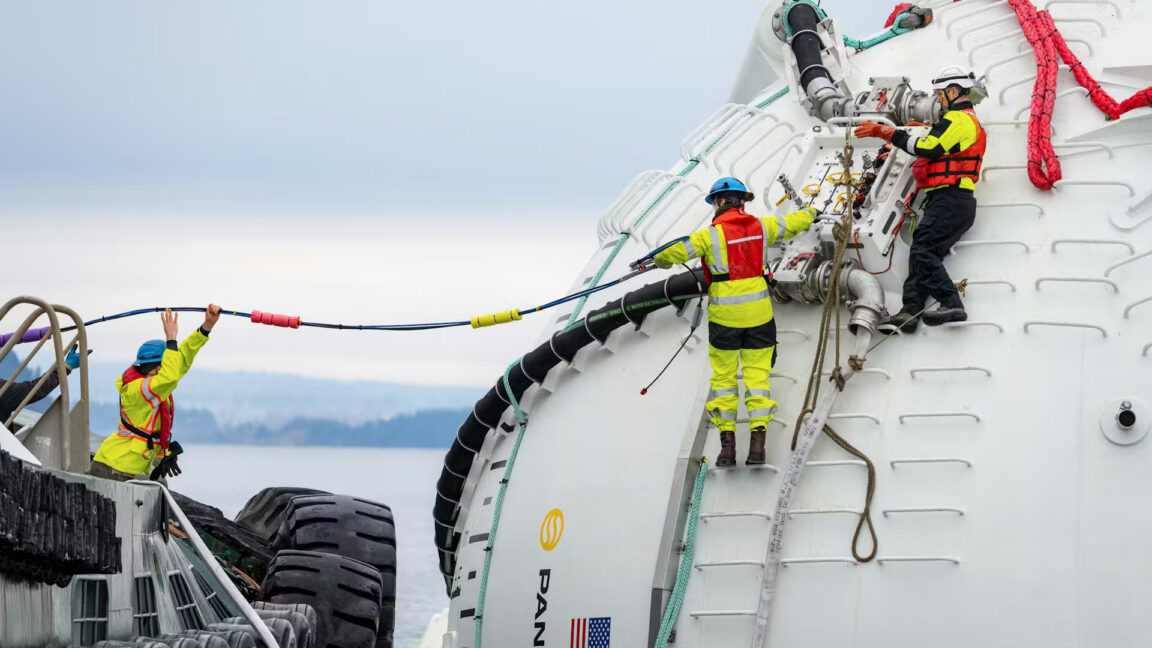
Panthalassa secured $140 million in a financing round to complete a pilot manufacturing facility near Portland, Oregon, and accelerate deployments of wave‑driven floating nodes that power onboard AI chips and return compact model outputs via satellite.
Panthalassa said it closed a financing round that includes bets from Silicon Valley figures, among them Palantir co‑founder Peter Thiel, raising $140 million to finish a pilot manufacturing facility near Portland, Oregon and speed deployment of wave‑driven ocean nodes, according to a May 4 press release. The funding is earmarked for the Portland site and for accelerating installations of the company’s floating platforms in the Pacific.
The nodes center on a large steel sphere that rides the surface with a vertical tube extending below. Wave motion pushes water up the tube into a pressurized reservoir; when that water is released it spins a turbine to generate electricity for onboard AI processors. Panthalassa also plans to use surrounding seawater to cool the chips, integrating generation and thermal management in a single floating unit.
Panthalassa expects to run an Ocean‑3 prototype in the northern Pacific later in 2026. The Ocean‑3 design measures about 85 meters in length and would rise nearly as tall as landmark structures such as Big Ben or the Flatiron. Earlier development milestones include Ocean‑1 in 2021 and a three‑week Ocean‑2 sea trial off Washington state in February 2024, which provided operational data for scaling the design.
The company’s architecture shifts the usual challenge from moving renewable power to land toward a data‑centric model: rather than transmitting bulk electricity to shore, Panthalassa intends to perform inference at sea and return compact model outputs, or “inference tokens,” to customers via satellite links. Benjamin Lee, a computer architect at the University of Pennsylvania, says this approach requires porting models to the ocean nodes and sending prompts remotely to receive responses from the platforms.
Technical constraints will limit use cases. Satellite terminals may deliver on the order of hundreds of megabits per second — sufficient for many real‑time prompt responses but far below fiber‑optic capacity — so high‑volume transfers, frequent node‑to‑node coordination, or streaming large datasets would be difficult. Panthalassa acknowledges that larger bulk transfers will require periodic physical transport of storage by ship.
Questions about operational durability and maintenance remain. Company job listings state a target of surviving more than a decade in harsh ocean conditions with minimal human intervention, and CEO and co‑founder Garth Sheldon‑Coulson has expressed hopes of deploying thousands of nodes. Still, maintenance complexity, signal latency and bandwidth tradeoffs make wholesale replacement of terrestrial data centers unlikely; the company’s systems are positioned as niche or complementary deployments rather than full substitutes for land‑based infrastructure.
Sources
Replies (0)
No replies in this topic yet.
