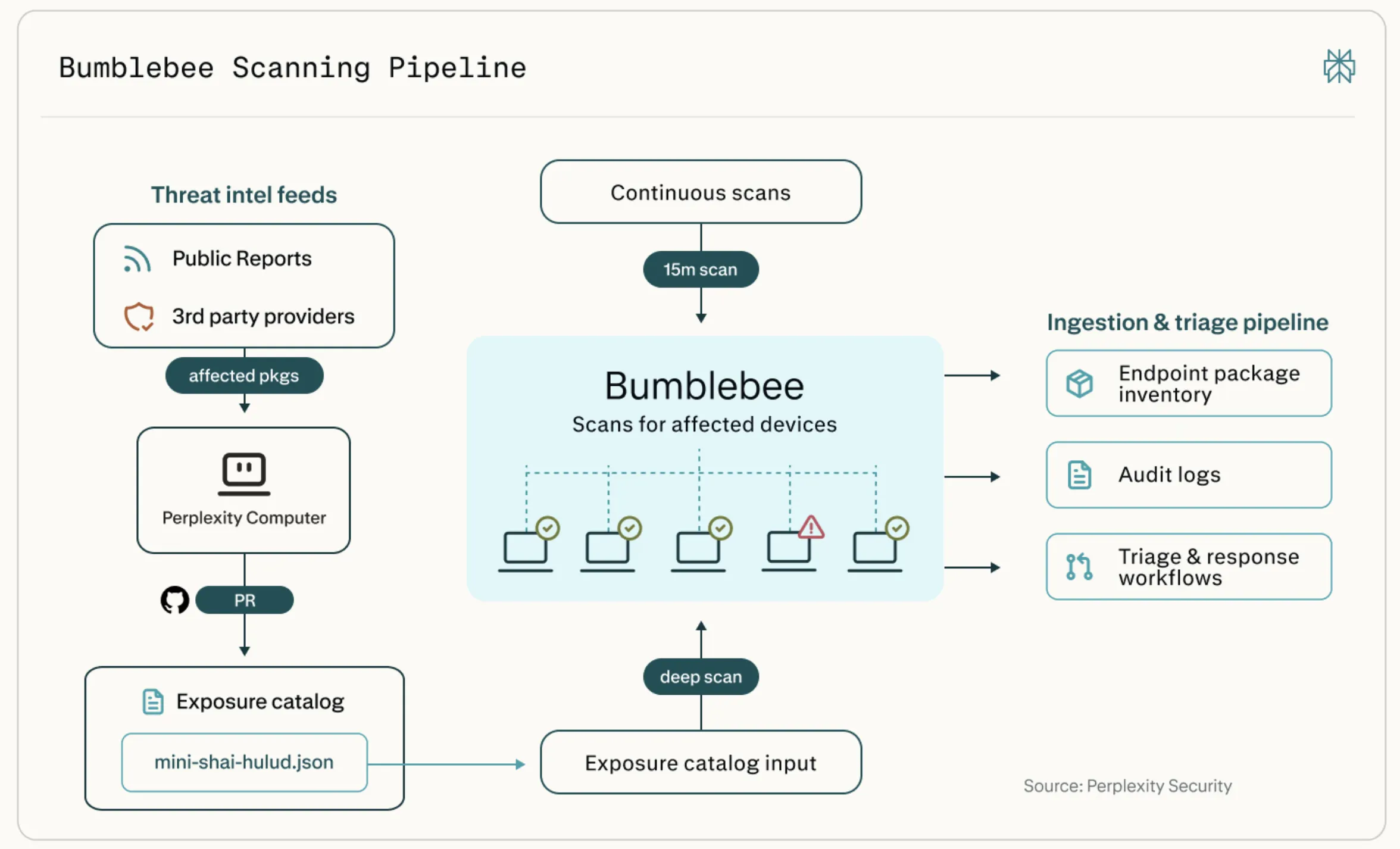
Perplexity has open‑sourced Bumblebee, a Go‑based, read‑only inventory scanner for macOS and Linux developer endpoints that reads lockfiles, package metadata, extension manifests and AI agent JSON configs without executing code;
Perplexity has published Bumblebee as an open-source tool to inventory developer laptops and servers, releasing the same reader it already uses to protect the developer systems behind its Comet search product, the Comet browser, and the Computer agent. The move gives other teams a read-only scanner they can run on macOS and Linux endpoints to quickly discover on-disk package metadata and AI agent configuration files that may indicate exposure to supply‑chain compromises.
Bumblebee is a one-shot inventory collector written entirely in Go with zero non‑stdlib dependencies. Each invocation performs a single scan and exits; operators control cadence with cron, launchd, systemd or MDM fleet tooling. The tool emits findings as NDJSON (one JSON record per line) and writes diagnostics to stderr, minimizing runtime footprint and integration complexity. The scanner offers three operator — selectable profiles. Baseline scans common global and user package roots and toolchains. Project targets configured development directories such as ~/code or ~/src. Deep performs wider sweeps over operator‑supplied roots and is intended for incident response scenarios where an entire home directory may be inspected.
Bumblebee reads lockfiles and installed package metadata without invoking package managers or executing code. Supported language ecosystems include npm, pnpm, Yarn, Bun (text bun.lock supported in v0.1; bun.lockb is not parsed), PyPI, Go modules, RubyGems and Composer. It inspects artifacts such as package — lock.json, pnpm-lock.yaml, go.sum and *.dist-info/METADATA. For AI agent configuration coverage, Bumblebee parses MCP JSON host files — filenames such as mcp.json,.mcp.json, claude_desktop_config.json, mcp_config.json, mcp_settings.json, cline_mcp_settings.json and ~/.gemini/settings are checked. Non‑JSON MCP configs are not parsed in v0.1.
Coverage extends to editor and browser extensions: Bumblebee reads extension manifests for VS Code, Cursor, Windsurf and VSCodium, and scans Chromium‑family and Firefox extension stores, including Chrome, Comet, Edge, Brave, Arc and Firefox. That lets operators identify risky or compromised extensions alongside package metadata. Perplexity frames Bumblebee as a response to a visibility gap attackers increasingly exploit: packages, editor extensions and AI tool configs living on developer machines. The company notes that SBOMs and build‑time vulnerability scanners focus on artifacts in repositories and build outputs, while EDR products capture process telemetry — neither reliably answers which developer machines actually contain vulnerable on‑disk metadata.
Sources
Replies (0)
No replies in this topic yet.
