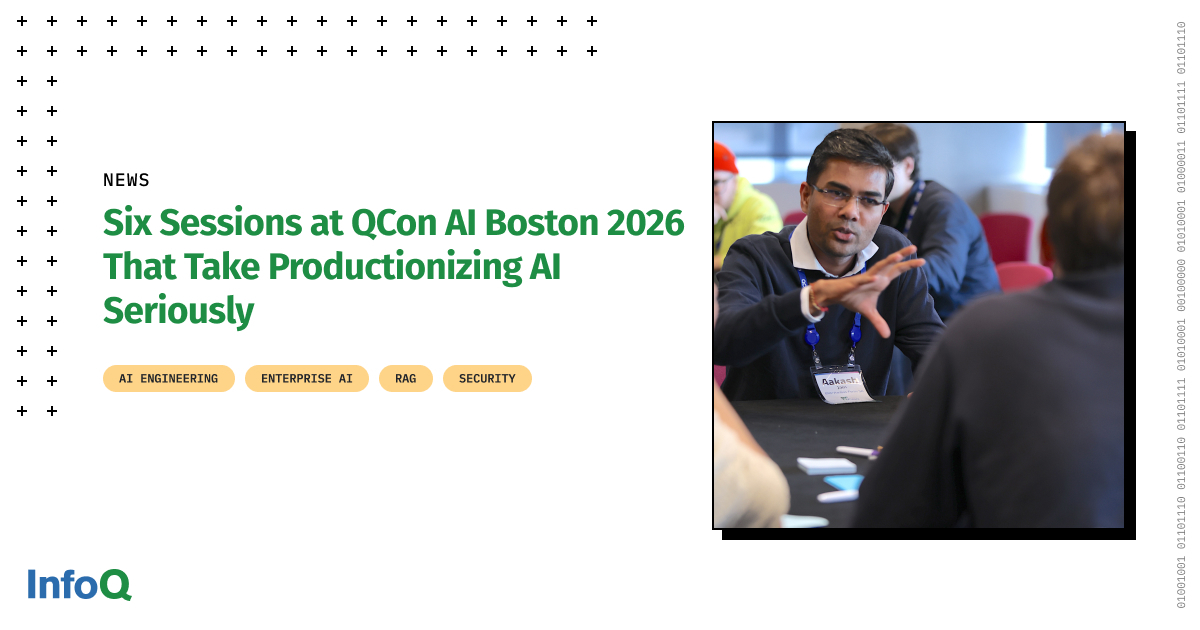
QCon AI Boston 2026, scheduled for June 1–2 at Boston University’s George Sherman Union, is two weeks away and nearly sold out. A program with more than 40 sessions includes six talks singled out in a recent preview for their focus on what AI engineering looks like after the demo-when prototypes meet real operational pressure.
Martin Spier will open day one with a keynote titled “Keeping ChatGPT Fast in the Agentic Era,” arguing that latency is not solely a GPU problem. He walks a single user request through client work, conversation loading, context assembly, tokenization, routing, inference, streaming and observability, and warns that agentic coding patterns can accelerate performance regressions. Spier describes an OpenAI approach that shifts performance engineering toward agent — operated investigation, with telemetry and tooling designed for agents to consume directly.
Ajay Prakash of LinkedIn will describe building an organizational context layer for AI agents using an MCP-based system called CAPT. His talk covers architecture and the deployment story — early rollout failures, iterative fixes, and measured outcomes — namely 70% faster issue triage and more than 500 community — authored skills that leverage the context layer.
Vinoth Govindarajan’s presentation, “The Agent Harness,” stresses that ostensible agent autonomy must be bounded by systems — level controls. He enumerates harness components — control planes, session state, single — writer execution, throttling, tool boundaries, approval paths and auditability — and uses the OpenClaw case study to illustrate a mental model: events enter, per-session state is rehydrated, execution is constrained, and important actions generate an audit trail.
Susan Chang of Elastic and a DoorDash platform team pair provide complementary operational perspectives. Chang describes running a user-facing AI agent in production for nearly two years and building a centralized evaluation framework that the team reuses across GenAI products, closing the eval→product feedback loop. DoorDash speakers Siddharth Kodwani and Swaroop Chitlur frame their GenAI platform story around a common failure mode: individual teams repeatedly rebuilding the same LLM plumbing.
Taken together, the sessions point to a consistent set of practical remedies for builders: invest in telemetry and observability that span context assembly through inference; design organizational context layers to encode company — specific services and conventions; adopt control planes and approval boundaries to enforce invariants; and centralize evaluation and platform plumbing to avoid duplicated engineering effort. These talks indicate a needed shift from prototype — centric work to platform — level controls, shared plumbing and telemetry if teams expect to operate AI at scale.
The conference’s near sellout reflects active demand among senior developers for production — focused patterns and operational guidance as organizations move beyond demos and toward deployed AI systems.
Sources
Replies (0)
No replies in this topic yet.
