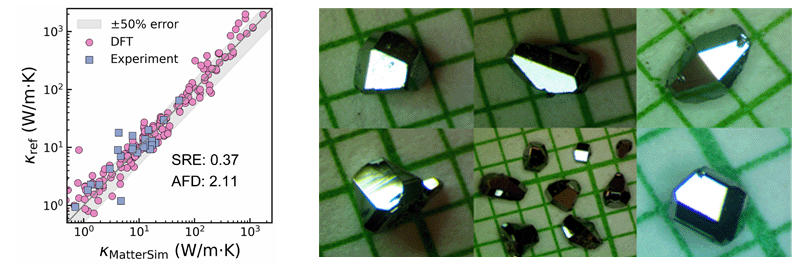
Researchers validated predictions from MatterSim‑v1 by experimentally synthesizing tetragonal tantalum phosphorus (TaP) and measuring its thermal conductivity at 152 W/m/K, a value the team says is close to silicon. That experimental confirmation demonstrates that the screening output from the ML-driven workflow can produce real, high‑conductivity candidates rather than only theoretical leads, narrowing the gap between computational discovery and lab validation.
The TaP sample was flagged from a high‑throughput screen that evaluated more than 240,000 candidate materials using MatterSim‑v1. The experimental synthesis and thermal measurements were carried out in collaboration with the University of Texas at Dallas, the University of Illinois Urbana‑Champaign, and the University of California Davis. Prof. Davide Donadio said the model’s combination of accuracy and efficiency unlocked screening at this scale, and Prof. Bing Lv noted the resulting database expanded the accessible materials space.
The team frames universal machine‑learning interatomic potentials like MatterSim as a way to shorten the slow, costly cycle of materials development by providing rapid, accurate predictions of stability and properties across diverse chemistries. These ML potentials run orders of magnitude faster than traditional first‑principles simulations and can capture realistic conditions such as finite temperature and pressure, making studies that once took impractical amounts of time feasible in hours.
On the simulation‑engineering side, the group reports a 3–5× acceleration of MatterSim‑v1 inference and an integration with the LAMMPS classical molecular dynamics package. That integration enables large‑scale simulations across multiple GPUs, addressing previous bottlenecks from compute limits or single‑GPU memory when running extended dynamical trajectories or very large supercell calculations. The researchers also introduced MatterSim‑MT, a multi‑task foundation model intended for in silico materials characterization beyond potential energy surfaces alone. MatterSim‑MT aims to simulate complex, multi‑property phenomena and the team highlights that ML interatomic potentials can estimate phonon contributions to heat transport, enabling screening of thousands of candidates before committing to costly experimental validation.
Sources
Replies (0)
No replies in this topic yet.
