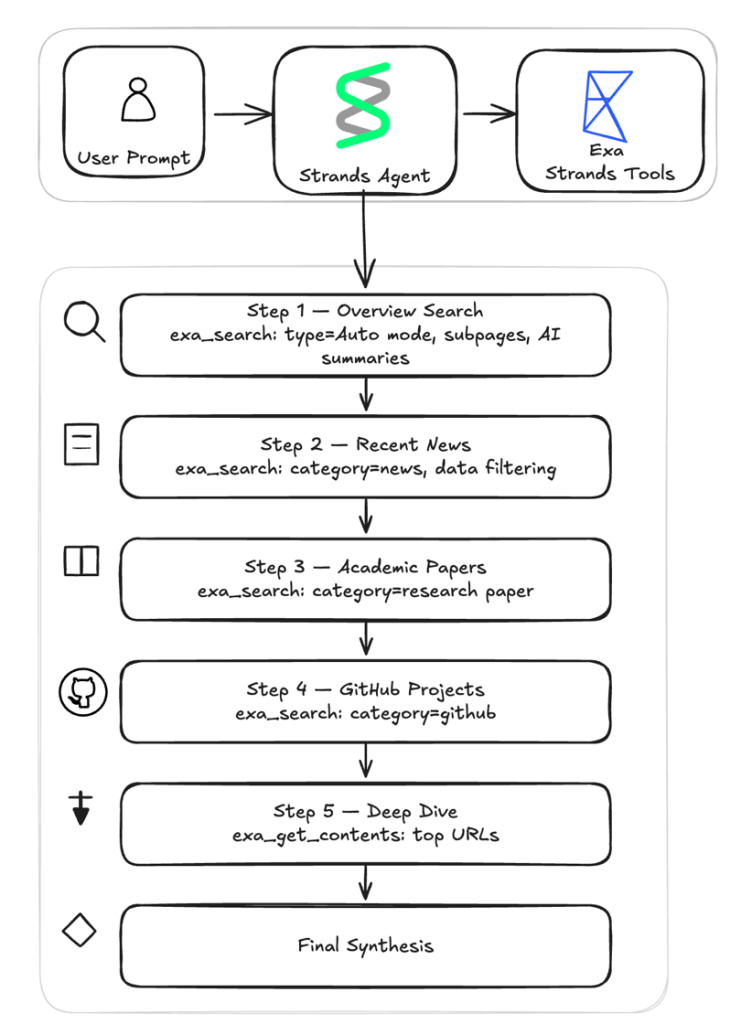
The Strands Agents SDK now exposes two Exa-powered tools, exa_search and exa_get_contents, through the strands — agents-tools package, giving agents direct access to web content formatted for LLM use. Instead of returning raw HTML or fragmented snippets, the integration supplies clean page text and metadata that agents can reason over without extensive post-processing, speeding up multi — step reasoning and realtime retrieval in agent workflows.
exa_search performs semantic search across the web and supports multiple modes — auto, fast, and deep-plus filters for category (news, research papers, repositories), domain, date, and text content. exa_get_contents retrieves full-page text from URLs an agent selects and returns cleaned content and associated metadata rather than raw markup. Both tools are designed so their outputs can be dropped straight into an LLM context window, and the blog post that introduces the integration walks through setup, tool signatures, and real-world examples for agent workflows.
Strands follows a model — driven agent loop: on each iteration, the model receives the full conversation and prior tool calls, then decides which tool to call next. The SDK ships with more than 40 prebuilt tools — file I/O, shell, web search, AWS APIs, memory, and code execution — and supports the Model Context Protocol (MCP), so MCP-exposed tools appear without extra integration. Adding Exa’s tools follows the same pattern: developers add them to tools=[] and the model learns how to use them from their signatures.
The post contrasts this approach with general — purpose search APIs that return HTML-heavy pages and short snippets optimized for human browsing. Those results typically require custom crawlers, parsers, and ranking layers before an agent can use them. Exa emphasizes semantic matching — finding pages that match query intent rather than string overlap — and returns results stripped of ads and SEO noise so agents can find relevant entities or documents even when the exact query phrase does not appear.
For builders, the practical consequence is a reduced need to build intermediate ingestion and cleaning layers: Exa’s structured outputs combined with Strands’ iterative agent loop let agents draw realtime web knowledge directly into chained reasoning. The integration targets use cases such as research, fact-checking, and competitive intelligence; the blog includes a detailed research assistant example showing how agents combine searches and retrievals to complete multi — step tasks.
Sources
Replies (0)
No replies in this topic yet.
