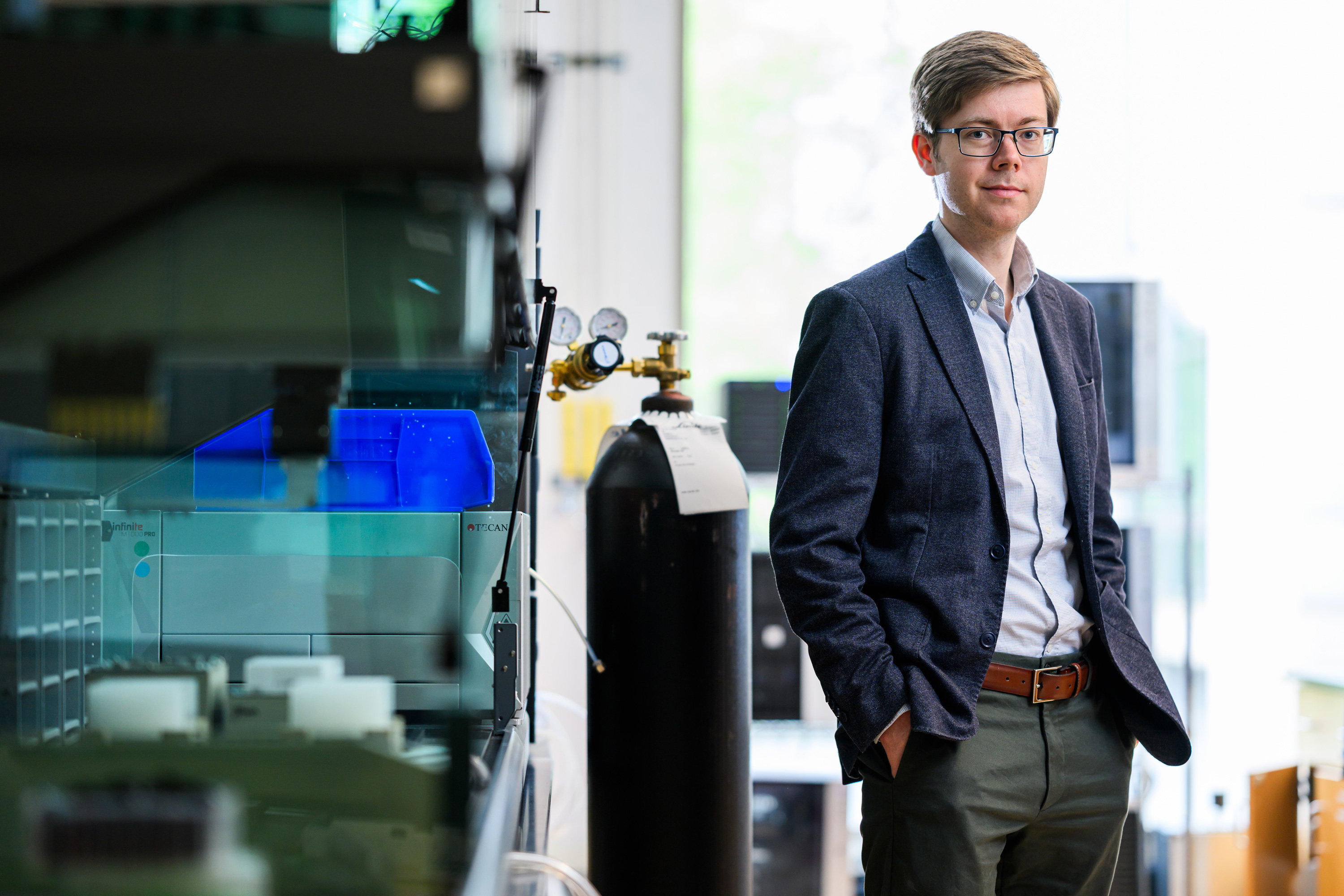
Connor Coley, an associate professor at MIT, is developing AI models that explicitly encode chemical principles to accelerate the discovery and design of small‑molecule drug candidates. The approach addresses an intractable search problem — researchers estimate between 10^20 and 10^60 possible compounds could hold potential as small‑molecule drugs — by steering computation toward molecules that are both promising and experimentally attainable. By prioritizing candidates with realistic synthesis routes, his work aims to shorten the time and cost from in silico hit to lab‑tested lead.
Coley holds shared appointments in Chemical Engineering and Electrical Engineering and Computer Science and is the Class of 1957 Career Development Associate Professor affiliated with the Schwarzman College of Computing. His lab builds and deploys computational systems that analyze vast libraries of compounds, design novel molecules, and predict reaction pathways that could synthesize those designs, integrating domain knowledge about reactivity into model architectures rather than relying on black‑box predictions alone.
Methodologically, the group emphasizes cheminformatics and machine learning to plan reaction pathways and to encode synthesis constraints so that suggested molecules are chemically plausible and accessible. The lab also develops hardware‑aware designs: predictive models are coupled with automated reaction equipment so that proposed syntheses can be executed with minimal manual intervention, shrinking the loop between computational proposal and physical synthesis.
Coley’s work spans collaborative, large‑scale efforts. He participated in DARPA’s Make‑It program, which funded projects applying machine learning and data science to improve synthesis of medicines from simple building blocks. He also deferred a faculty start for a postdoctoral stint at the Broad Institute, where he worked on computational screening of DNA‑encoded libraries containing billions of candidates — an example of how data‑driven triage can reduce discovery from billions of possibilities to testable leads.
For practitioners, the practical implications are concrete: models that incorporate chemical reactivity and synthesis feasibility can prioritize candidates that are not just high‑scoring computationally but also attainable in the lab, reducing wasted experimental effort. Coupling these models with automated reaction hardware seeks to accelerate validation cycles and lower the resources required to move promising compounds toward further development.
Coley’s path combines focused technical training and cross‑disciplinary experience. He began a PhD at MIT in 2014 and earned his doctorate in 2019, completing graduate work under advisors Klavs Jensen and William Green with a focus on optimizing automated chemical reactions. He accepted a faculty position at MIT at age 25 and deferred one year to pursue the Broad postdoc to gain hands‑on experience in chemical biology and drug discovery.
Sources
Replies (0)
No replies in this topic yet.
